
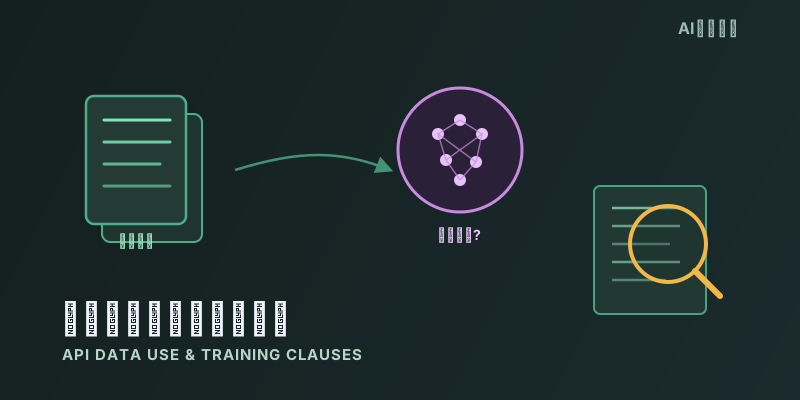
Verification Checklist
- ✓Have you actually found and read the vendor's own terms of service or privacy policy language on whether data is used for training, rather than relying on a third-party blog post or forum summary
- ✓If the console has an opt-out toggle (sometimes labeled "use data to improve experience" or similar), have you confirmed your own account's current setting rather than assuming the default favors you
- ✓Have you checked the free consumer-tier terms and the paid enterprise API terms separately, rather than assuming the two carry the same commitment — many vendors only spell out training use and opt-out in their consumer-facing privacy policy, while the API/developer terms may not address the question at all
- ✓Do you clearly distinguish "not used for training" from "retained for a period for security review or abuse detection" — a no-training pledge in the terms doesn't substitute for checking retention duration and purpose separately
- ✓For data involving customer privacy or trade secrets, have you gotten written confirmation from the vendor's support or account team on any parts the public terms leave vague, rather than assuming the risk is acceptable based on the public text alone
1. The core question: does your input train the next model version
When a company or developer calls DeepSeek's or Qwen's API to process business data — summarizing customer service chat logs, or running internal documents through Q&A — one question that's easy to overlook but potentially consequential is whether that input content, along with the model's output, gets collected and used as training material for the vendor's next model version. If the answer is yes, it means business information embedded in your customer chats or internal documents could, in theory, end up folded into the vendor's model capability through that training pipeline, even after de-identification — and that's something worth confirming before choosing which vendor's API to build on, not something to assume away. The answer shouldn't come from guesswork or hearsay; it should come from the actual terms.
2. What to search for in the terms: data use, model optimization, training data
Terms of service and privacy policies are structured and named differently across vendors, but most have a section along the lines of "how we collect and use your information," and it's worth specifically searching for phrases like "data use," "model optimization," "training data," or "use data to improve experience" — the exact section names and clause numbers vary by vendor, and this piece won't invent a single fixed name that applies to all of them. In practice, use your browser's in-page search (Ctrl+F) on the actual policy page to locate these terms and read the surrounding paragraph in full rather than just the heading. As one concrete example we verified: DeepSeek's official privacy policy, under its section on how it collects and uses personal information, states that input and corresponding output collected through the service may, after encryption and de-identification, be used for DeepSeek model training and service optimization — and separately explains that users can opt out via the "data management" page in settings by turning off "use data to improve experience," after which inputs and outputs are no longer used for training.
3. Free tier and paid enterprise API: not necessarily the same commitment
A point worth stressing: a vendor's clearly spelled-out training-use disclosure and opt-out mechanism in its consumer-facing product (an app or web chat interface) doesn't automatically carry over to its developer-facing open platform/API terms. Take DeepSeek as an example — after reviewing the full text of its DeepSeek Open Platform Terms of Service, the agreement specific to API and developer-tool use, we found that Clause 4 ("Input and Output") mainly addresses ownership of input/output content (for instance, that users retain rights to what they submit), without the kind of explicit statement on whether API input is used to train the official model that appears in the consumer privacy policy — a gap worth noting between the two documents. That doesn't mean the answer is necessarily yes or no; it's a reminder that a commitment made in one vendor's consumer product terms cannot simply be assumed to apply to the enterprise API or developer agreement you actually use. Even under the same vendor, the two documents can cover different scenarios with different levels of commitment, so check both separately, and when in doubt, get written confirmation directly from the vendor's business or support contact.
4. "Not used for training" isn't the same as "not retained"
Even when a vendor's terms explicitly state that your data "will not be used to train the model," that doesn't mean the data is never stored on the server or used for anything else — retention for security review, abuse detection, incident investigation, or legally required compliance is a separate question from whether data trains the model. A vendor can perfectly well both promise "we don't train on your data" and still "retain data generated by API calls" for a period, and the two are not contradictory. We verified this against Alibaba Cloud Model Studio's (the official platform behind Qwen's API) publicly published Compliance and Privacy page, which states "Alibaba Cloud strictly protects data privacy and will never use your data for model training" — while the same page also notes that "Model Studio stores data generated during model and application calls," pointing to its Model Studio Service Agreement for the specific terms on data processing, privacy, and security. That's a concrete, real-world example of "no training" and "yes retention" being stated side by side in the same official document — reading the terms and stopping at "no training" isn't enough to conclude nothing about your data is stored at all.
5. What to actually do when the terms leave you unsure
Putting this together, here's practical guidance for teams planning to run business data through domestic LLM APIs. First, before integrating, locate the actual terms of service and privacy policy for the specific product/API you'll use (not a different product from the same vendor), use in-page search for terms like "data use," "training," and "retention," and read the full paragraph rather than just the heading. Second, if the console has a toggle like "use data to improve experience" or similar, actively confirm its current state rather than assuming the default favors you. Third, for sensitive business data involving customer privacy or trade secrets, don't rely solely on the wording of public terms to judge that the risk is acceptable — get written confirmation (email or a support ticket, so there's a record) from the vendor's support or business contact on anything the terms leave unclear or ambiguous. Fourth, review periodically — terms of service and privacy policies change with product versions, and what you verified today may no longer hold six months from now, so for important business use it's worth building a habit of periodically re-checking for changes to the terms.