
Verification Checklist
- ✓Was the HTTP status actually 200, or a 4xx error? 200 means the model started generating and moderation happened during or after generation; a non-200 status usually means the request was blocked before it ever reached the model — these call for different debugging paths
- ✓Does the response body carry a field like finish_reason or stop_reason, and is its value something other than a normal stop or length-limit value (naming varies by vendor — check that vendor's current official API docs for the exact field name and enum values, don't assume based on another vendor or an old doc)
- ✓For streaming calls, did the connection end after some explicit terminal event, or did it just drop with no closing signal at all — the latter points more toward a network or client issue, the former toward moderation firing mid-stream
- ✓Have you checked that vendor's current billing docs for whether a filtered or blocked call still counts toward billed tokens — this varies by vendor, don't assume one vendor's rule applies to another
- ✓If the use case genuinely needs relaxed moderation (an internal enterprise tool, a specialized professional domain), have you checked the vendor console for an official whitelist/exception request path, rather than building your own client-side workaround around the moderation result
1. The pattern: no error, billed normally, yet the content is empty or cut off
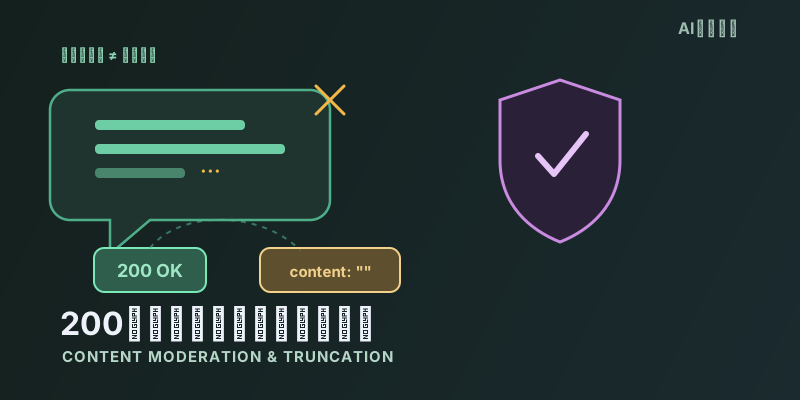
This is a common but confusing failure mode: calling a Chat Completions-style endpoint on DeepSeek, Qwen, or a similar domestic Chinese LLM API, everything looks fine at the HTTP layer — status 200, the call shows up in usage records — but the content field in the response is an empty string, or the text just stops abruptly mid-sentence with no visible warning. Because the status code is clean and nothing threw an exception, the first instinct is usually to suspect a parsing bug or a dropped connection somewhere in transit, and hours can go by debugging request and parsing code that was never actually broken. The real cause is almost always unrelated to the network — it's content safety moderation intervening at some stage of the response pipeline.
2. Why this layer exists: independent moderation on top of model alignment
Anomalous output from a domestic LLM API usually comes from two distinct mechanisms stacked on top of each other. The first is alignment baked into the model during training — the model learns to decline or deflect certain questions on its own, in which case it genuinely "generated" something, it's just a refusal rather than empty content. The second is a moderation layer the platform adds independently of the model itself — it can act on the input side (screening the user's request before it ever reaches the model) or on the output side (screening the model's generated content after the fact, and stripping some or all of it if it trips a rule). Under regulations like China's Interim Measures for the Management of Generative AI Services, the platform providing a generative AI service itself carries the primary responsibility for content safety — this is why nearly every domestic LLM API bakes in, or offers as an option, an independent moderation layer rather than relying solely on the model's own alignment. Figuring out whether you're looking at a model refusal or a moderation-layer block is the first fork in the road for debugging this.
3. Which field to actually check: it differs by vendor — don't assume
Distinguishing "generation completed normally" from "moderation cut it off" always starts with the response body itself, not a guess. In DeepSeek's own Chat Completions API documentation, the response carries a finish_reason field marking why the model stopped generating; besides stop (a natural end) and length (hit the max token limit), there's a dedicated content_filter value specifically meaning content was omitted because of a flag from the content filter — so the same 200 status and the same completed request can mean entirely different things depending on that field's value, and it's the first place worth checking. But not every vendor's moderation looks like this: Alibaba Cloud's Bailian (DashScope) platform, per its own documentation, describes its input/output AI guardrail mechanism as returning an HTTP 400 status directly when it flags a request or output as violating policy, along with an error code like data_inspection_failed and a message such as "Input data may contain inappropriate content" — that's a block at the request stage, not a field to inspect after a 200. So whatever vendor you're actually calling, you need to check its current official API docs for the exact field name and whether the block happens inside a 200 response or as a request-stage error — don't carry over assumptions from a different vendor.
4. Streaming makes it worse: content flows, then just stops
If you're calling a streaming endpoint, this kind of moderation cutoff gets harder to diagnose. Streaming responses arrive as a sequence of chunks pushed to the client incrementally, so if moderation triggers partway through generation — after the model has already produced dozens of tokens and the client has already rendered some of that content — what the client actually sees is "content stopped updating partway through," which looks almost identical to a network drop or a client-side timeout. The key differentiator is whether the stream ended with some explicit terminal event carrying a field indicating an abnormal stop (the exact event name and field vary by vendor — check that vendor's current streaming API docs), versus the connection just closing with no terminal signal at all. If there's a clear closing event with an abnormal finish_reason-style value, moderation intervening mid-stream is the likely cause; if the connection just drops with nothing, network layer or client timeout settings are worth ruling out first before suspecting moderation.
5. Does a moderated call still get billed? It varies — don't assume a universal rule
This is the assumption developers make most often: if content got moderated away, surely it shouldn't be billed? In practice this depends on the vendor, and this article deliberately doesn't offer one universal answer — check that specific vendor's current official billing documentation for how it treats this scenario. In some cases the model already generated some tokens before output-side filtering stripped them, meaning that compute cost was already incurred, and whether it's billed depends on vendor policy; in other cases the request gets blocked on the input side before the model ever runs inference at all, which can carry different billing logic entirely. Rather than guessing at a general rule, when a bill looks off, the more reliable path is looking up that specific call's request ID against the vendor's official billing docs or support channel.
6. If the business genuinely needs an exemption: use the official channel, don't work around it
If a use case is legitimate and compliant but keeps getting flagged because of inherently sensitive-sounding professional content (medical, legal, security research, and similar fields naturally touch on some flagged terms), or an internal enterprise tool needs a relaxed moderation policy, the right approach is applying through the vendor's official exception or whitelist channel — not building a client-side workaround to bypass the moderation result. Alibaba Cloud's Bailian documentation, for example, describes a console where users can review the guardrail's detection results and risk labels, and a support-ticket channel to request whitelisting for specific content when genuinely needed; that process typically requires describing the actual use case and requesting entity, and it runs through a formal, vendor-reviewed exception path rather than around the moderation itself. In short: a 200 response with empty or truncated content is almost always content moderation acting somewhere in the pipeline — figuring out which field and which stage triggered it, and then either adjusting your retry logic or filing a formal exception request, is far more effective than repeatedly assuming it's a network issue.