
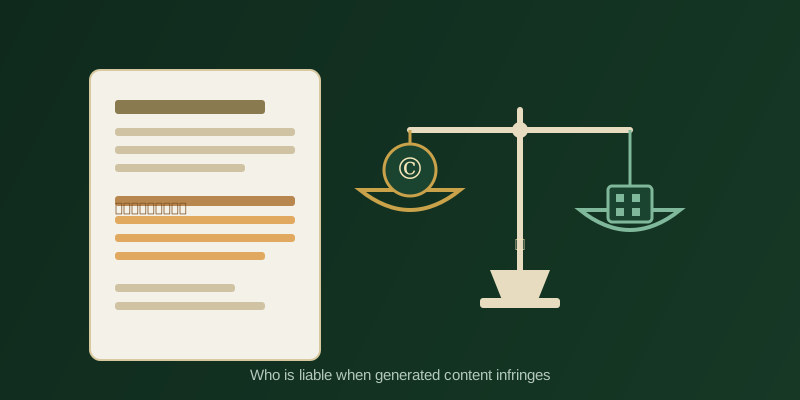
Verification Checklist
- ✓Have you actually turned to the "intellectual property and liability limitation" section of your vendor's service agreement and read, word for word, what it says about who's liable when generated output infringes — rather than guessing
- ✓Have you confirmed whether the agreement caps the vendor's damages if generated content triggers an infringement dispute — for example, a cap tied to fees actually paid over the past twelve months
- ✓If the generated content is going out for commercial use externally — marketing copy, promotional images, customer-facing product copy — have you added a human review step to the publishing pipeline instead of shipping raw model output as-is
- ✓Do you understand that if a third party comes after you for infringement, your company as the publishing entity may bear independent legal liability, rather than assuming the vendor will step in and handle it
- ✓Have you checked the actual agreement text for the specific vendor you use (not another vendor's terms, and not a generic summary circulating online), since the wording differs by vendor and by product line
1. The clause companies skip when integrating an LLM API
When a company wires a domestic Chinese LLM API — DeepSeek, Qwen, Doubao — into its own product or content pipeline, procurement decisions usually focus on model quality, per-call pricing, concurrency quotas, and SLA terms — the parts that directly affect whether the product runs. The "intellectual property and liability limitation" section tends to sit much further down the agreement, written in dense legal language, and few engineering or procurement teams read it in full before signing. The problem is that this is precisely the clause that decides who ends up holding the bag once something goes wrong: the moment marketing copy, promotional images, or code snippets generated in bulk by an LLM gets flagged by a third party as infringing, the first question is whether the vendor's agreement backstops that liability at all, or whether it already assigned that risk to the company doing the calling.
2. Three concrete scenarios: text, images, and code can all trip the wire
Infringement disputes over generated output aren't a hypothetical edge case — in practice they fall into roughly three buckets. First, using an LLM to mass-produce marketing copy, product descriptions, or press-release-style text: if the output ends up phrased too closely to an already-published piece, that can amount to copyright infringement of a literary work. Second, using text-to-image generation to batch-produce promotional images, posters, or product shots: if a generated image lands too close in composition or detail to an existing artwork or photograph, that can also be found infringing. Third, using code-generation to help write production code: if the generated snippet pulls in a fragment from an open-source project or commercial codebase that's copyrighted and whose license requires attribution or restricts commercial use, shipping that straight into a commercial product can trip both copyright and open-source license compliance. What these three have in common is that whether a given piece of generated output actually infringes is often something even the company itself can't be fully certain of ahead of time — the risk is probabilistic, not a guarantee that using an LLM automatically means a lawsuit.
3. "You judge and bear compliance for generated content" is an industry-wide design, not one vendor being unusually strict
Plenty of companies assume that because the model belongs to the vendor, the vendor should be on the hook when generated output causes an infringement problem — but that isn't how liability is generally allocated in this industry. Take DeepSeek's Open Platform Terms of Service: it explicitly requires developers, acting as the generative-AI service provider, to bear the corresponding legal liability under applicable regulations for providing generative AI services, and separately states that unless otherwise agreed, neither party bears incidental, consequential, punitive, special, or indirect losses or damages, with total liability capped at the total service fees the user actually paid over the preceding twelve months — meaning the vendor's own liability is explicitly capped, not an open-ended backstop. Alibaba Cloud Bailian's service notes state similarly that any dispute arising from a third-party model, service, or technology should be resolved by that third party, and that Bailian bears no liability for it — "we bear no responsibility for any representation, promise, or conduct of external third-party tools." Disclaimers along the lines of "you judge and bear the compliance of generated content yourself" are common across domestic LLM service agreements — this is a widespread industry design choice, not one vendor being unusually harsh — but the specific liability cap, scope of the disclaimer, and the conditions that trigger it differ from one vendor's actual agreement text to another's, so terms from one vendor shouldn't be assumed to apply to another.
4. Two things to confirm before integrating, instead of a vague "watch out for IP risk"
Rather than a generic reminder to "watch out for IP risk when integrating an LLM," there are two specific things worth confirming. First, pull up the exact disclaimer language in the service agreement and read for three things: whether the vendor takes on any liability or assistance role at all when generated content infringes, whether damages are capped, and exactly how that cap is calculated — a ceiling tied to total fees paid, or a blanket exclusion of liability altogether. Second, if the generated content is headed for external commercial use — marketing copy going straight to a website or social account, images used for packaging or ad creative — assess whether the existing content pipeline includes a human review step as a risk mitigant, rather than publishing raw model output with no check at all. Human review can't eliminate infringement risk entirely — reviewers can't catch every instance of overlap either — but it does filter out a meaningful share of obviously high-risk content, and it helps demonstrate the company exercised reasonable care if a dispute does arise.
5. A vendor's service agreement isn't designed to backstop your legal liability
At bottom, a vendor's service agreement is a commercial document the vendor uses to define the boundary of its own liability — its purpose isn't to backstop the calling company's legal exposure, it's to narrow and clarify what the vendor itself is on the hook for. A company that simply assumes "it's a major vendor's model, so the vendor will handle it" may well discover, once a third party actually comes after it for infringement, that the agreement already assigned compliance judgment for generated content to the company itself, and that even where the vendor does owe some form of compensation, it's very likely capped well below the actual commercial damages involved. The more reliable approach is to treat "who's liable when generated content infringes" as part of the company's own internal risk management: read the agreement carefully before integrating, assess the infringement risk level of the actual use case, add human review where it's warranted, and where appropriate, look separately into commercial insurance covering AI-generated content risk or negotiate clearer liability terms in a supplemental agreement with the vendor — rather than leaving it entirely to a standard service agreement nobody on the team actually read closely.