
Verification Checklist
- ✓Before funding, did you check the live stablecoin-to-balance conversion rate against what the top-up page actually shows landing?
- ✓Did you check the provider's site for issuance fees, top-up fees, exchange-rate markup, and idle/closure fees before opening the card?
- ✓Have you confirmed this virtual card explicitly supports auto-renewal/recurring charges, not just one-off purchases?
- ✓Have you closed cards you're no longer using, instead of leaving small idle balances exposed to maintenance fees?
1. Why you need a separate virtual card
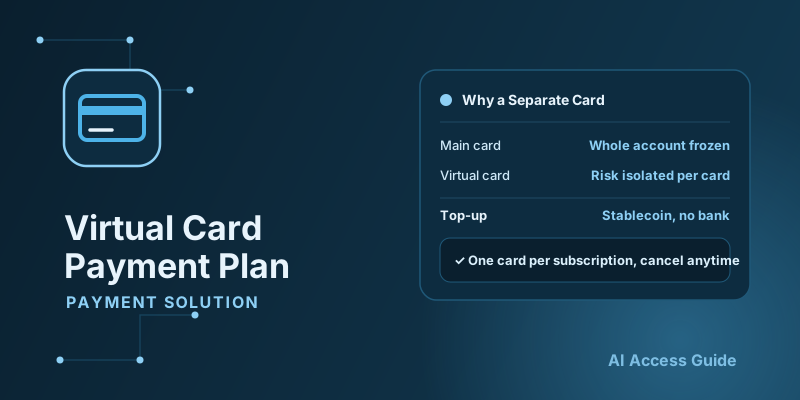
Subscribing to overseas AI tools usually means signing up for several services at once — ChatGPT, Claude, Gemini, Midjourney, Perplexity — and quite a few only accept cards issued outside your home country, billed automatically every month. Tying your main card directly to several auto-renewing subscriptions makes it easy for a card swap, low balance, or a risk-control block to interrupt service, and it also mixes your everyday spending with these subscription charges, making per-tool cost tracking harder. A dedicated virtual card for this purpose separates "AI tool spend" from "personal spend" — the limit is controllable, the card can be frozen or closed anytime, and reviewing what you actually spent on which tool each month becomes much easier.
2. How a virtual card works: from stablecoin to card balance
For individual users, the typical flow is: send a stablecoin (USDT/USDC) to the address the provider gives you, or convert it through a built-in swap — the stablecoin converts to a spendable card balance at the current rate, and you get a standard virtual card number (card number, expiry, CVV) to use on any subscription page that takes a credit card. None of this requires a traditional bank account. If your assets sit on a different chain than the one the provider accepts, you'll need to bridge to a stablecoin on the right chain first — a cross-chain swap aggregator can handle that step. AllSwap is a non-custodial aggregator that works without registration. For a full walkthrough — choosing a card, funding it with USDT, passing AVS/3DS, and binding it to ChatGPT or Claude — see our companion piece: Using Virtual Cards for AI Subscriptions: Full Guide. If you already use a card and want scenario-based advice on type and limit, see The Complete Virtual Card Guide for AI Subscriptions.
3. The core criteria for picking a virtual card service
Providers vary widely in stability, fee structure, and coverage. Check at least the following before signing up — not just the "instant card in seconds" pitch on the homepage:
- Recurring-billing success rate: does the provider explicitly support auto-renewal / recurring charges, not just one-off purchases — many virtual cards get flagged by a merchant's risk controls specifically on recurring billing.
- Fee transparency: are card-issuance fees, top-up fees, exchange-rate markup, and idle/closure fees clearly listed on the provider's site, rather than discovered only after you've funded the card.
- 3DS/AVS support: overseas AI merchants often trigger 3D Secure and address verification on the first charge or a large one — whether a card clears this step is usually the deciding factor in whether it "works" at all.
- Coverage: card network (Visa/Mastercard, etc.) and billing-address/currency settings that are actually accepted by the specific platforms you plan to subscribe to.
- Support responsiveness and freeze/refund process: whether you can reach a human when a charge fails or gets disputed, and how quickly it gets resolved.
4. Common pitfalls
A few problems come up often enough to plan for before you open a card: recurring charges getting silently blocked by a merchant's risk controls, so a subscription lapses without you noticing; a gap between the balance you funded and what's actually available, caused by exchange-rate movement between funding and charging; some providers only trigger identity verification (KYC) once you cross a certain amount or frequency, and being asked for extra documents mid-cycle can interrupt an active subscription; small idle balances sometimes accrue maintenance fees, so close cards you're no longer using instead of leaving them dormant.
5. Related resources and disclosure
AllSwap (a cross-chain swap aggregator) and RDVCC (a virtual credit card provider), both mentioned on this page, are covered in our disclosure section — these links may carry a commercial affiliate relationship, and you should verify current rates, supported chains, and acceptance directly on each provider's site. This page is meant to stay current and will be revised as provider policies change; nothing here is investment or transfer advice. Any virtual card or stablecoin activity should be for genuine, compliant subscription spending, in line with your local laws and each platform's terms of service.