
Verification Checklist
- ✓Did you register with a mainland Chinese phone number, and did the verification SMS come from the product's own official sender rather than an unfamiliar third-party number?
- ✓Does the membership/subscription page default to Alipay or WeChat Pay, rather than asking for a bank card number for cross-border billing?
- ✓If facial verification is required, does it happen inside the product's own official app/mini-program, rather than redirecting to an unfamiliar link?
- ✓Do the free tier's actual limits (context length, daily message cap) match your real usage before you decide whether to upgrade?
1. Domestic AI is a completely different subscription path
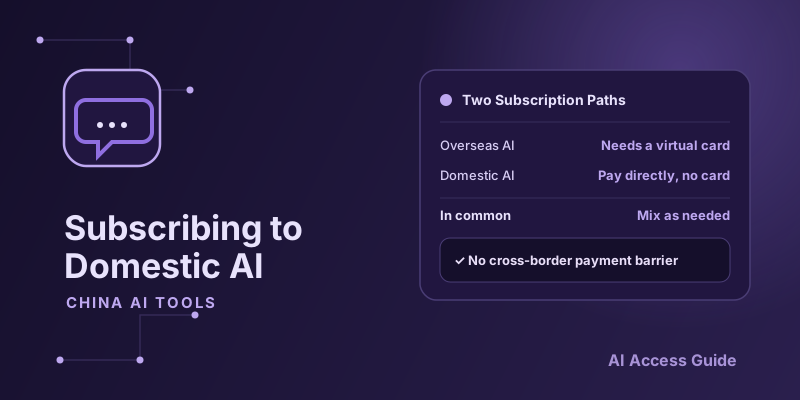
Every article on this site about virtual cards and stablecoins starts from the same premise: overseas AI services like ChatGPT and Claude don't accept domestic Chinese bank cards directly, so you need a virtual card that clears their risk checks, or a stablecoin workaround. But if your needs are day-to-day writing, translation, coding help, or office automation, domestic large-model products already cover a lot of that ground — and signing up is far simpler: register with a phone number, pay directly via Alipay or WeChat Pay, no cross-border step involved anywhere.
2. A quick look at the major domestic AI tools
| Product | Developer | Paid tier | Bottom line |
|---|---|---|---|
| DeepSeek | DeepSeek AI | Membership/API | Strong reasoning, active open-source ecosystem, high value for cost |
| Doubao (豆包) | ByteDance | Doubao membership | Polished mobile experience, mature voice interaction |
| Kimi | Moonshot AI | Membership tier | Long context windows and file parsing are the headline features |
| Ernie Bot (文心一言) | Baidu | Pro tier | Strong at Chinese-language content and local knowledge retrieval |
| Qwen (通义千问) | Alibaba Cloud | Plus/Max tiers | Tightly integrated with Alibaba Cloud and office tools |
| Tencent Yuanbao (腾讯元宝) | Tencent | Membership tier | Connects with the WeChat ecosystem and public-account content |
3. How to sign up: phone number registration, pay via Alipay or WeChat Pay
The sign-up flow is basically the same across these products: register and verify with a mainland Chinese phone number, go to the membership/subscription page and pick a tier, and the default payment method is Alipay or WeChat Pay (some also support bank card quick-pay). No cross-border payment tool needs to be set up anywhere in the process — that's the biggest practical difference from overseas AI services.
4. Is the free tier enough, and what does the paid tier unlock
The free tier is usually fine for light use, but it's constrained along a few dimensions: how much context a single conversation can hold, daily/monthly message caps, queueing during peak hours, and advanced features like file upload and image parsing. The paid tier mostly just lifts those limits — if you only use it occasionally, the free tier is probably enough; if you're a daily heavy user or work with long documents, the paid tier makes a noticeable difference.
5. Real-name verification is standard for domestic AI, unlike overseas AI
Domestic AI tools generally require phone-number real-name verification, and some scenarios also require facial verification — this is a compliance requirement independent of whether the account is paid or free. Overseas AI services typically only need an email to register, with no domestic phone verification step, but correspondingly no localized customer support either. This difference is worth knowing upfront so you don't get stuck mid-registration on a verification step you weren't expecting.
6. When domestic AI is enough, and when you still need overseas AI
For everyday Chinese writing, polishing official documents, local-life Q&A, and office document processing, domestic AI tools are already mature enough that there's no need to bother with an overseas account. But if you're reading a lot of English-language literature, deep-debugging a specific coding framework, or need a capability unique to one overseas model — an especially long context window, or a particular multimodal feature — overseas AI is still the safer choice, and that's when the virtual card or stablecoin payment setups covered elsewhere on this site come into play.
7. A mixed strategy: domestic AI daily, overseas AI for specific tasks
The more practical approach isn't picking one or the other — it's splitting by task type: hand off frequent, everyday tasks that need fast responses and strong Chinese-language handling to domestic AI, and keep a separate overseas AI subscription just for infrequent but specialized tasks that need a specific capability. That way you're only paying for actual usage on both sides, instead of carrying a full overseas subscription just to cover an edge case.
8. Team/enterprise scenarios: invoicing for domestic AI
Team/enterprise subscriptions for domestic AI tools go through the standard domestic invoicing process, so invoicing and reimbursement plug directly into a company's finance system — far simpler than reimbursing an overseas subscription. The "converting an overseas receipt into a reimbursable invoice" headache covered in our Invoices & Expense Reports for AI Subscriptions guide basically doesn't come up with domestic AI subscriptions.
9. Summary
Domestic AI tools and overseas AI services aren't competitors — they're two subscription paths that cover different needs. Domestic tools just need a phone number and Alipay or WeChat Pay, no cross-border barrier at all; overseas tools still have an edge in certain capabilities, but require a virtual card or stablecoin payment setup. Splitting usage by actual need beats forcing yourself to pick just one side.