
Verification Checklist
- ✓Beyond your site's ICP filing number from MIIT, have you separately checked whether your product needs a generative AI service filing, rather than assuming "the site got its ICP number so it's cleared to launch"
- ✓Does the API documentation or terms of service from the model vendor you're calling (DeepSeek, Doubao, Qwen, etc.) explicitly state that the accessing party must still complete its own filing, or does it simply not address this at all
- ✓Does your product carry public-opinion attributes or social mobilization capability — e.g. users can publicly post, comment, or reshare content — versus being a purely internal tool, since that descriptive standard is central to whether the filing obligation is triggered
- ✓Have you checked the CAC's official announcements or filing system for comparable products that have already completed filing, rather than guessing "this probably doesn't need it" based on hearsay
- ✓If your product is still in a small-scale internal test phase, have you documented the scope of test users and the timeline, so you can re-evaluate the filing question with evidence before opening up to the public
1. The pattern: ICP filing is done — is that the finish line?
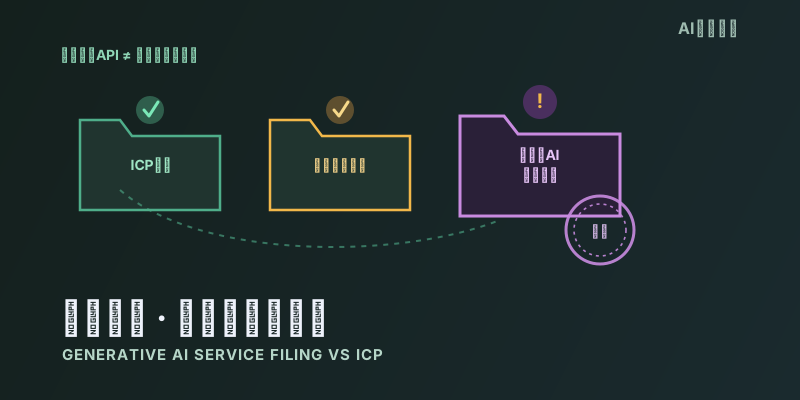
A typical path looks like this: register a domain, complete the site's ICP filing with MIIT (sometimes adding the public security network filing too), then call an API from a Chinese LLM vendor like DeepSeek, Doubao, or Qwen to power a public-facing AI chat, writing, or customer-service feature on a website, mini-program, or app. The last box checked before launch is usually "ICP filing done." But ICP filing addresses whether the site or app itself, as a hosting entity, is properly registered with MIIT and legally operable within mainland China — it has nothing to do with whether the generative AI service the product provides has separately completed its own algorithm filing. The two get conflated partly because both are called "filings" in everyday shorthand, even though the portals and the overseeing authorities aren't the same.
2. Three separate things: ICP filing, algorithm recommendation filing, generative AI service filing
Untangling the terms is the first step. ICP filing, overseen by MIIT, concerns whether the site or app as a "carrier" is legally operating within China, independent of what specific feature it offers. Algorithm recommendation filing, under the Provisions on the Administration of Algorithm-Generated Recommendations, has been handled since March 2022 through the CAC's algorithm filing system (beian.cac.gov.cn), originally aimed mainly at content distribution, personalized recommendation, and ranking algorithms. The third is the requirement in Article 17 of the Interim Measures for the Administration of Generative AI Services: providers of generative AI services with public-opinion attributes or social mobilization capability must conduct a security assessment per relevant national rules, and complete algorithm filing (and any change or deregistration filing) under the algorithm recommendation rules. In other words, if a generative AI service falls within that scope, it goes through the same filing system as the second item — but the trigger conditions and applicable scope come from the Interim Measures specifically, which isn't the same regulatory intent as ordinary content-recommendation filing, so "I don't do content recommendation, so this doesn't apply to me" isn't a safe conclusion.
3. The trigger: what the official text actually says about "public-opinion attributes or social mobilization capability"
Article 17's own wording is "providers of generative AI services with public-opinion attributes or social mobilization capability" — a descriptive, qualitative threshold rather than a threshold spelled out with a specific number. In practice this is generally understood to mean: whether a product allows generated content to be publicly distributed or spread to an unspecified public, or whether it has the capability to aggregate and steer public discussion or collective action. Public-facing AI chat or content-generation tools, or community-style products where generated content can be publicly shared and reshared, tend to fall within this scope; a tool used purely internally by employees, where generated content isn't distributed publicly, is generally considered lower risk. It needs to be stated plainly, though: the official rules do not provide a quantified exemption or trigger threshold — no specific number for monthly active users or concurrent users. Claims circulating online that "under X users you're exempt" have no corresponding official text found in the course of writing this piece, and shouldn't be treated as a reliable rule. Whether filing is required needs to be judged against your product's actual feature set, openness, and content-distribution capability — and when in doubt, the more reliable path is comparing your product against the CAC's own published filing lists and announcements, per the entry point in section 6, or seeking professional legal advice.
4. Does internal testing or limited rollout get you an exemption? There's no clear quantified answer
Another common question: if a product is still in a small-scale internal test phase and hasn't opened up broadly, can filing wait. Again, the official rules don't provide a clear quantified standard for "how long a test phase" or "how many test users" would qualify for an exemption — that's a genuine information gap, not something to fill in with an invented number. A more reasonable practical approach: if a product is genuinely confined to a closed, small-scale internal test (limited to invited employees or a whitelisted set of testers, without public-distribution capability), that can reasonably be treated as a lower-risk stage — but as soon as a product plans to open registration to the general public or allow generated content to be shared publicly, filing status should be re-evaluated before that expansion happens, rather than after a large-scale launch has already occurred and a problem has surfaced.
5. Does calling a model vendor's API mean the vendor already filed on your behalf?
This is the most commonly misunderstood point: accessing an API from DeepSeek, Doubao, Qwen, or similar vendors is fundamentally just obtaining a callable model interface. The vendor itself, as a generative AI service provider, is responsible for completing filing for its own platform product (e.g. DeepSeek's own chat interface, the Doubao app) — that is generally a separate filing subject and filing scope from the downstream product an accessing party builds on top of that API for its own end users. In other words, the vendor completing its own filing does not automatically cover a downstream product built by a third party using its API; if that downstream product falls within the scope described in section 3, the accessing party still needs to complete its own filing with its own product as the subject. Before integrating any model API, it's worth carefully reading the vendor's developer platform documentation and terms of service for any statement about the accessing party's own compliance obligations, rather than assuming "using a major vendor's API transfers the compliance responsibility to them."
6. Where to check and where to file: the official entry point
The publicly verifiable official information on where to file and check is this: the CAC's algorithm filing system has been operating since March 2022, at the official address beian.cac.gov.cn, where filing entities submit the provider's name, service form, application domain, algorithm type, and self-assessment report to complete filing, and the general public can also use the same system to look up already-published filing information. The CAC's official site (cac.gov.cn) periodically publishes filing-list announcements disclosing the names and filing numbers of services that have completed the process, which can be used to check whether comparable products have already filed and under what category. Specific documentation requirements, review timelines, and whether an additional security assessment is required can vary in execution across local cybersecurity administration offices — treat your local authority's guidance, or the requirements shown once you're actually inside the filing system, as authoritative. This article is meant to clarify that three distinct things exist and where the official entry points are, not to substitute for professional compliance advice.
7. Bottom line: ICP filing is the starting point, not the finish line
ICP filing confirms that a website or app as a carrier can legally operate within mainland China, but if a product calls a Chinese LLM API to provide a public-facing generative AI service with public-opinion attributes or social mobilization capability, it typically also needs to separately complete a generative AI service filing through the CAC's algorithm filing system, per Article 17 of the Interim Measures — a distinct process from ICP filing, handled through a different system, and one that calling a vendor's API does not fulfill on your behalf. The official trigger threshold is currently expressed qualitatively rather than with a specific number; when in doubt, check the officially published filing list for comparable products rather than guessing.