
Verification Checklist
- ✓Have you confirmed exactly which data node or region your traffic actually hits, rather than assuming it matches whatever the vendor's homepage advertises
- ✓If your business scope expands from domestic to overseas (or back), have you confirmed whether you can switch nodes without creating a new compliance gap
- ✓Does the vendor's service agreement or data processing agreement (DPA) have written clauses on data export and storage location, rather than only a sales rep's verbal assurance
- ✓If personal information or important data will cross borders, have you checked whether your data volume triggers the filing thresholds under China's data export security assessment rules
- ✓Have you kept an archived copy of the vendor's official documentation or contract terms as evidence for future compliance audits or regulatory inquiries
1. "Same vendor" does not mean "same compliance logic"
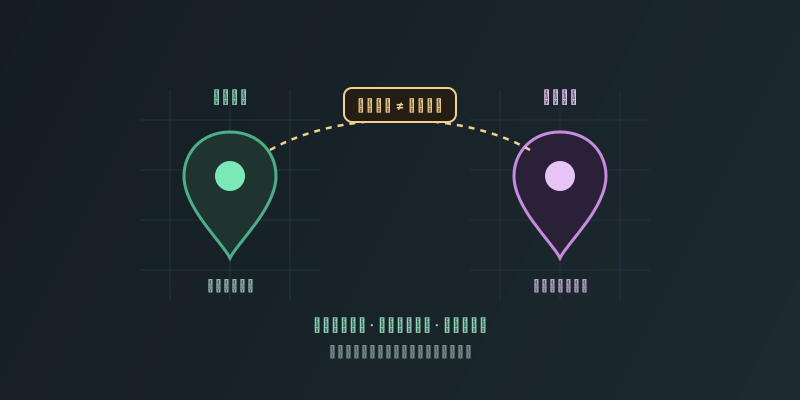
The most common purchasing assumption when a company picks DeepSeek, Qwen, or Doubao for a product is that once you've chosen a vendor, every API entry point it offers — the domestic console and the international-facing page aimed at overseas developers alike — runs on the same data-handling rules behind the scenes. That assumption is often wrong. To serve domestic customers while also expanding overseas, large-model vendors frequently stand up separate product entry points for different regions: one default node mainly serving mainland enterprises and developers, and a separate international or overseas-facing node designed around overseas billing and access patterns. Even if both entry points call the same underlying model capability and look similar on the surface, where the data actually gets processed, which privacy and data-protection laws apply, and even which legal entity operates the service, can be two entirely separate systems. A company that stops at "is it the same vendor" and skips verifying the specific node is basing its compliance judgment on an assumption that doesn't hold.
2. Domestic nodes: may fall under China's data export security assessment rules
If a company's data processing actually happens on a domestic vendor's China-based node — for example, calling DeepSeek models through Alibaba Cloud's Model Studio (Bailian) platform, whose official documentation states the service is currently only available in the China North 2 (Beijing) region and requires an API key configured for that region — then, as long as that data was collected or generated during operations within mainland China, any onward transfer to an overseas recipient (an overseas headquarters, an overseas partner, an overseas customer-support system) needs to be checked against the Cyberspace Administration of China's Measures for Security Assessment of Data Exports. Those measures specify that a data processor transferring important data overseas, or a critical information infrastructure operator or a processor handling personal information of more than one million people transferring personal information overseas, or a processor that has cumulatively transferred personal information of 100,000 people or sensitive personal information of 10,000 people overseas since January 1 of the previous year, all fall under mandatory filing scenarios. This framework governs the act of data flowing from within China to outside it — it has little to do with which vendor's model you call — but you first have to confirm your data is actually being processed on that regulated domestic node in the first place.
3. Overseas nodes: rules vary by vendor, with no single answer
If a company instead calls a vendor's international-facing node built for overseas developers, the picture changes: that node serves an overseas user base by design, and where its data gets processed, whether GDPR-style overseas frameworks apply, and whether any data flows back into mainland China, depends entirely on that specific vendor's own product architecture and service agreement — there's no single rule that every domestic AI vendor follows uniformly. To be upfront about this: how much each vendor discloses publicly varies a great deal, and we could not find one industry-wide, uniformly applied "overseas node data handling rule," so this article will not invent a specific storage location or compliance certification list for any vendor. What a company can do is require the vendor to spell out, in writing, in the service agreement or DPA, exactly where the overseas node processes data and which regulations apply — rather than making a purchasing decision based only on a sales pitch or a vague marketing page.
4. Whether nodes can switch seamlessly as the business expands is another easy thing to miss
Many companies naturally pick a domestic node at first, when their business only covers the domestic market. But businesses evolve — if operations later expand overseas, or the reverse, overseas operations consolidate back domestically — whether the vendor lets you switch calls to the matching regional node, and whether existing data needs a fresh compliance review during that switch, is something to ask during procurement, not something to discover after the fact. Similarly, if a company already has both a domestic team and an overseas branch, and both sides call different nodes of the same vendor to process the same batch of customer data, it's worth clarifying whether that kind of "mixed calling" pattern creates unintended cross-border data flow between the domestic and overseas nodes — this kind of edge case is often the part of a compliance review that's easiest to overlook and easiest to get wrong.
5. Bottom line: make "which node am I actually calling" a mandatory procurement question
When a company uses a domestic AI vendor's API to process customer data, "which vendor" and "where the data physically lands and which compliance framework applies" are two entirely different questions, and answering the first the same way twice doesn't mean the second is the same too. Three specific things worth confirming before purchase: which node or region your business traffic actually calls; whether you can switch nodes seamlessly, without creating a new compliance gap, if your business expands from domestic to overseas or vice versa; and whether the vendor's service agreement has explicit, citable written clauses on data export, rather than relying on a sales rep's verbal promise. Getting clear answers on these three things, and keeping the paperwork to prove it, beats scrambling to produce documentation only after a regulator or a client audit asks for it.