
Verification Checklist
- ✓Choose sanitized real tasks and define correctness, completeness and delivery deadlines before comparing services.
- ✓Include spending on failed tasks, retries and human handling in total cost.
- ✓Record first-pass acceptance, final acceptance, review minutes and failure reasons separately.
- ✓Before renewal, reconcile service and payment charges with accepted task counts and explicit handoff thresholds.
1. Define completion before comparing models
A support summary should preserve essential facts without inventing details. A code change should meet the requirement and pass relevant tests. A research note needs sources that support its claims. These tasks require different acceptance rules. Anthropic’s agent evaluation article distinguishes the execution record from the final outcome: reporting completion does not prove that the intended change actually happened. Inspect deliverables during a trial, not just an impressive demonstration.
2. Calculate the cost of an accepted result
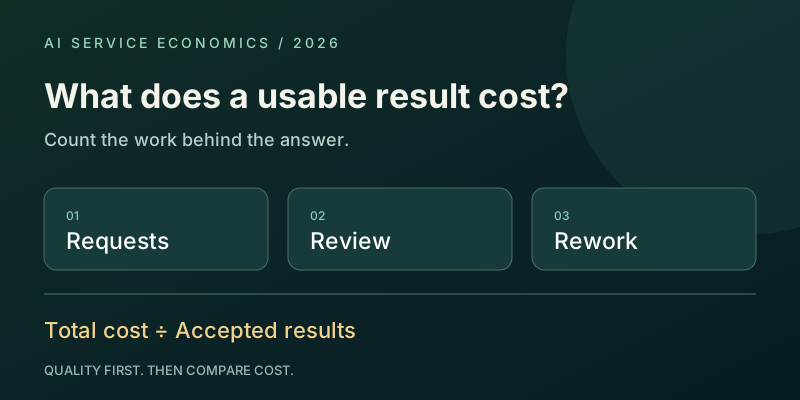
A useful internal metric is total batch cost divided by the number of finally accepted tasks. Include allocated subscriptions, requests, retries, human review and rework. Failed tasks still contribute to the numerator. Allocate shared subscriptions consistently across workflows without counting the same expense twice. If no task passes, the batch has produced no usable result; its unit cost cannot be reported as zero.
Consider two hypothetical batches of 100 comparable tasks. These amounts are illustrative currency units, not vendor prices or measured performance. Service A costs 20 for usage and 180 for human handling, with 80 accepted tasks: 200 / 80 = 2.50 per result. Service B costs 60 for usage and 60 for human handling, with 90 accepted tasks: 120 / 90 ≈ 1.33. B has three times the service fee but a lower delivery cost. Procurement can move expenses into employee time when it optimizes the API price alone.
3. Keep failures in the trial and define when to stop
Use sanitized examples covering ordinary work, difficult inputs and missing information, alongside a manual baseline. Compare services on the same tasks and acceptance rules. Check required fields automatically; sample factual claims and citations with human reviewers. Google Cloud’s evaluation documentation distinguishes rating rubrics from the metrics that measure performance against them, a useful basis for turning subjective impressions into explicit checks.
A small trial can expose problems without proving production reliability. Preserve failed examples, cap retries and task spending, and define a timeout handoff. After changing a model or prompt, rerun the retained tasks. Track first-pass acceptance, final acceptance and review time together rather than hiding repeated attempts behind a final success.
4. Route by difficulty only when failures are detectable
Start verifiable, repetitive tasks with a lower-cost service and escalate difficult cases when external checks indicate trouble: missing fields, inaccessible citations, contradictory answers or failing tests. The model’s own confidence is insufficient evidence for automatic delivery. Where reliable checks are unavailable, human confirmation may be easier to justify than adding another model as a judge.
Routing adds classification calls, latency and maintenance. At low volume, one service with human review may cost less. First require acceptable quality and turnaround time; then compare unit costs among the qualifying options.
5. Connect the payment ledger to the outcome ledger
For overseas AI subscriptions, visit RDVCC virtual cards to review its card and subscription payment options, then verify applicable card types, fees and refund rules against your intended merchant. This is a promotional link. A payment service handles the billing layer; it cannot improve model accuracy or guarantee merchant acceptance.
Assign each subscription an owner, renewal date, actual spending and accepted-task count. Include payment charges in the same cost calculation. At renewal, ask whether unit cost and human workload improved. Freezing or replacing a card is a separate action from cancelling a subscription. If requests keep increasing without more accepted output, revise the workflow before purchasing additional capacity.