
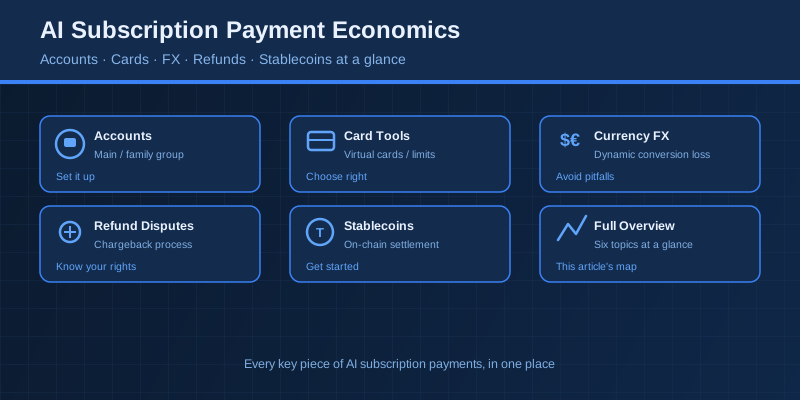
Verification Checklist
- ✓After grouping your AI subscriptions into work/personal/team, are tools in the same group actually sharing one email and one payment method, or is it still one card per tool?
- ✓Pull up your bank statement — how many distinct AI/subscription merchants has the same card been charged by in the last month, and has it crossed three or four?
- ✓Open one AI subscription charge on your statement and compare it against the bank's published exchange rate for that date — how much does the actual amount differ from the "sticker price"?
- ✓Did a platform you cancelled last month still show up as a charge on this month's statement?
- ✓If you're disputing a charge, are you filing a platform refund ticket first, or have you already skipped straight to a chargeback with your card issuer?
1. Let's admit it: AI tool subscription payment is getting harder
A few years back, using one AI tool meant binding a card, paying one monthly fee, and being done. Not anymore. With chat, coding, image, and search subscriptions all running at once, AI tool subscription payment shifts from "pay once" to "a bill you watch every month." The trouble isn't the size of any single charge — it's that they're scattered, cross-border, and each has its own quirks. Total what you actually spent and where it went, and it's far more work than it should be.
2. How subscriptions reshaped the way we use AI
Almost every AI tool runs on a subscription, and that's no accident. For vendors, monthly fees mean predictable cash flow and pressure to keep shipping. For users, the bar looks low — twenty dollars a month, anyone can afford that. The catch is that subscriptions stack: five together is well over a hundred a month in fixed spend. The real headache is that the payment rails behind these subscriptions aren't unified at all — OpenAI runs one setup, Anthropic another, image and video tools each wire up their own processors. One person ends up entering card details at several disconnected checkouts just to keep a handful of tools running, not because unifying it is technically hard, but because each platform would rather keep users inside its own billing system.
3. How many accounts do you actually need?
I've seen both extremes: cramming every AI tool into a single email and one card for convenience, or opening a fresh account per platform with a new card each week until nobody remembers what they subscribed to. The right number sits in between. Instead of one account per vendor, split by purpose: one for paid work, one for personal exploration, one for team collaboration. Tools serving the same purpose can share an email and payment method; different purposes stay fully isolated, so a risk flag or leaked password on one doesn't touch the others. Written out this sounds complex; in practice it collapses to two or three "account + card" pairs for most people — one long-term primary, one for trials and short-term tools, and a third if you split costs with family or friends.
4. Card binding risk, and where family or team sharing should stop
Bind the same card to five or six AI platforms and the issuing bank's fraud model will notice fast — cross-border, high-frequency, low-ticket charges sit right in its sensitive zone. Worse, once one platform flags that card, others may start declining too. Splitting accounts and pairing each with a virtual card contains the blast radius. Seat-based plans like ChatGPT Team or Claude Team normally have one owner with several members, but sharing seats doesn't mean sharing the owner's personal card — when the owner leaves or the card expires, everyone drops off. A cleaner setup routes team billing through a dedicated virtual card whose balance and limit are independent and can be stopped instantly.
5. The FX and fees hiding in the bill
Cross-border subscriptions carry a hidden cost most people never look at closely. Overseas AI services price in USD, and paying with a local card triggers a currency conversion where the bank or card network adds a markup over the real rate, sometimes plus a cross-border transaction fee. On one charge it's a few dollars, easy to shrug off; across several subscriptions billed every month, the yearly "hidden premium" adds up, and it never shows on the price tag you saw on the subscription page. For many users the more concrete problem is simply not having a card that reliably pays overseas subscriptions, or hitting merchant risk declines and getting stuck at 3DS verification.
6. The "residual charge" after cancellation nobody notices
Clicking "cancel subscription" often isn't the end. Some products only cancel at the end of the current cycle, some prorate then keep charging, and some annual plans still attempt renewal after cancellation. By the time a familiar name shows up on next month's statement, the refund window has usually closed. The most frustrating part of payment is also that cold "charge declined" at renewal — insufficient balance, a mismatched billing address, a merchant category block, a risk hold — and the failure is often silent, discovered only after the service already stopped. Routing each subscription through a dedicated virtual card means you can zero out its limit the moment you cancel, effectively closing the door on the platform rather than trusting it to stop on its own.
7. Refunds and chargebacks: work the platform first
To claw back a wrong charge, order matters. Step one is always a platform ticket with screenshots and the order ID; most AI services will cooperate on "unused + recent" refunds. Only after that should you consider a chargeback with the issuing bank — chargebacks leave a record on the merchant side, and the same card may be rejected outright on your next subscription. Another reason to split accounts and cards: if you truly need to chargeback, the "casualty" is a single card, not your whole stack.
8. Pulling AI tool subscription payment onto one virtual card
Connect these problems and the idea becomes clear: consolidate every AI subscription onto one card and one statement rather than juggling multiple channels. Overseas AI platforms almost universally accept mainstream network credit cards, with Visa virtual cards having the highest acceptance rate. When picking a virtual card platform, focus on whether you can open a separate card per subscription, whether the limit is truly adjustable from the dashboard, and how fast pausing and refunds are. Providers like RDVCC, a US virtual credit card platform that supports per-card management and stablecoin top-ups, pair well with the account-splitting strategy above and put more of the AI tool subscription payment flow back in your hands.
9. Stablecoin top-ups: a new way to fund the card
A virtual card needs a balance before it can be charged. More and more virtual card platforms let you top up with stablecoins — USDT and USDC are both common — by sending to the address the platform provides, usually crediting within minutes. If your stablecoins are scattered across chains, a non-custodial swap like AllSwap can consolidate and convert into the coin the card needs before funding — no signup, and failed swaps refund to your address. This route hands more of the control over cross-border payment back to the user, rather than leaving it entirely to a bank's international card rails.
10. Looking ahead: where AI subscription payment is headed
Look a few steps further and AI tool subscription payment will most likely move toward "more consolidated, more transparent." The demand for unified billing that manages many subscriptions in one place is already obvious; virtual cards make each subscription independently controllable and stoppable on demand; stablecoins sidestep the traditional rails' markup on the cross-border leg. These threads won't necessarily merge into one standard answer, but they point the same way — making payment stop being the hardest hurdle before you get to use AI.
11. Summary: account structure is the real foundation
In hindsight, "is this card any good" is only the surface of AI tool subscription payment; the account structure underneath is the actual foundation. Decide how many purposes you have, whether you'll share seats, and which card sits under each; watch for FX markups, residual charges, and failed charges as the hidden links; and when money goes missing, work the platform refund before you ever consider a chargeback. Skip chasing a perfect one-shot answer — start with 2 to 3 account pairs, add one virtual card and stablecoin top-ups, run it for a cycle, and adjust based on what actually breaks. Paying should be the last thing that blocks you from using AI well.