
Verification Checklist
- ✓Open the knowledge-base console bill and see whether spec hours are still accruing. Do not use an idle chat window as proof that billing stopped.
- ✓Check what free hours or resource packs actually cover: standard spec only, or also embedding, rerank and answer tokens.
- ✓Count how many knowledge bases the app mounts. Query embedding and rerank scale with that count, not with “one question, one charge”.
- ✓Rerank cost tracks preliminary recalled chunks, not the few snippets finally sent to the LLM. Lower TopK or turn rerank off to change that line.
- ✓On Volcengine / Coze: after deleting documents, is compute still reserved? Stopping the bill means unbinding and deleting the knowledge base in the Volcengine console, not merely pausing the chat app.
1. Closing chat stops the answer model, not the knowledge base
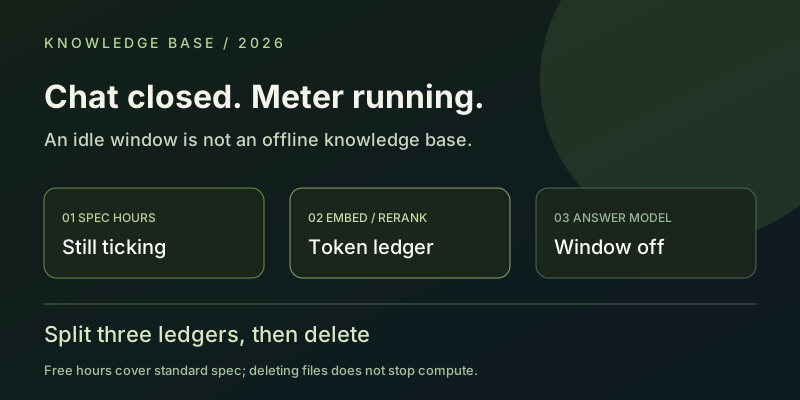
The usual month-end misread is: conversation volume fell, so why didn’t the knowledge-base line fall with it. The product is not “a few extra retrieval tokens on the chat bill”. It is a service that keeps retrieval capacity reserved. Closing the chat window stops answer generation. If the knowledge-base instance still exists, the spec clock keeps running.
Aliyun Model Studio states this in the billing guide: total cost is spec fees plus model-call fees. Spec billing starts when the knowledge base is created, accrues by runtime, and invoices hourly. The documented way to stop that meter is to delete the knowledge base. Deletion wipes data and cannot be undone, so idle instances often stay up — and keep billing by spec.
Treating “nobody asked a question” as “we are not using it” confuses the interaction layer with the billing layer. The first can be idle while the second still sees a live instance.
2. Free hours cover standard spec, not embedding or rerank
Model Studio gives a one-time free-hour grant for standard-spec knowledge bases, consumed in order: free quota, then resource pack, then pay-as-you-go. The scope is narrow. Official text says the free quota offsets standard spec fees only, not enterprise spec, and model-call fees sit outside it. Multiple knowledge bases drain free hours by count: four standard instances in parallel consume four hours of quota per wall-clock hour. They are not “one company pool”.
Model calls are a separate ledger. Create and update jobs embed documents. Retrieval embeds the query, may route across knowledge bases, and may rerank. The answer stage then bills the chat model you picked. The same page writes the full formula: spec runtime + retrieval-stage model fees + answer-stage model fees. Closing chat at most cuts the third term. The first two can continue.
Unused free hours expire; resource packs have validity windows. If you treat free hours as “the knowledge base is free”, the month-end bill still shows embedding, rerank and answer lines. That is not overage. Those three ledgers were never one product.
3. Multi-KB retrieval multiplies tokens; rerank bills preliminary recall
An app that mounts several knowledge bases runs retrieval in each of them. Model Studio says query embedding and rerank tokens scale with the number of knowledge bases. Mounting three “for better recall” can triple retrieval-side model cost while the answer model barely moves.
Rerank is easier to miss. The ranking model is billed on all preliminarily recalled chunks, not on the handful finally inserted into the prompt. High vector TopK plus high keyword TopK, then a rerank pass, bills the volume sent in, not the five snippets shown. Official cost tips match that mechanic: turn rerank off if precision is not critical; if you need to cut cost, lower preliminary recall, not only the final return count.
So do not close the month with “how many questions did we ask”. Ask how many knowledge bases were mounted, whether rerank was on, and how large preliminary recall was. Answer count can be tiny while retrieval is expensive.
4. Volcengine: deleting files does not stop compute
Volcengine knowledge bases bill compute, offline storage, embedding and rerank. Coze’s guide on linking a Volcengine knowledge base is blunt: after you create the knowledge base and upload documents, the system allocates and reserves compute and starts billing. Deleting documents does not release that reservation; billing continues. To stop it you must unbind and delete the knowledge base in the Volcengine console. Coze credits do not cover those charges; Volcengine Ark collects them.
That contradicts the instinct that “emptying the files takes the product offline”. Files can be gone and the index empty while reserved compute remains. Pausing a Coze reference or unbinding a workflow only stops recall. It does not delete the instance. The stop-billing action is “delete the knowledge base”, and it is irreversible.
The vendor page is Volcengine knowledge-base billing. When you check, do not stop at whether Coze still lists documents. Open the Volcengine console and see whether the knowledge base still exists and whether compute is still allocated.
5. Split three ledgers; do not mix cloud CNY with overseas cards
A domestic knowledge base is a yuan cloud bill, not the same rail as ChatGPT Plus or a Claude seat. Reconcile at least three columns: spec or compute hours, retrieval-side model tokens, answer-model tokens. Which column is still rising tells you whether to delete or downsize the instance, turn off rerank or unmount extra knowledge bases, or pick a cheaper answer model. Fold them into one “AI monthly fee” and teams will close the chat window to fix a meter that is still running.
If the same team also pays overseas web subscriptions, that card-network charge should not share a card or a GL account with cloud usage. Isolate those seats on a virtual card with its own limit and expiry, such as RDVCC, so a subscription renewal and a pay-as-you-go cloud bill are not fighting one payment rail. That is a sponsored link, not a claim that a virtual card can pay Aliyun or Volcengine knowledge bases. Those products settle against the cloud account and resource packs. Stopping them is a console delete, not a card swap.