
Verification Checklist
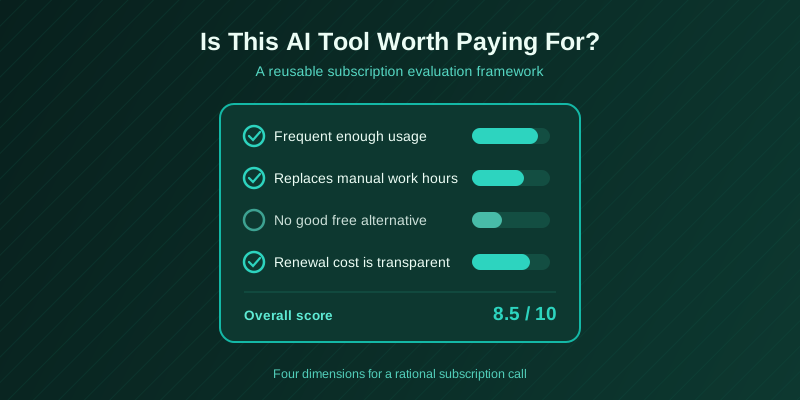
- ✓List your genuinely high-frequency use cases and confirm the count actually stays at three or four, rather than growing every time something new comes to mind
- ✓Open the dashboard for every AI tool still charging you and check the actual "opens in the last 30 days" figure, instead of guessing from memory whether you use it often
- ✓Check the free-tier terms and identify the specific feature you're likely to hit the paywall on, rather than vaguely assuming "I'll have to pay eventually"
- ✓During a quarterly review, honestly answer "would I re-subscribe today from zero" for each tool — two "no" answers means it goes on the prune list
1. The feature table is the laziest, most misleading shortcut
Why are feature checklists everywhere? Because they're easy to make, easy to skim, and they look objective. Lay two tools side by side, tick the boxes, whoever has more ticks "wins." But that neat grid hides an assumption: that more features are better. In reality, the features you'll actually use are usually a small slice of the list — paying for a pile of capabilities you never touch is itself a comparison pointed the wrong way. Benchmarks have the same problem: a model edging out a rival by a few points on some eval set sounds convincing, but that test may have nothing to do with your actual tasks. Response speed, output consistency, and how natural the interface feels — none of which show up on a leaderboard — are what decide whether you open it every day.
2. The real test: can it embed into how you work
Flip the frame. The value of an AI tool isn't how much it can do in isolation, but how smoothly it plugs into the process you already have. For the same writing assistant, can it read the documents you live in, drop straight into your editor, or does its output need endless copy-paste? Comparing "embedding cost" matters more than comparing features — the less it forces you to change your habits, the more fully its value shows up. Real work also rarely finishes on one tool: writing something might cycle through search, drafting, images, and proofreading; automations chain several APIs. Past a certain scale, what's worth comparing isn't which tool is strongest, but which few can be stitched into one smooth line — orchestration often decides the final output more than any single capability does.
3. Switching cost, lock-in, and the free-tier game
Plenty of comparisons only count the subscription fee and quietly skip a pricier line item: switching cost. The prompt templates, chat history, and team conventions you build inside one tool almost never come with you to a competitor — you retrain yourself and your team from scratch. The second hidden cost is the free-tier game: almost every tool hands you a taste, then puts the genuinely useful features behind a paywall right when you're hooked. Don't let the free tier dazzle you — assess which wall you're likely to hit and whether the upgrade is worth it. Solo, "feels good to use" is basically enough; in a team, the yardstick swaps out entirely — permissions, collaboration conflicts, per-seat vs per-usage billing, and whether the admin dashboard is workable. A team's comparison is really about whether a group can rely on the tool repeatedly.
4. Tools went from scarce to overflowing — and choosing got harder
Think back to the first time you used AI to write, draw, or fix code — the usable products were few, and landing on one that worked felt like luck. Now it's flipped: pick any narrow task and a long line of nearly identical products stands behind it. There's a classic finding in psychology: when options grow from three to thirty, deciding gets harder and regret afterward gets stronger. The sneakiest cost of choice overload isn't picking wrong — it's getting stuck in a permanent state of picking, spending time comparing tools instead of using them.
5. Don't outsource judgment to a leaderboard — subtract instead
When tools pile up beyond what anyone can review, a lot of people cope by not judging at all — check who ranks first, buy that. Convenient short-term, but it dulls your own judgment over time. The way out isn't finding the single best tool — it's decisively locking in a few "good enough" ones and stopping. List the scenarios you genuinely hit often — probably no more than three or four — keep exactly one main tool per scenario, and give yourself a rule: no switching for three months just because "I heard there's a better one." Choosing good enough and then focusing almost always beats endlessly chasing optimal.
6. Most comparisons stop at signup — the real one starts three months in
Almost everything we think we know about a tool is formed before we've really used it: a review, a couple of clips, the free tier, then checkout. Three months is an oddly consistent line — the first two weeks are onboarding, by week three preferences harden, and by month three your behavior has said more than any review could. What decides value is not the pre-purchase comparison — it's what survives afterward.
7. Sunk cost, migration drag, and the pruning wall
After using something a while, cutting it gets harder, not easier. You go to cancel and your brain floats justifications — I just paid this month, I trained so many prompts into it. All of that is sunk cost lobbying for the tool. A blunt fix: ask "if I were starting from zero today, would I still subscribe?" If no, "I already paid" isn't a reason to keep going. Even after deciding to switch, chat history, custom instructions, and third-party sign-ins all move at their own pace — plenty of people aren't failing at comparison, they're failing at the last mile of it. And cutting a subscription feels like throwing something away, even though a tool that's missed your weekly-use list for two straight quarters is no longer a subscription — it's a donation.
8. A quarterly review method that actually gets done
Turn this into one repeatable action. Every quarter, spend thirty minutes listing every AI tool still charging you, with three columns: opens in the last 30 days, replaceable by another tool you already have, and "would I re-subscribe today from zero." Any tool with two "no" answers goes on the prune shortlist and gets handled before next month's billing date. That's the full-fat comparison — far more valuable than the pre-purchase table, because it compares the actual you. Most people end up with three to five tools they genuinely use — that's your real AI toolkit.
9. Once the tools are chosen, the billing gets messy
After all that comparing, you finally settle on a tool stack — and then get blocked at the last step. Most of the genuinely good tools live overseas, billed monthly and priced in US dollars, and you may not hold a card that clears risk control reliably. Even a disciplined three or four regulars each charge separately, each with its own renewal date and exchange-rate markup — you subtracted your choices, but payment stayed scattered. This is where a single virtual credit card to absorb every AI subscription closes the loop: one card, one place to reconcile, limits and validity you control. Platforms like this US virtual credit card (Visa virtual card) issuer keep the sign-up bar low and bind cleanly to ChatGPT, Claude and the rest — and if you ever need to prune again, you can just freeze the card.
10. Funding the card: getting stablecoins onto it
Virtual cards are mostly topped up with stablecoins. If your USDT or USDC isn't on the chain your issuer supports, a non-custodial cross-chain aggregator can swap it first — no registration required, failed swaps refund to your address — so a low balance never fails a charge on renewal day. Get the "pick the tools — subtract — quarterly review — consolidate — fund" chain sorted once, and most months take care of themselves.
11. Wrap-up: get the direction right and the comparison isn't wasted
Back to the opening line: the value of an AI tool comparison never lives on the feature list or the leaderboard — it lives in whether the tool truly embeds into how you work and survives past the three-month mark. Map your process first, then weigh embedding cost, switching cost, and the free-tier game; when tools pile up, subtract rather than outsource judgment to a leaderboard; run a quarterly review and prune ruthlessly; finally, smooth over payment with one virtual card and stablecoin top-ups. Get the direction right, and you pick not the tool with the prettiest specs, but the one you're still opening three months from now.