
Verification Checklist
- ✓Is the AI scenario you're using one where "a human is still in the loop reviewing output," or does it claim "fully automated decisions" — the latter is usually still hype until you confirm otherwise
- ✓Has your team scenario actually solved collaboration permissions, data consistency, and traceable results, rather than just copying an individual's usage pattern
- ✓When multiple AI tools work together, does data actually flow between them automatically, or does a human have to manually move it — a great single tool isn't the same as a smooth end-to-end scenario
- ✓Does the card you use for overseas AI subscriptions let you set and adjust a limit per subscription, rather than all subscriptions sharing one uncontrolled card
1. The novelty phase is over, and AI use cases are changing gears
For the past two years, most people related to AI through "let me try this": sign up, ask a few questions, feel impressed, then let it sit. That is the classic novelty phase, where the tool is the star and the scenario is an afterthought. But the gear change is happening. More people no longer debate whether AI can do a task; they assume it is already a step in the process. An AI use case only truly lands when it goes from "something you go out of your way to use" to "something you reach for without thinking."
2. What changes productivity is not the tool, it is the workflow rebuild
We tend to equate capability with value, assuming a stronger model with more features must mean more productivity. Reality says otherwise: plenty of people hold the strongest tools and see no change in output. The reason is that a tool is only a part. What actually works is refitting the parts into the process: who triggers it, where the result flows, who reviews it. A strong tool carelessly jammed into an old process loses to an ordinary tool thoughtfully embedded into a workflow.
3. Solo and team AI use cases are not the same thing
An individual using AI wants instant relief: draft an email, polish a paragraph, look something up, then move on, with near-zero cost to failure. A team is entirely different. For the same AI use case to work, you first have to solve collaboration, permissions, data consistency, and traceable results. Personal scenarios are judged on "does it feel good to use," while team scenarios are judged on "can it be repeated in a way people trust." Porting personal habits straight into a team setting usually does not take.
4. Which scenarios actually work, and which are still hype
Peel back the marketing and the scenarios that genuinely work share a trait: clear task boundaries, generous room for error, and a human still in the loop. Code completion, first drafts, meeting notes, research retrieval — these all fit the "AI produces a version, a human vets it" pattern, and they are stable and time-saving. On the flip side, the demos boasting "fully automated decisions" or "no-human closed loops" are mostly still hype. Not because the tech fails, but because the scenario itself cannot yet absorb a mistake.
5. The hidden barriers: data, habits, and accounts
When a scenario does not work, it often gets stuck somewhere invisible. The first barrier is data: your material is scattered and inconsistently formatted, so the AI cannot get a clean input and its power goes to waste. The second is habits: reshaping a process asks people to change how they have worked for years, and that resistance is routinely underestimated. The third is the most overlooked — accounts and payment. Many of the genuinely good tools live overseas, and just "can I pay for it, and will it stay reliable" keeps people at the door.
6. Multi-tool orchestration: a great single tool is not a great scenario
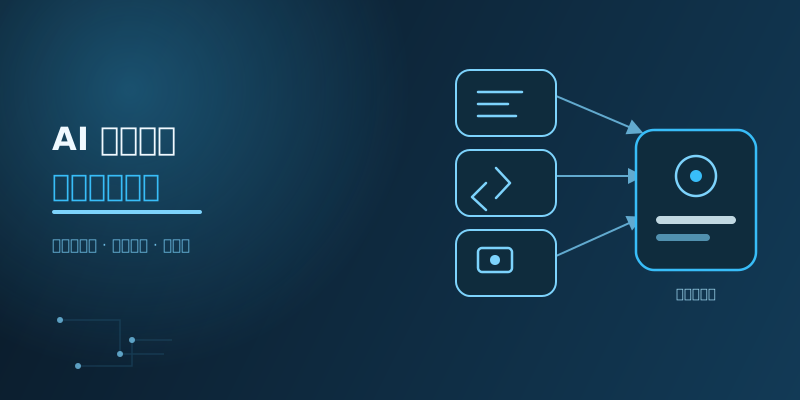
A complete real-world scenario rarely runs on one tool. Writing an article might need search, drafting, images, and proofreading, each living in a different product; running an automation might chain several APIs. However good the single-point experience is, if the tools do not connect and the data will not move between them, the whole process still stutters. That is why the integration of AI use cases is becoming more decisive than the capability of any single tool. The people who stitch a few things into one smooth line are the ones who actually capture the upside.
7. To put overseas AI scenarios to work, you cannot skip payment
Once you start orchestrating multiple tools, you quickly notice the handiest few tend to live overseas, billed monthly and priced in US dollars. At that point "can I pay reliably" directly decides whether the scenario keeps running. Plenty of people have no international card that can cover an overseas subscription, or keep hitting risk-control declines. A virtual credit card dedicated to online subscriptions has become a common practical fix, freeing payment from the precondition of "do you happen to hold an international card."
8. Use one virtual card to consolidate multi-scenario subscriptions
When you are running writing, coding, and image workflows all at once, your bills scatter into a pile. The saner move is to consolidate those subscriptions onto a single card and a single statement. Take US virtual credit card provider RDVCC as an example: you can open a separate card per subscription amount, adjust limits anytime in the dashboard, and pay with a mainstream Visa virtual card, which merchants tend to accept more readily. Choosing a virtual card platform with a reasonable approval bar beats swapping cards over and over; if you want to compare tools first, browse an overseas tools directory before deciding.
9. Looking ahead: scenarios embed deeper, barriers fall lower
Looking further out, AI use cases will most likely grow more "invisible" — no longer standalone tools you open, but quietly baked into the software and processes you already have, to the point you barely notice them at work. At the same time, the barriers to adoption keep getting smoothed away: data interfaces become more standard, collaboration more mature, and even the perennial payment headache gets backfilled by paths like virtual cards and stablecoin top-ups. The real dividing line will fall on who reorganizes their scenarios first, not on who bought the newest tool.
10. Wrap-up: rebuilding the scenario beats chasing new tools
Back to the opening claim: the value of AI use cases is not in the feature list, but in whether they are genuinely embedded in your daily workflow. See the difference between solo and team, tell the working scenarios from the hype, face the data and habit barriers head-on, then smooth the unavoidable overseas subscriptions with a virtual card and stablecoin top-ups. Do all that, and AI turns from an "occasionally dazzling toy" into "the part of your process quietly helping every day." You will never finish chasing new tools; rebuilding the scenario is the far better homework.