
Verification Checklist
- ✓What exactly does Wysa's FDA Breakthrough Device Designation cover — is it limited to depression/anxiety management tied to chronic musculoskeletal pain, rather than a blanket approval across all of Wysa's products
- ✓Does the mental health chatbot you or someone you know is using actually route an explicit suicidal-intent disclosure to a human crisis line or emergency service, rather than handling it itself
- ✓Which technical path does a given smart prosthetic's multi-intent grip recognition rely on — myoelectric pattern recognition or an implanted neural interface — and is the maturity/cost gap between the two clear
- ✓Can the drone search-and-rescue market figures and disaster-response case studies cited here be verified against the original industry report or official incident summary
1. "Can AI save lives" isn't a marketing line — it's a testable question
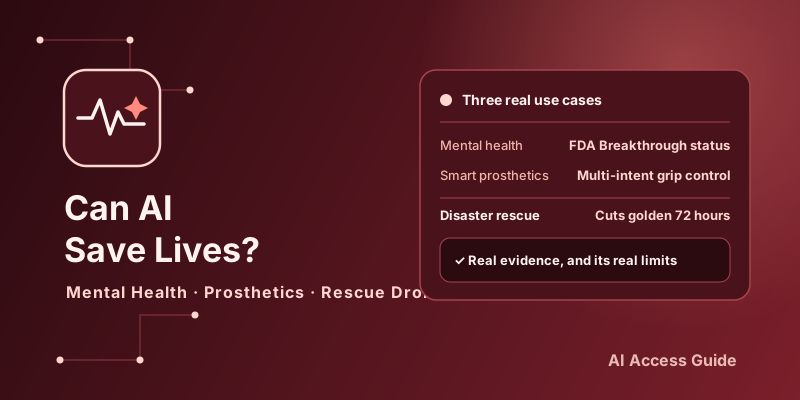
"AI saves lives" sounds like exaggerated marketing copy, but this piece takes it seriously enough to check. Whether a system deserves that label depends on whether it does something in a life-or-death window that traditional methods either couldn't do or couldn't do fast enough — a mental health crisis that hits at 2am when no one is reachable, an amputee who lost not just a hand but the touch and muscle memory behind everyday tasks, or a disaster search where ground teams can only cover so much ground within the golden 72 hours. These three cases are picked deliberately far apart because each maps to a different failure mode of traditional methods: "can't wait for a human" (mental health crisis), "permanent loss" (prosthetics), and "not enough coverage" (rescue) — not three variations on the same theme. Each section below is grounded in a specific regulatory designation, clinical trial finding, or real deployment record, not a vague claim about "potential."
2. Mental health: can an AI chatbot actually intervene in suicide risk
The biggest bottleneck in mental health care is access — a therapy appointment can take weeks to book, and a crisis often hits during exactly that waiting period, often late at night. Woebot and Wysa are the two most rigorously studied AI mental health chatbots, both built around structured cognitive behavioral therapy (CBT) conversation, available any time with no appointment needed. Wysa has been formally procured by parts of the UK's NHS and received an FDA Breakthrough Device Designation for managing depression and anxiety associated with chronic pain — a designation that signals regulators recognize it's addressing a clinical need current options don't fully meet. Woebot has multiple randomized controlled trials published in peer-reviewed journals showing meaningful drops in depression scores after about two weeks of use. What needs to be said clearly: these tools are currently positioned as "support between crises" and "self-help for mild-to-moderate symptoms." When a user expresses explicit suicidal intent, the design principle across every serious mental health AI product is to detect the risk signal and route to a human crisis line or emergency services — not to handle an acute suicide risk on its own. That boundary is the disclaimer most easily skipped when evaluating these tools, and it's the one that actually matters most.
3. Smart prosthetics: how AI lets amputees grip a cup again
The real limit of a traditional prosthetic isn't its shape — it's control precision. Reading a crude electrical signal from residual limb muscle only supports a handful of gross motions like open and close, so gripping an egg and gripping a dumbbell use the exact same stiff motion. Recently approved neural-controlled prosthetics — like Coapt's pattern recognition system and multi-degree-of-freedom prosthetic hands — use machine learning to read patterns across multiple channels of muscle signal in real time, rather than a single open/close channel, letting the device distinguish a dozen-plus distinct intents: a precise pinch, a firm grip, a wrist rotation. Training usually takes just a few repeated motions for the model to learn from. The more experimental frontier is implanted neural interfaces that read motor nerve or motor cortex signals directly, skipping the muscle layer entirely — still mostly in clinical trials, but amputees and people with high-level paralysis have already used these interfaces to grip a cup or use utensils independently for the first time since their injury. What "saves lives" means here isn't literally preventing death — it's restoring a capability that was permanently taken away. Whether someone can feed themselves or button a shirt without help directly determines whether they need to depend on a caregiver, a metric disability researchers return to again and again when measuring quality of life.
4. Disaster rescue: how drone swarms make the golden 72 hours count
After an earthquake or landslide, a trapped person's survival odds drop sharply with time — the industry commonly calls this window the "golden 72 hours" — while traditional search dogs and ground teams have inherently limited coverage speed, especially on damaged roads and difficult terrain. Drone swarms equipped with thermal imaging and AI image recognition can run wide-area aerial scans before ground teams even arrive, using machine learning to automatically flag rubble heat signatures that look like vital signs, so rescue teams get directed to the most likely survivor locations instead of clearing a grid square by square. Industry market research estimates the global drone search-and-rescue market at roughly $27 billion in 2025, growing to about $70 billion by 2030, with growth driven by actual procurement from government emergency agencies and international relief organizations rather than proof-of-concept pilots — itself a sign this technology has moved past the demo stage. Thermal-equipped drone swarms have been deployed in real operations including Turkey's 2023 earthquake response and repeated mountain rescue missions, with official reports crediting them for cutting the time to locate likely survivors — not for replacing rescue personnel. Actual extraction and medical care still require ground teams on-site; the drone's role is reconnaissance and fast localization.
5. Three use cases compared: strength of evidence, regulatory status, and current limits
| Use case | Representative system/evidence | Core capability | Current limit |
|---|---|---|---|
| Mental health support | Wysa (FDA Breakthrough Device Designation) / Woebot (multiple RCTs) | CBT-structured self-help for depression and anxiety | Cannot handle acute suicide risk alone; must route to human crisis lines |
| Smart prosthetics | Coapt pattern recognition / implanted neural interfaces (clinical trials) | Multi-intent grip recognition | Implanted options still immature; high cost and maintenance barrier |
| Disaster rescue | Thermal-imaging AI drone swarms | Wide-area scanning, likely-survivor localization | Cannot replace ground extraction and medical care; grounded by extreme weather |
6. Being honest about the limits: AI isn't a paramedic or a universal substitute
Lining up these three cases can create the impression that AI can save anyone from anything, but each one has a clear line of responsibility it doesn't cross. Mental health chatbots are designed, by principle, not to handle acute suicide risk alone — their value is filling the gap during a waiting period or a lonely 2am, while real crisis intervention still depends on human hotlines and emergency services. Smart prosthetics solve a control-precision problem, not nerve damage itself, and implanted options are nowhere near mature or affordable enough for widespread use. Drone-assisted rescue improves localization speed, not the final extraction and medical care, and still fails under severe weather or communications blackouts. Behind all three limits is the same principle: AI's role in each case is to spot the problem faster and surface the signal earlier — the decisive action itself, whether that's crisis referral, surgical-grade neural connection, or physical extraction, still belongs to a human or a more specialized system. Naming these limits isn't a knock against AI's value — it's exactly what makes the claim "AI saves lives" hold up under scrutiny.
7. Takeaway: the honest answer, and where to look next
Back to the opening question — can AI actually save lives? Within clearly bounded use cases, yes, and it's backed by FDA designations, clinical trial data, and real-world deployment records, not marketing language. Mental health chatbots fill the gap during appointment waits and lonely nights when no one else is reachable, smart prosthetics restore a capability that was permanently taken away, and rescue drones buy back the most valuable minutes inside the golden 72 hours. All three share the same underlying logic: fill a gap traditional methods couldn't close or couldn't close fast enough, rather than replace a professional's final judgment call. If this topic interests you, related directions worth following include AI-based early warning in chronic disease remote monitoring (home monitoring for heart failure or diabetes complications), AI-assisted PTSD treatment, and the fall-detection and automatic emergency-calling features increasingly built into consumer wearables — all of them should be judged by the same standard used here: does it genuinely close a gap that had no solution before, not how futuristic it sounds.