
Verification Checklist
- ✓Does the fall-detection product you're considering give a spoken confirmation window before alerting an emergency contact, or does it dial out the instant it detects a possible fall
- ✓Does the companion robot's own documentation clearly state it isn't a substitute for professional mental health care, and does it route crisis signals to family or a professional rather than handling them itself
- ✓Is the remote health monitor's alert based on that specific person's own historical baseline, or a generic "normal range" applied to everyone
- ✓Can the specific figures cited here — the ElliQ pilot data, the "golden hour" after a fall — actually be verified against the original official sources
1. "AI eldercare" isn't a buzzword — it's what families actually worry about
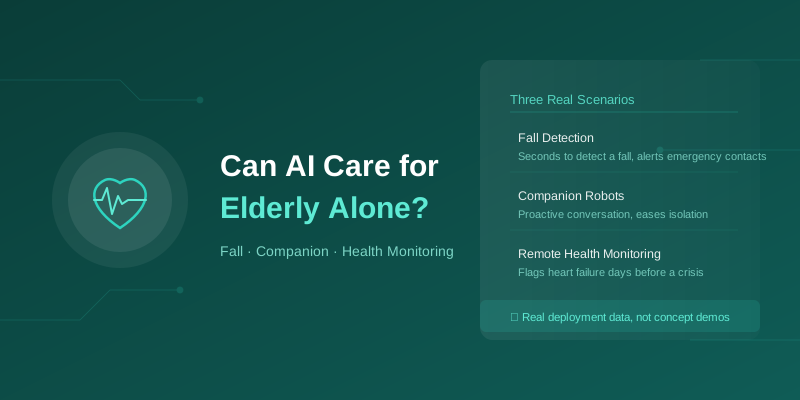
"AI eldercare" is easy to dismiss as a marketing term, but for people with a parent living alone, it maps directly to three concrete anxieties: will someone know immediately if they fall, are they getting through the day without real human contact, and will a health problem get flagged before it turns into an emergency. These three scenarios are deliberately spread across different failure modes: detection speed (falls), presence gap (isolation), and warning lag (chronic disease deterioration) — not three variations on a single theme. Each section below is grounded in specific product data, clinical research findings, or deployment scale, not a generic claim that technology makes aging better.
2. Fall detection: how AI tells "fell" apart from "sat down" within seconds
One of the most dangerous risks for elderly people living alone is a fall that goes unnoticed for hours — research consistently shows that outcomes are significantly better when help arrives within an hour of a fall versus hours later. Traditional call buttons fail at exactly this moment: a person who's unconscious or out of reach of the device can't press anything. Current AI-based fall detection falls into two categories. Wearable devices — a smartwatch or pendant — carry accelerometers and gyroscopes that use machine learning to analyze the speed of descent, the angle of the body, and stillness after impact, distinguishing a real fall from sitting down or lying down intentionally. False-alarm rates with modern ML-based systems are substantially lower than early threshold-based approaches. The second category is contactless: radar or computer vision sensors installed on ceilings or walls that track body posture without requiring the person to carry anything, which also sidesteps camera privacy concerns. After detecting a likely fall, both types typically give the person a brief spoken confirmation window — "fall detected, I'll notify your emergency contact in 10 seconds unless you respond" — before alerting anyone. That confirm-then-notify design is considered the essential detail separating a useful product from one that gets switched off after too many false alarms.
3. Companion robots: can AI actually ease the loneliness of living alone
The loneliness of living alone isn't just an emotional issue. A well-established body of medical research links chronic social isolation in older adults to meaningfully higher risk of cognitive decline and depression — and this is precisely the problem adult children most struggle to solve, not because they don't want to help, but because they can't be there every day. AI companion robots like ElliQ are designed around a different premise than a voice assistant: rather than waiting for the person to speak first, the device initiates. It remembers a grandchild's birthday mentioned weeks earlier, brings it up at a relevant moment, reminds about medications and hydration, and suggests short cognitive games — maintaining a thread of ongoing interaction rather than responding to one-off queries. A pilot program supported by the New York State Office for the Aging tracked ElliQ users over time and found that the majority reported a reduction in loneliness, with usage frequency staying higher than many observers expected past the initial novelty period. What needs to be said plainly: these companion systems address the gap in daily interaction, not professional mental health care. When a user shows signs of serious depression or emotional crisis, the product's design routes to alerting family members or suggesting professional help — the same boundary that responsible mental health AI maintains. The companion robot fills the space between those contact points, not the crisis itself.
4. Remote health monitoring: how AI flags heart failure deterioration days in advance
Many serious deteriorations in chronic illness don't happen suddenly — they have a gradual signal window. A heart failure patient's weight quietly ticking up, oxygen saturation dipping slightly, these changes often begin days before an acute episode, but they're subtle enough that the person doesn't notice, and "I still feel okay" isn't a reason to call the doctor. Remote health monitoring systems connect scales, blood pressure cuffs, and pulse oximeters to continuous AI analysis of that individual's personal baseline trend — not a one-size-fits-all "normal range" — and alert a family doctor or family member when a metric starts drifting from that person's own historical pattern. Multiple clinical studies focused on heart failure patients have shown these systems can identify deterioration trends days to a week before clinical symptoms become obvious, giving doctors and families an actionable head start rather than reacting to an emergency room visit. The value here isn't replacing checkups or clinic visits — it's turning the blank interval between two appointments into a continuous, observable data curve, so that worsening gets caught before it becomes a crisis.
5. Three use cases compared: evidence, representative systems, and current limits
| Use case | Representative system/evidence | Core capability | Current limit |
|---|---|---|---|
| Fall detection | Wearable accelerometer / contactless radar sensors | Distinguish fall from normal motion; notify emergency contacts after spoken confirmation | Wearable type depends on being carried; contactless installation has upfront cost |
| Companion robots | ElliQ (New York State Office for the Aging pilot data) | Proactive conversation, medication reminders, cognitive micro-exercises | Cannot substitute for professional mental health support; routes crises to family or specialists |
| Remote health monitoring | Heart failure remote monitoring (multiple clinical studies) | Flag chronic disease deterioration days to a week in advance | Requires device connectivity and user compliance; cannot replace clinical diagnosis |
6. Being honest about the limits: AI eldercare doesn't outsource family responsibility
Lining up these three cases can create a misleading impression that installing AI devices means everything is handled. Each use case has a clear line it doesn't cross. Fall detection solves the discovery speed problem, not fall prevention itself, and contactless systems require installation and ongoing maintenance costs. Companion robots fill the daily interaction gap, not the role of genuine mental health support or periodic in-person family visits — many users report that the most meaningful effect is reducing the guilt their adult children feel about not visiting enough, not that AI replaced the visit entirely. Remote health monitoring improves the timing of alerts, but final diagnosis and treatment decisions still require a doctor, and the system only works if the person actually uses the devices. The common principle behind all three limits is the same one at work in AI's other life-adjacent applications: AI surfaces the signal faster and earlier, while the decisive action — rescue, genuine human presence, clinical care — still belongs to a person. Naming those limits is what makes AI eldercare genuinely useful to real families, rather than a reassuring label that turns out to be empty on the day it matters.
7. Takeaway: the honest answer on AI eldercare, and where to look next
Back to the opening question — can AI actually care for elderly people living alone? Within clearly defined use cases, yes, backed by product deployment data, pilot research, and real adoption by care organizations, not marketing copy. Fall detection shrinks the dangerous window between a fall and someone knowing about it. Companion robots fill the gap on the many days adult children can't be there. Remote health monitoring brings forward the warning on chronic disease deterioration that previously only became visible in a hospital. All three share the same underlying logic: close a gap that traditional home care couldn't close or couldn't close fast enough, rather than substitute for family or professional judgment. If this area interests you, related directions worth following include AI-assisted medication adherence and smart pill dispensers, home environment monitoring for cooking safety and unusual appliance use, and voice and behavioral analysis tools for early cognitive impairment screening — all of them should be evaluated by the same standard: does it genuinely close a gap that had no adequate solution before, not how impressive the technology sounds in a product demo.