
Verification Checklist
- ✓When citing Khanmigo's "millions of accounts" or "thousands of classrooms," check Khan Academy's current official page for the latest coverage figures rather than an outdated promotional number
- ✓Confirm which year's Pew "homework gap" survey a figure comes from (2018, 2020, and 2021 numbers differ) and label it clearly to avoid mixing datasets
- ✓Check the stated methodology behind any UNESCO figure on children lacking connectivity — whether it covers students affected during pandemic closures or the broader global school-age population
- ✓Before judging whether an AI education program actually advances equity, check whether it has a dedicated plan for low-bandwidth or no-connectivity settings, not just its reported learning-outcome data
1. What "the education gap" actually means beyond test scores
Before asking whether AI can close the education gap, it helps to be precise about what that gap actually is. It's not just a difference in test scores — it stacks at least three structural layers. First, a teaching-quality gap: well-resourced schools can afford lower student-teacher ratios and more experienced staff, while under-resourced schools face chronic teacher turnover and overload. Second, an access-to-personalized-help gap: families who can afford private tutoring get targeted feedback, while everyone else follows the average pace of a classroom. Third, a digital-infrastructure gap: reliable internet and a personal device are still not a given for every household. AI tutoring, in theory, can ease the first two layers — it can give feedback as personal as a tutor's, at a fraction of the marginal cost. But if the third layer isn't addressed, the equity promise never reaches the students who need it most, which is the tension this article digs into.
2. Khanmigo's real scale and outcome data
Khan Academy began rolling out Khanmigo, its GPT-based AI tutor, to schools and families starting in 2023. It's now used in thousands of U.S. classrooms, with registered student and teacher accounts in the millions. Pilot data shared by Khan Academy in partnership with several school districts shows students using Khanmigo for math made noticeably larger gains on conceptual-understanding assessments than control groups, particularly on step-by-step explanation tasks the AI tutor can repeat indefinitely without losing patience — something a human teacher managing a full classroom simply can't match. Teacher feedback tells a complementary story: many pilot teachers report Khanmigo absorbs a large share of repetitive Q&A and grading-support work, freeing up time for the one-on-one intervention and lesson design that actually require a human. This data suggests AI tutoring is producing real gains in patience and granularity of instruction — not just a compelling demo.
3. Who actually benefits: middle-class households vs. under-resourced regions
The catch is that most of this outcome data comes from schools and households that already have baseline digital access. A 2021 Pew Research Center survey found a significant share of lower-income U.S. students still face a "homework gap" — no stable home broadband or personal device to complete online coursework — a gap that's especially pronounced in rural areas and low-income urban communities. That means even a fully free Khanmigo rollout mostly reaches students who already have devices and connectivity — not necessarily the students who need the extra support the most. Khan Academy and other edtech organizations are aware of this and have partnered with some districts on device lending and lightweight offline-capable versions, but the scale of that coverage still lags far behind actual need in under-resourced areas. This isn't a limitation of the AI model itself — it's a digital-infrastructure investment gap that no amount of product iteration alone can close.
4. The teacher's role changed — it wasn't replaced
Another commonly misread point is whether AI tutors will replace teachers. The evidence so far tells a different story: AI tutors absorb the high-frequency, repetitive, standardized parts of Q&A and practice, while the teacher's role shifts from "grade every problem" to "identify which students are genuinely stuck and what intervention they need." That shift actually increases the information burden on teachers — they need to learn to read AI-generated progress reports and tell the difference between a student who truly understands and one who just looks correct under AI guidance. Multiple pilot districts report that insufficient teacher training investment is one of the biggest bottlenecks in rollout; many teachers simply haven't been given enough time or support to learn to interpret and use these tools effectively. That's why the same AI tutoring product produces wildly different results across schools — the tool's capability isn't the deciding factor, the support given to teachers is.
5. The Global South view: mobile-first, offline-first paths
Shift the lens outside the U.S. and the shape of the education gap looks different again. In many developing regions, students' primary point of internet access is a shared mobile phone rather than a personal computer, and connectivity is often intermittent mobile data rather than stable broadband. In that context, a product model like Khanmigo's, which assumes continuous online interaction, doesn't transfer directly — lightweight AI learning tools built specifically for low-bandwidth environments, supporting offline caching, SMS-based interaction, or low-resolution voice tutoring, have more realistic paths to actual deployment. A 2023 UNESCO report also notes that hundreds of millions of school-age children globally still have limited or no internet connectivity, a population almost entirely excluded from the reach of today's mainstream AI tutoring products. This is a reminder that the answer to "can AI tutors close the education gap" varies enormously by region — talking about equity without grounding it in actual infrastructure conditions easily turns into an unearned optimism.
6. Four dimensions compared: progress, real beneficiaries, and remaining gaps
| Dimension | Representative evidence | Who actually benefits | Remaining gap |
|---|---|---|---|
| Learning outcomes | Khanmigo district pilot conceptual-understanding data | Students who already have devices and connectivity | Lack of long-term studies across income and regional lines |
| Teacher workload | Pilot teacher feedback on reduced grading burden | Teachers in pilots who received adequate training support | Training investment is inconsistent; outcomes depend heavily on school support |
| Device & connectivity access | Pew Research Center homework-gap survey | Middle-class and above urban households | Low-income and rural student coverage remains low |
| Global South scenarios | UNESCO connectivity-gap report | A small number of low-bandwidth pilot beneficiaries | Mainstream products still default to continuous connectivity |
7. Being honest about the limits: an amplifier, not an equalizer
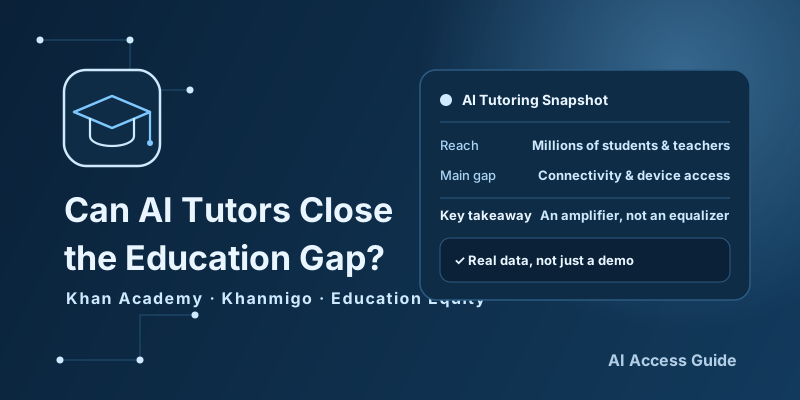
Placed under the broader theme of "AI serving humanity," the easiest mistake with AI tutoring is treating it as an automatic equalizing force. The more accurate description is that AI tutoring is an amplifier: it boosts learning efficiency for groups that already have digital access, but without dedicated infrastructure investment and resource redistribution, it doesn't automatically shrink the starting-point gap — and in the short term, it can even widen it, since the groups already ahead are usually first to adopt better tools. That's not a case against Khanmigo-style products; they deliver genuine learning gains and real relief for teacher workload wherever they can actually be used. But if the conversation stops at "how good is this AI tutor" without asking "who is actually using it, and who is left out," it fails to answer the harder equity question sitting at the center of "AI serving humanity."
8. Takeaway: the right questions to ask about any AI education-equity tool
Like the other pieces in this site's AI-serving-humanity series on companionship, elderly care, and life-saving use cases, judging an AI tutoring tool shouldn't stop at "does it teach well" — it needs to also ask "does it shrink the gap, or widen it." Khanmigo's pilot data shows real value in patience and personalization, and teacher feedback confirms it can meaningfully offload repetitive work. But Pew's homework-gap findings and UNESCO's global connectivity report are equally real evidence on the other side. Worth asking before trusting any AI tutoring product or education-equity initiative: does it have dedicated support for low-bandwidth, low-device-ownership contexts; does it come with real teacher training investment rather than just shipping a tool and walking away; and does its outcome data actually cover students across different income levels and regions, rather than only the better-resourced pilot schools.