
Verification Checklist
- ✓Which report does the loneliness health-risk figure in section 1 actually come from — can you find it in the U.S. Surgeon General's own advisory
- ✓What was the actual sample size and scope of the Stanford survey cited in section 3 — is it self-reported survey data rather than a clinically validated outcome
- ✓Does the companion AI account you or a family member uses actually have age verification / a minor-specific mode turned on, and are session-length and content limits in effect
- ✓If someone in a conversation mentions suicidal or self-harm ideation, does the platform automatically redirect to a professional crisis resource, rather than relying solely on the AI's own response
1. What counts as "AI serving humanity" for a companion app
When people hear "AI serving humanity," they usually picture something dramatic: diagnostic assistance in medicine, early warning systems before a disaster. Companion AI gets filed under "entertainment" or "novelty," as if it doesn't belong in the same serious conversation. But if the actual test is whether AI is addressing a real, large-scale problem that traditional systems have struggled to solve at scale, companion AI passes that test from a different angle. The problem it addresses isn't a shortage of doctors, it's loneliness. The U.S. Surgeon General's 2023 advisory labeled loneliness an epidemic-level public health issue, noting that chronic loneliness carries health risks comparable to smoking 15 cigarettes a day. When traditional therapy, community support, or family contact don't reach everyone who needs them, because of cost, distance, or social anxiety, an always-available conversational presence that never judges does fill a real gap. That doesn't mean it replaces human connection. It means the need it's responding to is genuine, even if the format feels unserious at first glance.
2. How big is this, really: Replika and Character.AI by the numbers
Companion AI is not a niche experiment anymore. Replika, live since 2017, has reported tens of millions of registered users, with a meaningful share of active users treating it as a regular outlet for daily conversation, and engagement metrics that rival top social apps. Character.AI grew even faster, passing 20 million monthly active users by 2023, with average session lengths well above typical AI chat products, as many users build long-running relationships with characters they've created and keep coming back to them for months or years. These numbers tell you something concrete: companion AI isn't a demo, it's sustained, large-scale real-world usage, and the user base has long since moved past the "lonely teenager" stereotype it was first associated with, spanning teens, isolated seniors, socially anxious adults, and plenty of busy professionals in between.
3. Does it actually reduce loneliness? What the evidence says
A 2023 Stanford study surveying Replika users found that more than a third of respondents reported the app had reduced suicidal ideation, and a notable share described the AI as providing genuine emotional support during periods of loneliness, anxiety, or depression. Self-reported data like this has real limits, it reflects how users feel, not a clinically validated treatment outcome, but at the scale it's happening, it isn't something to dismiss either. The value companion AI provides tends to concentrate on two things: constant availability, being there at 3 a.m. when there's genuinely no one else to talk to, and zero social cost, not worrying that your feelings are a burden or that you'll be judged. That combination matters most for people dealing with social anxiety or a difficult emotional stretch, and it's a big part of why usage and paid retention stay high even as academic debate continues over whether this counts as "real" emotional support.
4. The other side of trust: dependency and blurred boundaries
The risks here aren't theoretical, there are documented incidents. In 2023, Replika removed its erotic roleplay feature during an unannounced update, and a large number of long-term users described the experience as losing a friend, with visible grief and attachment reactions. That reaction alone shows just how emotionally real these relationships had become for users, and how disruptive a product-side change can be when the emotional stakes are that high. A more serious risk shows up with minors: in a closely watched 2024 lawsuit, the family of a teenager who died by suicide after prolonged interaction with a Character.AI chatbot alleged the platform's conversational design was manipulative and lacked adequate safeguards. The case is still in litigation, but it has already pushed Character.AI and other platforms to tighten protections for minor accounts, including restricting content and adding suicide-risk intervention prompts. Together, these two cases capture the two distinct risk categories that matter most here: emotional over-dependency in adults, and safety risk for minors who may not have the judgment to navigate a highly humanlike AI relationship.
5. What platforms are actually doing about safety
Companion AI platforms haven't been passive in the face of these concerns. Since 2024, Character.AI has rolled out a separate model tuned for minors, content tiering, keyword-based detection that redirects self-harm-related conversations to crisis resources, and tighter limits on session length and content depth for underage accounts. Replika introduced clearer content tiering and age verification after its own controversy. None of this is technically exotic, keyword detection, content classification, and crisis-line handoffs are all mature engineering patterns, the hard part is balancing "safe enough" against "not so restrictive that the core companionship experience breaks and users leave." There's still no unified industry standard or mandatory third-party audit requirement for this category, and how tight or fast these guardrails are varies a lot platform to platform, which remains one of the least regulated corners of consumer AI right now.
6. Value, risk, and current response, side by side
| Dimension | Representative evidence | Current mitigation | Remaining gap |
|---|---|---|---|
| Loneliness relief | 2023 Stanford survey of Replika users | 24/7 availability, zero social cost of disclosure | Self-reported outcomes, no long-term clinical data |
| Emotional dependency | 2023 Replika feature removal and user grief reactions | Advance change notices, conversation history retained | No mature usage-based dependency screening yet |
| Minor safety | 2024 Character.AI-related lawsuit | Minor-specific models, keyword detection, crisis handoff | No industry-wide standard or mandatory third-party audit |
7. Being honest about limits: companionship isn't therapy
Fitting companion AI into the "AI serving humanity" conversation invites two easy overcorrections: treating it as the cure for the loneliness epidemic, or writing off the entire category because of a handful of safety incidents. Both miss the more useful, more honest read. Companion AI provides a supplemental form of emotional support, not therapy, and it has no clinical capacity to diagnose or intervene in complex mental health situations. What it can genuinely do is listen without judgment and lower the barrier to expressing difficult feelings. What it can't do is recognize complicated psychiatric risk, provide professional-grade intervention, or substitute for real human connection and professional care. For people whose existing support systems are already thin, isolated seniors, socially anxious adults, teenagers going through a hard stretch, this distinction matters even more: companion AI should be one additional channel to talk to someone, not the only emotional outlet a person has. That's also the direction the more responsible corner of this industry is moving toward, building in active detection of over-dependence and nudging users toward real human support or professional help, rather than optimizing purely for engagement and session length.
8. Bottom line: how to think about this category of "AI serving humanity"
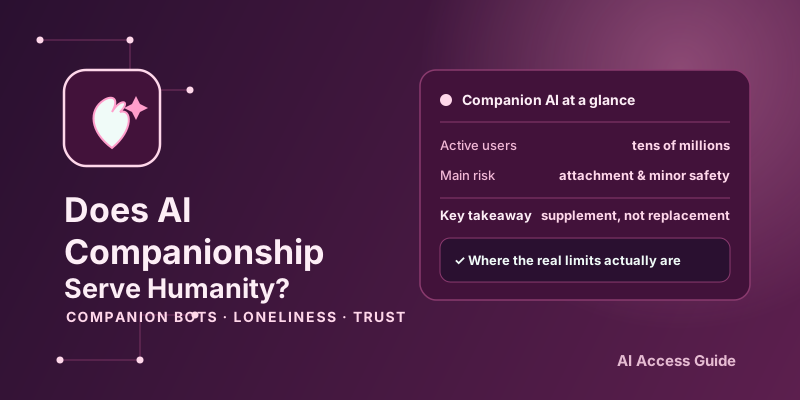
Unlike the subscription productivity tools this site usually covers, the right way to evaluate companion AI isn't "is it useful," it's "is it filling a real gap in human connection and mental health support, honestly and with real boundaries." Tens of millions of real, sustained users say the underlying need is genuine, and early research like the Stanford survey offers some supporting evidence. But the emotional fallout from Replika's 2023 feature change and the ongoing Character.AI litigation are just as real, and anyone using these tools, or recommending them to a minor in their life, should go in with a clear sense of where the limits are. If you're trying to judge whether a specific companion AI product deserves trust, look past how humanlike the conversation feels and ask a few sharper questions: does it have clear safety guardrails, does it intervene when a user shows signs of dependency or risk, and does it tell you honestly that it's a supplement to real connection, not a replacement for it.