
Verification Checklist
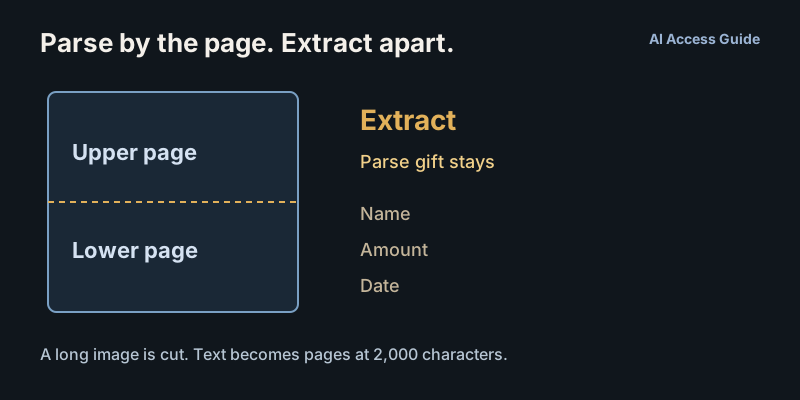
- ✓Open the task record and read whether this run was Parse or Extract, and how many pages or seconds it processed. If that page count disagrees with the file, check for a long image that was cut, or text converted at 2,000 characters per page.
- ✓On a direct extract of a new document, watch the extract gift only. The parse gift should not fall. The price already includes parsing, so do not add a second parse charge.
- ✓Reuse only a document or image ParseResult from ParseX itself, and only while it is inside the 7-day window on the FAQ. Audio, video, and files prepared in another tool are not that price.
- ✓The workflow document node is not billed, according to that page. Follow the wire to the model node. The summary still bills that model's input and output tokens.
- ✓If a field is
missingorconflict, read the task status before the field. A fully evaluated schema can still besuccess. An empty field is not proof that the run was free.
1. Two ledgers, not one page count
The pricing page splits the meters in the first lines. Parse and Extract record usage separately. Documents and images count by the pages actually processed, and a long image is cut into pages. Word files, spreadsheets, Markdown, plain text, HTML and e-books are converted into pages by dividing the text amount by 2,000. Audio and video count by the seconds actually processed. A long text file can become many pages. A tall screenshot can become more than one. When the bill's page count disagrees with the file manager, that conversion is the first place to look.
The first time an account enables ParseX, it receives 3,000 pages of document parsing, 3,000 pages of field extraction, 100 hours of video and 100 hours of audio. The rule says the gift is issued once. It is not refreshed by the day or by the month. When it is gone, usage becomes pay as you go. A direct extract of a new document spends the extract gift only. The page's example is a 10-page file: ten pages leave the extract gift, and the parse gift does not move. A remaining parse balance is not evidence that extract should be free. The two gifts do not pool.
The price of a direct extract on a new document already includes parsing. You do not add a parse fee on top. Extracting from a reusable parse result is a different price. "Already parsed" means this extract actually reused a ParseX result. A file that was processed in some other tool is not that scenario. Converting a file to Markdown on your own machine does not buy the cheaper reuse tier. Unit prices stay on the pricing page. This note does not freeze a number from one day.
2. Extract only accepts documents and images
The limits page draws the boundary in a table. Parse accepts documents, images, scans, spreadsheets and text, and it also accepts audio and video. Extract accepts documents and images only, and it can reuse a valid document or image ParseResult. Reuse exists so the same file is not parsed again. An audio or video ParseResult cannot be handed to Extract. The FAQ says the same thing in one sentence. A meeting recording that has already been parsed is still the wrong input for field extraction.
The FAQ also says a reusable document or image ParseResult is kept for 7 days. The download address can expire sooner. Use the expiry the API returns. A dead download link does not by itself prove the result has left the 7-day window, and a live link is not a reason to invent a different retention period. When the two disagree, read the task record and the error code. Do not guess a reusable id from a label on the console.
The console experience page caps a single file at 200 MB. The FAQ says that cap is not the API limit. On the limits page, documents, text, web files and e-books are 1 GB on the API and 200 MB in the console. Images are 20 MB on both. Audio is 2 GB on the API. Video is 10 GB on the API. A file the console refuses can still be a valid API input. A file the API accepts should not be priced as if the console's 200 MB cap decided the page count.
3. The workflow node is free. The model is not.
The workflow document node says, in its opening paragraph, that the node is not billed for now. It emits structured variables: a layout array with Markdown for ordinary documents, and cells for Excel. The page's own example parses a file and then asks a model node for a summary. That first node does not enter the ParseX page meter. The model node receives the parsed text and bills that model's input and output tokens. Reading "parse is free in a workflow" as "the whole summary path is free" drops the second node.
The node is also a different surface from ParseX. Its own limits are 150 MB and 15,000 pages, one file at a time, not a list. A web page URL fails. The page says a web URL is not a document file. A failure on this node stays on the "not billed for now" rule written there. If you retry the same file through the ParseX API, that retry is back on the page or second meter. The word "parse" is shared. The switch is not.
4. Do not fold in the knowledge-base clock
A knowledge base starts an hourly spec clock when it is created, and closing the chat window does not stop it. That is a different article. Embedding, rerank and the answer model bill tokens of their own. ParseX pages and seconds do not include that clock, and the hourly spec fee does not include ParseX pages. After the chat stops, both meters can still be running. Web search is a per-call line, covered separately. A model free quota that converts to pay as you go is another balance. The ParseX gift is once, at enablement. It is not the model's free token pool.
The FAQ says both Parse and Extract are asynchronous. Submit returns a biz_id. The result is processing, success or failed. Only success has the final result. missing or conflict on a field does not mean the task failed. If the system evaluated the whole schema, the status can still be success. Missing means the field was not found. Conflict means the source had competing candidates. An empty field is not a free run, and success is not proof that every field was filled.
Files, configs, tasks and results are isolated by workspace. Switching workspace and losing sight of a task does not erase the usage. The usage view is a period total by capability. The task record is one run: which capability, and how much it processed. A blank in one of those views does not cancel the number in the other.
5. A top-up does not shorten the pages
Reconcile the run in four columns. The first is Parse, in pages or seconds, including pages cut from a long image and pages made by dividing text by 2,000. The second is Extract: a new document moves the extract gift only, the price already includes parsing, and reuse requires a ParseX document or image result that is still inside its retention window. The third is the workflow document node, free for now, with the following model tokens still billed. The fourth is the knowledge-base hourly clock and its retrieval models. Those four do not collapse into "the file was uploaded, so it should be paid once."
A top-up of the Alibaba Cloud account happens before those columns settle. Swapping a stablecoin into an asset the account can take in does not merge a tall image into one page, does not let extract quota pay for parse, and does not make the model node after a workflow free. When that swap is the step you need, a no-signup, non-custodial AllSwap exchange can do it. A completed swap only means the asset changed hands. Pages and seconds still follow what this run actually processed.