
What to check
- ✓On Bailian dedicated deploy, or a Volcengine endpoint, check whether status is still running or healthy. A zero token count does not prove the clock stopped.
- ✓Stop the meter by billing type. Postpaid duration needs the deployment taken offline. Prepaid PTU also needs an unsubscribe. Deleting the API key only blocks surprise token calls.
- ✓Read the overflow policy. With automatic overflow, response header
x-dashscope-ptu-overflow: truemeans that call left the reserved price and billed as tokens. - ✓A Volcengine model unit stops when you unsubscribe on the endpoint page. Without smart wake, the minimum unit count cannot be 0, so the floor still bills.
- ✓Do not mix arrears rules. Volcengine token services shut off after about a minute overdue. Model units and TPM packs stay up for about two hours and keep charging.
1. A zero call count only closes the token column
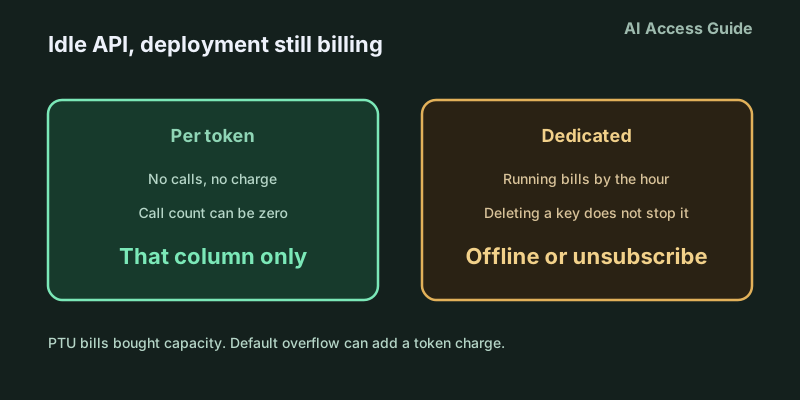
Volcengine Ark splits online inference into three columns on its model service billing page. Postpaid tokens: no calls, no charge. A TPM assurance pack and a model unit: billed for the time you bought, including time with no calls. The first column is prompt_token and completion_token. The other two are whether the reservation is still held and whether the unit was unsubscribed. An export of “model call tokens” will show a live dedicated pool as zero spend.
On Bailian, the bill and stop-billing guide is blunt. Deployment fees follow duration. They start when status becomes running, and they do not depend on API calls. Nobody hitting that model does not matter while the deployment stays running. The training and deployment billing FAQ adds the boundary: deploying, in arrears, or failed does not bill the deployment fee. Running does. A monthly prepaid term starts consuming its term once status is running. A failed deploy and a successful idle deploy are not the same invoice line. Failure is free. Success while idle is not.
This is not the knowledge-base clock. That one bills spec hours, embeddings, and rerank. This one bills inference capacity reserved for a model. Closing the chat, stopping the script, even deleting the key, can leave the capacity clock running.
2. Provisioned throughput bills the capacity you bought
PTU billing says charges start when creation succeeds. Calls inside the reserved capacity do not add a token fee. The capacity fee follows what you bought, not what you used. Low utilization is not a discount. Buying 10,000 TPM and sending a few hundred still bills the 10,000. Auto-renewal is on by default. It charges one day before expiry, with up to four attempts between 08:20 and 20:00 that day. Turn it off before the expiry date, not after the renewal has already landed.
Traffic past the reservation is not a free queue. The default policy is automatic overflow: the extra request drops to that model’s standard token price, the call still succeeds, and it no longer uses the reserved rate. The response carries x-dashscope-ptu-overflow: true. Switch to “reserved capacity only” and the extra request returns 429, with no extra charge. One more edge: under automatic overflow, a single input longer than the model’s max input tokens also flips that call to token pricing. The reservation can be under its cap and the token column can still grow.
Unsubscribe is not a pro-rata refund at list price. Used time of 30 days or less settles at a 1.2 penalty coefficient. Past 30 days the coefficient is 1.0. The longer it has run, the smaller the remainder, and the refund can be zero. The stop path for prepaid PTU is: take the deployment offline, then unsubscribe the instance. Deleting the API key stops surprise token calls. It does not stop the duration or capacity column.
What happens at expiry is not the same sentence on two official pages. The training and deployment page says a prepaid order keeps serving for two hours after expiry, then holds the resource another 14 hours before release. The PTU FAQ says expiry stops and releases immediately, and the dedicated model code is gone and cannot be restored. Do not treat 23:59 on the calendar as the console status. If the code still exists and status is still running, the meter has not stopped. If the code is already dead, a failed call does not prove the duration fee has settled. For postpaid arrears, the deployment billing page says the resource becomes unavailable and stops billing until you pay. That is not Volcengine’s grace window in the next section.
3. Ark starts the clock at a successful order
The model unit overview bills postpaid units for purchased time, down to the second, and a fraction of a second rounds up to one second. Billing continues after purchase. The stop action is unsubscribe on the endpoint detail page, not driving call volume to zero. The documented example runs from 16:00, when the order succeeds, to 18:20:31, when unsubscribe succeeds: 2 hours, 20 minutes, 31 seconds. Zero requests in between still count. Bills are hourly and usually appear one to two hours after the period. The 16:00–17:00 window shows up around 18:00–19:00. An empty current hour is not proof the meter stopped.
Arrears rules changed on 16 July 2025, and they exclude model units and TPM packs. Token services shut off after about a minute overdue, unless a resource pack is still available, in which case they run until that pack is gone. Postpaid hourly model units and TPM packs get an arrears-to-shutdown stage of about two hours, with the exact window in the notice. During those two hours the resource still serves and still bills. If you are done, unsubscribe on the endpoint page. Do not wait for shutdown. Monthly prepaid units take effect on the calendar day of purchase. Expiry is noon on the day after the term’s calendar end, and reclamation is 24 hours after that. The docs’ example: buy at 09:00 on 13 April for one month, expiry is noon on 14 May, reclamation is noon on 15 May. After reclamation you cannot renew. You create a new endpoint. Unsubscribing before expiry applies a penalty coefficient, not a full refund of unused time. Units are bought as an instance group, so renewal and unsubscribe have to be issued together.
Autoscaling does not stop a floor above zero. Creating a model unit says the minimum count cannot be 0 unless smart wake and sleep is on. Scaling to the minimum still bills. Smart wake is an invited preview. With it on, the minimum can be 0, and scaling to zero after idle time stops billing. Waking from 0 to 1 is a cold start of several minutes. A deployment whose minimum is 0 is deleted after seven days with no traffic. Turning the replica count down without that feature does not zero the clock.
4. Three things that look like shutdown are not an unsubscribe
The first is moving traffic away. The token column goes to zero. The duration column does not. Bailian token postpay is a hold plus a monthly settlement: a bill a few minutes after the call is not the same event as the debit early next month, and neither event is the deployment duration fee. Free quota, resource packs, and savings plans sit in the token-deduction order. They do not pay for capacity or time you already bought. During arrears, leftover Bailian free quota still cannot place token calls until the balance is cleared. That does not retire a deployment that is still running, and it does not explain a zero token line next to a rising total.
The second is deleting the API key. The bill page splits the paths. Token postpay: take the deployment offline, or delete the key to block surprise calls. Model-unit or compute-duration postpay: take the deployment offline. Prepaid PTU: offline, then unsubscribe. The key is a lock, not an unsubscribe button. After the key is gone, nobody can steal calls. The unit you bought is still there.
The third is retrying a 429. Under reserved-capacity-only, a 429 is the wall. Retries do not convert the call to token pricing, and they do not stop the capacity clock. Under automatic overflow the call succeeds, and the expensive part is that it already left the reserved rate. A log that stored only HTTP 200 will not show x-dashscope-ptu-overflow. Treating overflow as “still inside the reservation” is how the monthly close shows one line for capacity and another for tokens.
5. Topping up the cloud account does not release the unit
Reconcile four columns. First, deployment or endpoint status: running, healthy, scheduling, offline, or unsubscribed. Second, the billing mode: tokens, PTU, or model unit, and whether overflow is automatic or a 429. Third, expiry, auto-renewal, and reclamation time. Bailian’s two pages do not agree on whether expiry stops immediately, so use the console. Fourth, which arrears rule applies: Volcengine token services shut off after about a minute, while model units and TPM packs keep billing for about two hours; Bailian’s postpaid deployment page says arrears makes the resource unavailable and stops that fee.
Funding the cloud account is a fifth ledger. Moving stablecoins on-chain into assets that can top up Alibaba Cloud or Volcengine happens before that credit lands. It does not change deployment status, and it is not an unsubscribe. When that funding step is what you need, AllSwap is a no-signup, non-custodial swap. A completed swap means the assets moved. A running dedicated deployment still has to be taken offline, and a model unit still has to be unsubscribed.