
Verification Checklist
- ✓Check whose name is on the contract and the invoice — the cloud provider's entity or the model vendor's own entity — against your latest procurement invoice
- ✓Confirm whether a technical issue goes to the cloud platform's ticketing system or a direct line to the model vendor's own support, and what response-time commitments each side gives
- ✓Compare the marketplace price line-by-line against the model vendor's own published rate card to see whether there's a markup or, instead, an exclusive discount
- ✓Check whether the SLA referenced in your contract is the cloud provider's own service-level agreement or a direct pass-through of the model vendor's original SLA — the remedies can differ
- ✓Don't assume "bought through a major cloud platform" automatically equals "same as signing directly with the vendor" — put the above items on your procurement checklist and ask explicitly
1. The pattern: DeepSeek bought through a cloud marketplace may not be billed by DeepSeek
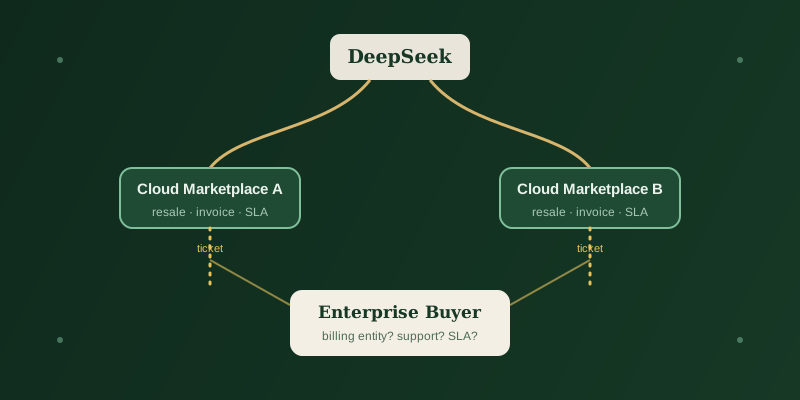
Many companies accessing DeepSeek or Qwen APIs go through a "model marketplace" console — Alibaba Cloud's Model Studio (百炼), or Tencent Cloud's model/API marketplace — log in, pick a model, turn on pay-as-you-go billing, and start calling the API. The experience feels identical to using the cloud provider's own native product, which makes it easy to assume this is an "official" channel by default. But there's a specific fact worth untangling: in many of these marketplaces, the cloud provider is acting as a distributor or reseller, while the model vendor is the actual model provider — two distinct legal entities. That means the entity actually billing you for this API service — the cloud provider's own corporate entity, or the model vendor itself — is something to verify explicitly on the contract and invoice, not something to assume.
2. Billing entity: who invoices you shapes reimbursement and the contract relationship
A different billing entity first affects your reimbursement workflow and which contract relationship actually governs the purchase. If the invoice is issued by the cloud provider, your reimbursement, reconciliation, and tax documentation all carry the cloud provider's corporate name, and the underlying contract relationship — including any disputes, refunds, or renewals — sits with the cloud provider. If the invoice is actually issued by the model vendor (or the marketplace is just a discovery/checkout front end that settles back to the vendor's own account system), the contracting party and the party responsible for after-sales issues are something else entirely. This is exactly where things stall in practice: if procurement didn't confirm the entity up front, finance can end up going back and forth trying to reconcile an invoice that doesn't match the entity they expected, slowing down the whole reimbursement cycle.
3. Support responsibility: cloud platform tickets, or the model vendor's own support?
The second dimension that's easy to overlook is where technical support responsibility actually sits. When an API call misbehaves — an error code, rate limiting, or a response that doesn't match the documented model behavior — does it go through the cloud provider's own ticketing/customer service system, or can you reach the model vendor's own support team directly? The response speed and depth of troubleshooting on these two paths can differ noticeably. A cloud platform's ticketing system typically has its own support staff first determine whether the issue sits with the cloud platform's own request wrapper and network path, or with the model's underlying behavior — and if it's the latter, the cloud provider may then need to relay it to the model vendor, adding a hop that slows down both response time and the back-and-forth needed to actually resolve it. Conversely, if the contract or service description explicitly names a direct channel to the model vendor's own support, model-layer issues tend to get resolved faster. This is worth clarifying before you buy, not discovering after something breaks that there's an extra hop in the way.
4. Pricing: marketplace rates don't automatically match the vendor's own list price
Pricing is the third place people often assume too much. A marketplace channel price may include a markup the cloud provider adds during resale, or it may actually come in lower than the vendor's own list price because the cloud provider negotiated a bulk discount or applies its own savings-plan/resource-package mechanics — both situations exist, so you can't simply assume "marketplace price equals vendor list price" or "marketplace is always pricier / always cheaper." The more practical approach is to line up the per-unit rate shown in the marketplace console against the rate published on the model vendor's own official platform or website before you buy — same model, same input/output token pricing, whether batch-call discounts apply, whether there's tiered pricing or off-peak pricing — rather than going by impression.
5. SLA terms: whose service-level commitment does the contract actually reference
The fourth dimension is the service-level agreement. When a company buys API access, the availability, latency, and remedy commitments named in the contract or service description may reference an SLA the cloud provider wrote itself, or a direct pass-through of the model vendor's own original SLA — and these aren't necessarily the same thing. A cloud provider's own SLA may cover availability at the infrastructure layer (console, gateway, billing system uptime) without necessarily extending the same remedy terms the model vendor's original SLA offers for the model's own response quality or output consistency. Before signing, it's worth getting the counterparty to state in writing exactly which document the SLA references, what triggers a remedy, and what the cap is — rather than a vague line like "per industry standard."
6. What to do before buying: don't default to "major cloud platform = same as direct"
Putting the above together into concrete procurement steps: first, confirm explicitly whether the contracting entity and invoicing entity is the cloud provider or the model vendor; second, confirm the support entry point after something breaks, and each side's stated response-time commitment; third, line up the marketplace price against the model vendor's own published price to check for a markup or an exclusive discount; fourth, confirm exactly which party's SLA the contract references and what the remedy terms are. None of these steps are complicated, but they're easy to skip under the default assumption that "it's bought through a major platform like Aliyun or Tencent Cloud, so it should be fine." The marketplace channel itself isn't inherently unreliable — it just has a few specific contractual differences from a direct vendor deal, and verifying them up front costs far less than chasing accountability after something goes wrong.
7. To be clear: specifics vary by vendor and over time — the signed contract governs
To be clear: this article argues that these procurement decision points are worth verifying, not that any specific cloud provider follows a fixed, universal policy. The actual billing-entity arrangement, whether pricing carries a markup or discount, and the exact SLA text for a given model at a given cloud provider can change as the commercial terms between the cloud provider and the model vendor evolve — different channels and different points in time can produce different answers, and there's no single rule that applies across the board. This article makes no uniform claim about Aliyun's, Tencent Cloud's, or any other specific cloud provider's resale policy. The actual billing entity, pricing, and SLA terms are governed by the contract, invoice, and service description both parties actually sign at the time of purchase.