
Verification Checklist
- ✓Does your production code call a specific dated model snapshot, or the vendor's "latest/general" alias — have you actually confirmed which one
- ✓Do you know the minimum advance notice period your vendor commits to before deprecating a model — this varies by vendor, and even by model type (snapshot vs mainline) within the same vendor
- ✓Are you subscribed to the vendor's model-update announcement channel (in-app message, email, developer group), rather than only discovering a version is retired when calls start failing
- ✓If you chose the "latest" alias instead of pinning a version, have you set up periodic sampling to catch silent shifts in output quality or format
- ✓After receiving a deprecation notice, have you left yourself a real window to run comparison tests and a staged rollout before the cutoff, instead of starting testing in the final days
1. Fast iteration means retiring old model versions is routine, not exceptional
Compared with the relatively slower release cadence of many overseas LLM vendors, platforms like DeepSeek, Qwen, and Doubao ship new flagship or lightweight models much more frequently — often every few months. New releases are typically paired with a scheduled wind-down of older model versions; this isn't an occasional surprise, it's the normal operating rhythm of the domestic LLM industry. For a business integrating one of these APIs, the real question isn't whether a version will eventually be retired — it's whether your systems are ready when it happens. If your integration hardcodes a specific model identifier, such as a dated snapshot version, then every vendor deprecation notice is effectively a mandatory migration task with a fixed deadline.
2. Pinning a version vs. using the "latest" alias are two genuinely different trade-offs
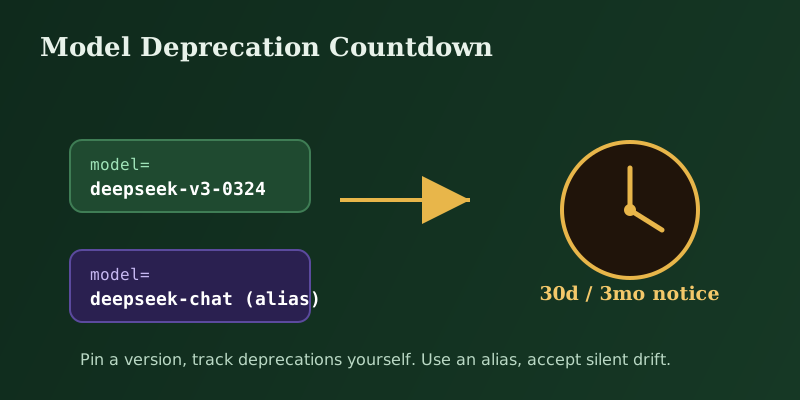
Most domestic LLM APIs offer both calling conventions at once: a fixed identifier that points to one specific version (similar to the dated snapshot models on Alibaba Cloud Model Studio, or the version-suffixed model IDs listed on DeepSeek's own pricing page), and a vendor-maintained "latest" alias (a generic name in your request that the vendor quietly repoints to a newer underlying model without requiring any code change on your end). These represent two genuinely different risk trade-offs. Pinning a specific version keeps model behavior completely stable until you choose to upgrade, but the cost is that you must personally track the vendor's deprecation announcements — miss the cutoff and calls simply start failing. Using the "latest" alias means you never have to think about deprecation, since the vendor's upgrade takes effect automatically, but the cost is that output style, formatting, or capability boundaries can shift with no code change at all — and if your business depends on stable output (structured parsing, fixed downstream formats), that silent drift is itself a risk. Decide deliberately which kind of certainty your business actually needs, rather than defaulting to whichever option is easiest to wire up first.
3. Deprecation notice windows aren't standardized — they vary by vendor, so ask before you integrate
Advance-notice practices for model deprecation differ significantly across vendors, and there's no industry-wide rule. Alibaba Cloud's Model Studio (Bailian) publishes a concrete example: it treats "snapshot models" (dated identifiers) and "mainline models" (a series' core version) differently — snapshot models get a 30-day advance notice before retirement, while mainline models get three months, and the platform also gradually tightens rate limits (QPM/TPM) during the transition instead of cutting access off abruptly. The fact that notice periods differ even within a single vendor's own policy — let alone across different vendors — is exactly why this can't be assumed. Before committing a business dependency to a specific domestic LLM API, ask the vendor directly whether they publicly commit to a minimum deprecation notice period, which accounts the notification channel actually reaches (some notify only accounts with recent call history), and whether there's a rate-limit tightening phase during the transition. None of this has a universal answer — treat each vendor's current official documentation as the source of truth rather than assuming every platform follows the same process.
4. Build an internal model-version watch instead of waiting on vendor emails
Relying passively on a vendor's deprecation email or in-app notice carries a real gap: these channels usually only reach accounts with recent call activity for that specific model, and in a larger organization where API calls are spread across multiple teams or subsystems, it's entirely possible the company receives the notice but it never reaches the engineer who actually maintains that integration. A more reliable approach is to maintain an internal inventory of which model identifier — version or alias — each business module actually calls, which vendor it belongs to, and what that vendor's known deprecation-notice practice is, then periodically (say, monthly) proactively check the vendor's model listing or changelog rather than depending entirely on inbound notifications. For integrations using the "latest" alias, add periodic sampling to compare output against a baseline, since a change to what the alias points to typically doesn't trigger a formal deprecation announcement the way retiring a model outright does.
5. Bottom line: settle the version strategy before integration, not after the deprecation notice lands
Fast iteration and routine retirement of old versions are just how domestic LLM APIs work; the part teams most often skip isn't "will this get deprecated" but the actual decision of whether to pin a version or use an alias in the first place. Pinning a version buys stable behavior at the cost of tracking deprecation notices yourself; using an alias buys convenience at the cost of accepting that behavior can shift silently at any time — neither is free certainty. Asking the vendor about their deprecation notice mechanism and lead time before integrating, then maintaining an internal model-version watch afterward, beats scrambling to test a new model version the moment a deprecation email arrives.