
Verification Checklist
- ✓Before picking a tier, did you roughly total your own monthly word output (Jasper) or workflow runs (Copy.ai), rather than relying on the vendor's "typical user" estimate?
- ✓Have you confirmed whether team-collaboration features (brand-voice library, team workspace) are gated to mid-to-high tiers only?
- ✓Before switching to annual billing, did you run one or two months on the monthly plan to confirm you'll actually use it long-term, given how strict mid-cycle downgrade/refund rules are on annual plans?
- ✓Have you confirmed that discarded regenerated drafts also count against your word or credit allowance, not just the final version you keep?
1. What Jasper AI and Copy.ai actually are
Jasper AI and Copy.ai both sit in the "AI writing assistant" category — tools built specifically for marketing copy, blog drafts, ad variations, and repetitive business writing, rather than general-purpose chat. Jasper leans toward brand-voice consistency and longer-form content workflows, with templates aimed at marketing teams and agencies. Copy.ai leans toward quick-turnaround short copy and workflow automation, chaining prompts together to produce batches of ad headlines or email variants in one pass. Both wrap an underlying language model in templates, brand guidelines, and team collaboration features, and both charge for that wrapper on top of the raw generation cost — which is where their billing starts to diverge.
2. Jasper AI vs Copy.ai: full plan comparison
| Dimension | Jasper AI | Copy.ai |
|---|---|---|
| Billing unit | Subscription tier + monthly word credit allowance | Subscription tier + monthly generation credit allowance |
| Free tier | Short trial period only, no permanent free plan | Limited free plan with a small monthly credit pool |
| Entry paid tier | Creator plan, fixed word allowance per seat | Starter/Pro plan, fixed credit allowance shared across workflows |
| Team tier | Teams/Business plan, pooled word credits across seats | Team plan, pooled generation credits and shared workflow templates |
| Overage handling | Extra word credits sold as add-on packs once allowance is exhausted | Generations slow or lock until the monthly credit cycle refreshes |
| Enterprise/API | Custom enterprise pricing, separate from consumer tiers | Separate API and enterprise plans, billed independently |
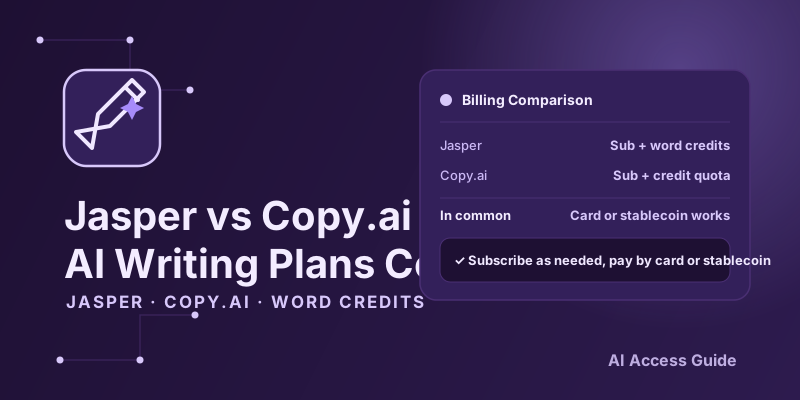
3. How word-credits and generation-credits billing works
The unit each platform meters is the biggest source of confusion. Jasper counts output in words — every piece of generated text draws down a monthly word allowance, so a long blog draft costs proportionally more than a short headline, and the meter runs regardless of how many drafts you regenerate before landing on one you like. Copy.ai counts in generations or credits per action instead — running a workflow, generating a batch of variants, or triggering an automation step each consumes credits at a rate tied to that specific action rather than raw word count, so a workflow that produces ten short ad variants can cost more than one long-form draft. Neither unit maps cleanly onto the other, so a plan that looks "bigger" on paper isn't necessarily more generous for your actual writing pattern.
4. Estimating your real monthly cost
Start from how you actually write, not the marketing page's example numbers. If most of your work is long-form — blog posts, landing pages, full email sequences — Jasper's word-based allowance is easier to reason about: estimate your typical monthly word output across drafts (including regenerations, since those count too) and compare against the plan's allowance with some buffer for revisions. If your work is high-volume, short-form — batches of ad headlines, subject line variants, social captions — Copy.ai's per-generation credits may go further per dollar, but track how many workflow runs you actually trigger in a week, since automation chains can burn credits faster than manual single generations. Run either tool's entry tier for two to three weeks before upgrading; both companies' "typical user" estimates skew toward lighter usage than most professional content workflows.
5. Individual writer vs team/agency use
For a solo writer or freelancer, the entry-level paid tier on either platform is usually enough, and the deciding factor is simply which billing unit matches your typical output — long-form favors Jasper, high-volume short-form favors Copy.ai. For agencies and marketing teams, both platforms offer pooled team plans similar in spirit to the shared-allowance model discussed in our Copilot vs Cursor: Which AI Coding Plan to Pick piece — multiple seats draw from one shared credit pool rather than each seat getting an isolated allowance. The practical risk for a team is the same one that shows up with any pooled resource: one or two heavy users (often whoever's running client work with the most revision cycles) can quietly consume a pool sized for the whole group, so usage needs monitoring per seat even though billing is per pool.
6. Common pitfalls
A few mistakes show up repeatedly with these tools. Underestimating regeneration cost — both platforms meter every generated draft, including the ones you discard, so a workflow that involves a lot of "regenerate and compare" burns through allowance far faster than a single clean draft would suggest. Confusing Jasper's word-based meter with Copy.ai's generation-based meter when switching between them, leading to a plan sized for the wrong unit. Buying a team plan sized for headcount rather than actual combined usage, then hitting monthly limits mid-campaign. And treating brand-voice or template features as included at every tier, when some of the more advanced workflow and collaboration features are gated to higher plans on both platforms.
7. Paying with a virtual card or stablecoins
Jasper AI and Copy.ai both bill overseas the same way most AI subscriptions do — recurring card charges, typically in USD. If you're already using a virtual card or stablecoins to pay for ChatGPT, Midjourney, or a coding assistant, the same setup extends directly to either writing tool; there's no separate payment rail to figure out. If your stablecoin holdings sit on the wrong chain for your card top-up, a cross-chain swap aggregator can bridge them ahead of a renewal date — AllSwap works without registration and is non-custodial: pick your source and destination assets, compare quotes, and complete the swap before the charge is due.
8. Summary
Jasper meters output in words against a monthly allowance; Copy.ai meters output in generation credits tied to specific actions and workflows. Neither company prices a flat "writing subscription" the way it first appears — actual cost depends on whether your work leans long-form or high-volume short-form, and on how much regeneration your process involves. Track your real usage for two to three weeks before picking a tier, and treat team plans as a shared-pool monitoring question rather than a per-seat one. Payment for either still comes down to the same virtual card or stablecoin setup used for any other AI subscription. This is the sixth piece in the "Beyond Chatbots" series — the first five covered how AI services break down by category, coding assistants, image generation, video generation, and AI search engines. AI writing assistants are an expanding category too, with tools like AI presentation and slide-deck generators drawing similar attention; future pieces will likely cover billing for those as they come up.