
Verification Checklist
- ✓Does the receipt or bill show "approximate" language, and does the listed currency match what actually got charged
- ✓Has the currency symbol on the same subscription's bill changed from one month to another
- ✓When a currency option pops up at checkout, is "settle in local currency" pre-checked by default
- ✓If you suspect overcharging, can your issuer pull up both the original transaction currency and the actual settlement currency for comparison
1. What's actually happening here
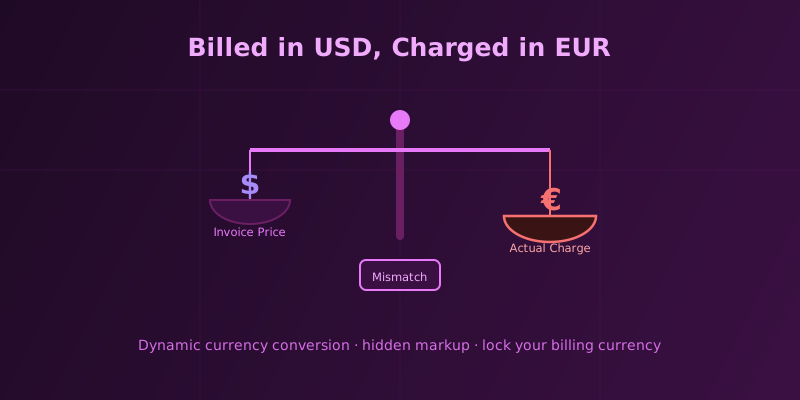
In theory, the currency on your bank statement should match the currency the AI platform priced its subscription in — the platform bills $20, your card gets charged $20, and your issuing bank handles the conversion to your home currency using its own rate. But some payment processors, especially in parts of Europe and Asia-Pacific, insert an extra step: they convert the USD amount into the currency tied to your card's country before sending the final figure to your issuer. That mechanism is called dynamic currency conversion (DCC). It's marketed as a convenience — "see your bill in a currency you recognize" — but the processor adds its own markup during that conversion, typically 3–8% worse than the interbank rate your issuer would have used.
2. Who's making this decision for you: the default-opt-in problem
The easiest part of DCC to miss is that it's rarely something you actively chose. A handful of payment pages show a toggle for "settle in local currency" that's pre-checked by default, and if you don't notice and uncheck it, the charge routes through DCC. More often there's no toggle at all — the system just settles in your card's home currency, and the only clue is a small line on the receipt reading something like "exchange rate: 1 USD = 0.92 EUR," which you don't see until after the charge has gone through. This is a different path entirely from your issuer applying its own official rate on a normal cross-border charge — the processor is the one setting the rate this time, and it's almost always worse than the interbank price, with the gap being the money quietly siphoned off.
3. Where the extra money actually goes
Break down a single charge: say a subscription costs $20. Normally, your issuer converts $20 to your home currency at the day's official rate, with a standard 1–2% conversion fee baked in — that part is basically unavoidable industry practice. But if the charge routes through DCC, the processor first converts $20 into, say, €18.40 using its own rate, and that conversion alone can carry a markup of around 5%. Only then does that €18.40 get sent to your issuer for the actual charge — meaning you didn't skip your issuer's conversion fee (since the statement now shows euros, the issuer assumes no further conversion is needed), you just added an extra DCC markup on top of it. The two markups stack, and the real cost ends up noticeably higher than if the charge had simply stayed in USD. That's also why the same subscription tier sometimes shows a slightly different bill amount month to month — the payment route or whether DCC triggered can change without warning.
4. How to spot the warning signs before it happens again
The clearest signal is language on the confirmation page or receipt email like "approximate amount" next to a currency you didn't expect — the page says "USD 20.00" but the receipt reads "EUR 18.40 (approx. USD 20.00)." That "approx." wording is basically a tell that DCC kicked in. Another signal is the currency symbol on the same subscription's bill changing from one month to the next, which usually means the payment route switched, or your card got re-flagged under a different country during a renewal. Getting in the habit of checking the currency unit every time a charge notification lands catches the issue early, instead of discovering six months later during a statement review that you've been quietly overpaying the whole time.
5. How a virtual card locks the billing currency down
DCC only works because the processor can tell which country your card belongs to and "helpfully" convert accordingly — and a dedicated USD virtual card removes that signal entirely. The card is a USD account settling in USD from the start, so there's nothing for the processor to convert or any reason to. With a US virtual card provider like rdvcc.com, every card is issued as USD-denominated from day one, so no matter where the processor sits, the billing currency stays consistent and "approx." language never shows up on the statement. Issuing a separate card per subscription also means that if a particular platform's processor does trigger DCC somewhere, the impact is contained to that one card and easy to spot when reconciling line by line.
6. Funding with stablecoins: avoid a second conversion outside the bill
If the virtual card itself is a USD account, pay attention to which coin you fund it with too — USDT and USDC are pegged to the dollar and load into a USD card close to 1:1, with no additional conversion layered in. But funding through a non-USD stablecoin or an indirect route adds a second conversion on top of whatever DCC risk already exists at the billing stage. When consolidating stablecoins scattered across chains, a non-custodial service like allswap.io lets you swap directly into USDT or USDC before topping up, with no account required and failed transactions refunded automatically — keeping the entire chain from top-up to charge in a single currency, with no room for DCC or an extra markup to sneak in anywhere.
7. Already overpaid? Can you get it back?
If a statement review turns up months of DCC markups, start by contacting your card issuer to confirm whether the processor triggered a currency conversion on those charges — most banks can show both the original transaction currency and the currency it actually settled in. From there, you can try contacting the AI platform's support team; some will reimburse the difference once it's confirmed, but many will say it's "the bank's or processor's behavior, not something the platform controls" — which is technically accurate, since DCC happens on the acquiring side, outside the platform's own billing settings. Rather than chasing refunds after the fact, switching to a USD-locked virtual card up front removes this markup from the charge path entirely, which is a far more reliable fix than clawing back money already spent.
8. Common mix-ups: what isn't actually DCC
A few situations get mistaken for DCC but are something else. First, a platform that simply prices in your local currency to begin with (EU users seeing euro pricing that was never a USD conversion) — the billed currency matches the listed price, so no conversion markup is involved. Second, your issuer's standard foreign transaction fee, usually labeled clearly as such — that's a flat percentage your bank charges based on your card type, unrelated to DCC's conversion markup, and whether you're charged it depends on whether you hold a no-foreign-fee card. Third, ordinary day-to-day exchange rate fluctuation causing a slightly different bill amount — that's just market movement, not an extra charge. Telling these apart determines whether you need to contact your bank, the platform, or nobody at all.
9. The bottom line: remove the currency choice from the equation entirely
Dynamic currency conversion works because your card leaks a signal — the processor can tell which country it's tied to, and that's the opening it needs to insert its own rate. A dedicated USD virtual card funded with USD-pegged stablecoins closes that opening from the start: the currency chain from the platform's listed price to the final charge never changes, and there's no room for a hidden markup to ride along. This is the fourth piece in the series; more overlooked details in AI subscription payments are coming.