
Verification Checklist
- ✓Open this AI subscription charge in your Wise or Revolut transaction details — does the exchange rate it lists correspond to the date you checked out, or a different date one to three days later
- ✓Compare the same subscription's charge across two or three consecutive months in your local currency — is it a fixed number, or does it drift slightly month to month even though the billed amount and currency haven't changed
- ✓Does the "estimated rate/estimated amount" shown at checkout match the actual amount charged once the transaction shows as completed, and if not, by how much
- ✓Have you checked your card issuer's (Wise, Revolut, or a traditional bank) own official page for how many days settlement typically takes and which stage determines the applied rate, rather than assuming every issuer works the same way
- ✓If this AI subscription renews automatically every month, have you recognized that FX drift is a recurring possibility on every billing cycle, not a one-time thing to check only when you first sign up
1. The symptom: the rate you see at checkout isn't necessarily the rate you pay
When paying for an overseas AI subscription (say, ChatGPT Plus or Claude Pro, priced in USD or EUR) with a Wise or Revolut multi-currency account or card, it's common to glance at the in-app conversion the moment you check out and assume that's the final local-currency amount you'll be charged. In reality, the conversion shown at that instant is just an estimate based on the current real-time rate — the rate that actually determines the final charge may only be locked in days later. That's why some users notice the local-currency amount deducted for the exact same subscription, same billed currency and amount, isn't identical from one month to the next, even though the subscription price itself never changed.
2. The mechanism: authorization and settlement are two different points in time
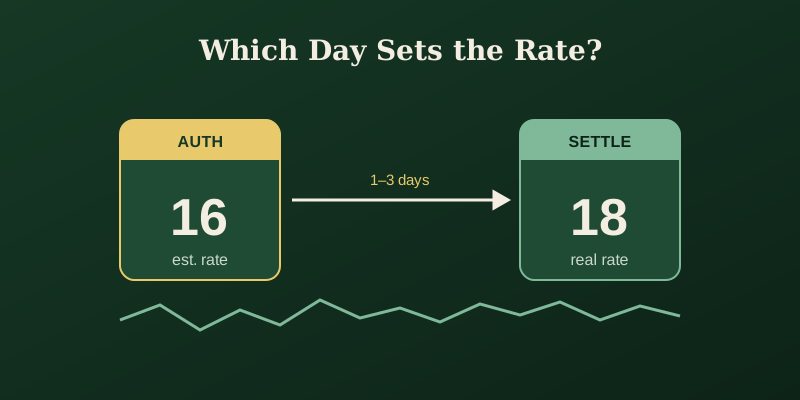
To understand why, it helps to separate two stages in cross-border card payments. Authorization is the moment you check out — the merchant, acquirer, and card network verify in real time that your account has sufficient funds and can complete the purchase, producing an estimated conversion on the spot. Settlement is when funds actually move between institutions and clearing completes — commonly one to three business days after authorization, though the exact number of days varies by card issuer, card network, and account type, with no single fixed figure across the board. In a cross-border, multi-currency transaction, if the FX market moves between these two points, the estimated conversion at authorization and the actual local-currency amount deducted at settlement can differ. This is related to, but distinct from, the "authorization hold vs. settlement amount mismatch" this site has covered before — that case typically involves the same currency throughout, where the hold and settlement amounts themselves differ for reasons like taxes, tips, or gas-station pre-authorization adjustments. Here, even if the merchant-side local-currency amount never changes at all, the final amount deducted in your account's currency can still differ purely because of which date's exchange rate got applied during conversion.
3. Whose rules apply: settlement-date FX usually decides, but check your issuer's own rules
So which date's rate actually applies? According to Visa's and Mastercard's own published explanations of their foreign exchange conversion mechanics, both networks apply the rate based on the processing/settlement date rather than the date you made the purchase — meaning if you swiped your card on a Tuesday but the transaction doesn't clear until Thursday, the rate applied is typically Thursday's, not the one you saw on Tuesday. Newer multi-currency accounts like Wise and Revolut don't necessarily follow the exact same settlement path as a traditional bank card: their own smart-conversion and real-time FX technology can, in many scenarios, lock in a rate and complete the conversion right at the moment of spend. But for certain merchant clearing paths, or when your account temporarily lacks the relevant currency balance and needs an automatic conversion, exactly which point in time determines the applied rate still depends on that provider's own official help pages and what your actual transaction details show — the rules and settlement speed genuinely differ across providers and transaction types, and shouldn't be assumed to be uniform.
4. How much this matters: usually small per transaction, but recurring for subscriptions
For a single transaction, the FX drift over a one-to-three-day gap between authorization and settlement is usually modest, barring a period of unusually sharp market volatility. What makes an AI subscription different is that it isn't a one-time purchase — it renews automatically every month (or more often), which means the authorization-vs-settlement rate mismatch isn't something that "happens once and is done." It can recur every single billing cycle. Over a long subscription, even if the billed price in the original currency never rises, the total local-currency cost you actually pay can accumulate a degree of uncertainty from these small monthly swings — a different order of magnitude than "a few cents extra" on a single purchase, and worth paying attention to for anyone on a long-running subscription.
5. What you can actually do: check the transaction date, don't trust the checkout estimate alone
A practical approach: don't treat the conversion shown at checkout as the final locked-in number. Once the transaction status changes to "completed/posted," check the transaction details for which date's rate was actually applied and how far it deviated from the earlier estimate. If you notice the local-currency charge shifting slightly month to month, don't immediately assume a billing error or a stealth price increase — first cross-check against that month's transaction date to confirm it's a normal FX settlement timing difference. If the discrepancy is clearly larger than a routine FX move, then it's worth contacting your card issuer's support to confirm their settlement rules and the exact basis for the charge.
6. Takeaway: multi-currency accounts cut fees, not FX volatility itself
The core advantage of Wise, Revolut, and similar multi-currency accounts is avoiding the obvious markups and extra fees of traditional bank dynamic currency conversion (DCC) — but they neither can, nor claim to, eliminate FX volatility itself. As long as there's a time gap between authorization and settlement, the final applied rate can end up different from the estimate you saw at checkout. Exactly which stage determines the rate, and how many days settlement typically takes, varies by card issuer, card network, and account type — there's no single site-wide fixed answer, so check your own provider's official documentation and your actual transaction details. For a recurring AI subscription charged automatically every month, this isn't a one-time event but a recurring feature of the mechanism itself — understanding it up front is more useful than second-guessing any single month's charge after the fact.