
Verification Checklist
- ✓Before filing a dispute, have you contacted platform support via ticket/email and kept a record of that exchange
- ✓Is the charge date still within your card issuer's 60-120 day dispute window
- ✓Do you have all four evidence categories ready: transaction record, communication history, supporting proof (trial/cancellation screenshots), and a written statement
- ✓Can you confirm the platform's terms don't already show a clear record of you agreeing to auto-renewal, which would weaken the dispute
1. First, tell the difference: a billing error vs. a missed cancellation
The step people skip most often is figuring out which situation they're actually in. AI subscription disputes generally fall into two buckets: the platform genuinely made a mistake — charging a full month before a free trial ended, continuing to bill after cancellation, or double-charging the same period — or you simply forgot to cancel before the renewal date and only noticed once the charge posted. The second case isn't a billing error, it's a change of mind, and card issuers know the difference. If the platform can produce a record of you agreeing to auto-renewal terms, a dispute filed on shaky grounds is likely to be denied, and that denial stays on your dispute history, making future claims harder to win. Getting this distinction right up front keeps you from escalating something that should be a support conversation into a chargeback you're unlikely to win.
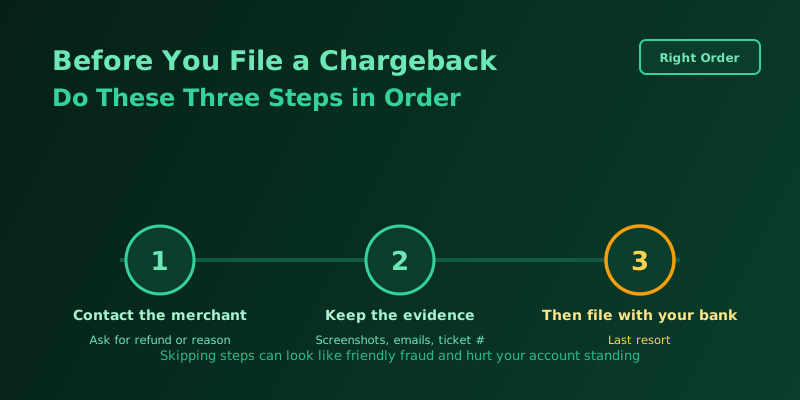
2. Step one: contact support before anything else
Even with a solid case, filing a chargeback shouldn't be the first move. Nearly every AI subscription platform's terms require you to attempt resolution with the merchant before disputing with your bank, and skipping that step has two real consequences: the platform may flag your account as high-risk — meaning even a successful chargeback can come with an account suspension that wipes out your subscription history and generated content — and card issuers weigh "did the cardholder contact the merchant first" when evaluating dispute evidence, which lowers your odds of winning if you didn't. The right order is to open a support ticket or send an email describing the unrecognized charge and requesting a refund, and to keep a record of when you sent it and what it said. Whether or not support actually resolves it, that record becomes the single most persuasive piece of evidence if you do end up filing a dispute later.
3. Step two: gather evidence as it happens, not when asked
Evidence should be collected the moment something looks wrong, not dug up after your bank has already opened a case and is asking for documentation. Useful evidence includes: a screenshot of the charge as it appears on your card or virtual card statement, your account's subscription status or cancellation timestamp, the support ticket number and message history, and anything proving the service wasn't used or the trial hadn't ended (an account dashboard showing "never logged in" works well). Keep everything in one dated folder, because chargebacks have hard deadlines — most issuers require disputes to be filed within 60–120 days of the charge, and no amount of evidence helps once that window closes. Building the habit of screenshotting a questionable charge right away beats trying to reconstruct the timeline later.
4. Step three: decide whether the chargeback is actually worth it
A chargeback isn't free. A successful one leaves a mark on your relationship with the issuing bank, and if the same card racks up multiple disputes in a short window, the bank may reassess its risk level and lower the limit or close it outright. On the merchant side, a chargeback usually comes with a dispute fee passed on to the platform, and some smaller AI tools respond by permanently blacklisting the account that filed it — no coming back even if you want to resubscribe later. So before submitting, it's worth weighing the alternative: for small amounts where the platform seems willing to talk, an in-app refund request is usually faster and doesn't burn the relationship. A formal dispute is the better path only once the platform has clearly refused to help, or you simply can't reach anyone.
5. What your bank actually wants in the dispute file
Turning scattered evidence into something a bank will accept usually comes down to four pieces: the transaction record (amount, date, merchant name), your communication history with the merchant (ticket numbers, what was said, whether they replied), supporting proof the charge was unjustified (trial screenshots, cancellation confirmation, duplicate-charge comparison), and a short written statement of what happened and what you're asking for. The more specific and chronological the file, the faster it usually clears review; a one-line "I don't recognize this charge" with nothing attached is far more likely to bounce back asking for more, or get rejected outright. Organizing these four categories in advance turns a dispute that could drag on for weeks into something that clears on the first submission.
6. Where a virtual card helps: contain the blast radius to one card
If every AI subscription runs through the same primary card, a dispute on one platform can spill over onto everything else on that card — a risk flag from the bank or a temporary freeze during investigation can also interrupt renewals for subscriptions that had nothing to do with the dispute. Binding each platform to its own virtual card avoids that. With a US virtual card provider like rdvcc.com, you can issue a separate card per subscription, so if a dispute comes up, only that one card gets frozen or closed while everything else keeps renewing normally. The per-card transaction history is also clean and easy to export on its own, which means pulling together the evidence file in step 5 is a matter of exporting one card's statement instead of hunting through a mixed bill for the relevant lines.
7. Funding with stablecoins: limit exposure before a dispute even starts
Topping up a virtual card with stablecoins has a side benefit here: funding in small, as-needed amounts means the balance sitting on any given card is naturally low, so even if a dispute freezes a card mid-review, only a small amount is locked up — unlike a card preloaded with a year's worth of subscription fees. When consolidating USDT or USDC scattered across chains, a non-custodial service like allswap.io lets you convert into whatever you need without creating an account, with failed transactions refunded automatically — no added layer of third-party custody risk on top of the dispute itself. Pairing small, frequent top-ups with one-card-per-platform habits keeps the blast radius of a dispute small from the start, rather than something you're managing after the fact.
8. Common mistakes: situations where a chargeback isn't the answer
A few scenarios get mistaken for chargeback-worthy problems when a different path fits better. A subscription raising its price and you not noticing until the bill arrived is a pricing change, not fraud — a dispute is unlikely to succeed, and the right move is contacting support to confirm whether the price change was properly disclosed and asking about a downgrade. Miscalculating your own free trial end date usually isn't the platform's fault either, as long as the cancellation terms were disclosed in the service agreement. And simply deciding a subscription "isn't worth it anymore" after using it for a while is a change of mind, not a billing error — it doesn't qualify. Separating these from genuine billing mistakes keeps you from filing disputes likely to be denied, which also protects your standing for the next dispute that's actually justified.
9. The bottom line: a chargeback is the last step, not the first
The core logic for handling an AI subscription billing dispute stays the same throughout: confirm the charge is actually wrong, contact support and keep a paper trail, escalate to a formal dispute only if that goes nowhere, and use a separate virtual card per platform so the fallout of any one dispute stays contained. It looks like extra steps, but it's really insurance for both the dispute's success rate and your account's survival — skipping straight to a chargeback might feel faster, but it's the path most likely to end in a frozen account, a rejected claim, and a harder time the next time something actually goes wrong. This is the third piece in the series; more overlooked details in AI subscription payments are coming.