
Verification Checklist
- ✓How many Pro searches does your Perplexity account settings page show remaining today — is it close to or already at the daily cap
- ✓Does the credit balance shown in your You.com account match what the official pricing page states for your tier
- ✓How often are you actually seeing a "fell back to standard mode" prompt — frequent enough to justify upgrading (track it for 1-2 weeks first)
- ✓For a shared team account, is anyone tracking the pool's burn rate across the month, so you're not blindsided by an empty pool at month-end
1. AI search engines bill differently from chatbots
Perplexity and You.com both sit in a category sometimes called "answer engines" — they run a live web search, then summarize results with citations instead of answering purely from a trained model. That extra step changes the cost structure. A single query can trigger multiple retrieval calls plus a model generation pass, so the platform's cost per query is higher and more variable than a plain chatbot reply. Both companies handle that the same general way chatbot vendors do — a base subscription with a usage allowance, and either throttling or paid top-ups once you're past it — but the units they count, and what counts as a "heavy" query, differ enough to matter.
2. Perplexity vs You.com: full billing comparison
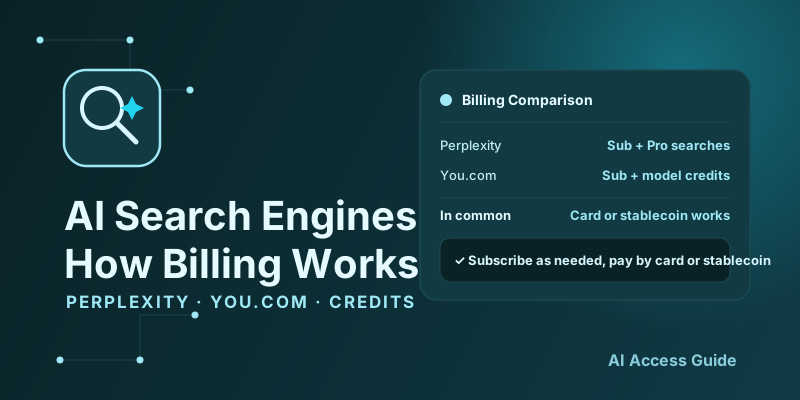
| Dimension | Perplexity | You.com |
|---|---|---|
| Billing unit | Subscription tier + daily/monthly Pro search allowance | Subscription tier + monthly credits across chat and search modes |
| Free tier | Unlimited basic search, limited advanced ("Pro") searches per day | Limited daily searches and credits, fewer model choices |
| Paid tier | Pro plan, much larger Pro search allowance plus premium model access | Pro/Team plan, larger monthly credit pool shared across features |
| Model choice | Lets you pick the underlying model per query on paid tiers | Bundles multiple models behind one credit pool, model switch included |
| Overage handling | Advanced searches throttle or fall back to standard mode once exhausted | Features slow down or lock until credits refresh next cycle |
| Team/API | Separate API pricing, billed per request, independent of the consumer plan | Separate enterprise/team plans with pooled seats |
3. What actually counts as a "search" varies
The single biggest confusion with these tools isn't the price — it's what triggers a metered unit. Perplexity separates "basic" search (cheaper, faster, less thorough) from "Pro" search (deeper retrieval, choice of underlying model, higher cost to the platform), and only Pro search draws down your allowance in any meaningful way; casual lookups mostly don't. You.com pools chat and search together into one credit balance, so a complex multi-step research question and a quick fact check draw from the same pot at different rates. Before assuming either plan is "enough," check whether your typical usage leans toward quick lookups or toward the deeper, multi-source research queries that burn allowance fastest.
4. How to estimate what you'll actually pay
Start from your actual query pattern, not the marketing page. Track roughly how many deep/advanced searches you run in a typical week — not total searches, since simple ones barely register on either platform's meter. If that number is in the single digits, the free tier on either service may genuinely be enough. If you're running research-heavy sessions daily, comparing sources across a dozen queries per topic, the paid tier's larger allowance usually pays for itself once you'd otherwise be throttled or bounced to a weaker model. Run the free tier for a week first and note how often you hit a limit before deciding to upgrade — it's a more reliable signal than either company's suggested "typical user" profile.
5. Which tier fits an individual vs a team
For individual use, the calculus is simple: pick whichever plan matches your actual query intensity from section 4, and don't buy the top tier speculatively — model access and search depth on the mid tier of either service already covers most day-to-day research. For teams, neither Perplexity nor You.com bills strictly per seat in the way a per-user SaaS tool might; both offer team plans with pooled credits or allowances that multiple members draw from, similar to the account-sharing model discussed in our Copilot vs Cursor: Which AI Coding Plan to Pick piece. The practical question for a team is less "how many licenses" and more "how much combined query volume across the group," since a handful of heavy researchers can exhaust a shared pool that would comfortably serve a dozen light users.
6. Paying with a virtual card or stablecoins
Perplexity and You.com both bill overseas the same way most AI subscriptions do — recurring card charges, typically in USD. If you're already using a virtual card or stablecoins to pay for ChatGPT, Midjourney, or a coding assistant, the same setup extends directly to either search tool; there's no separate payment rail to figure out. If your stablecoin holdings sit on the wrong chain for your card top-up, a cross-chain swap aggregator can bridge them ahead of a renewal date — AllSwap works without registration and is non-custodial: pick your source and destination assets, compare quotes, and complete the swap before the charge is due.
7. Common pitfalls
A few mistakes come up often enough to flag directly. Assuming "search" means the same thing on both platforms — it doesn't, and a heavy You.com user who switches to Perplexity without checking Pro-search limits can burn through a daily allowance in minutes. Paying for the top tier "just in case" without tracking actual weekly usage first, when the mid tier would have covered it. Forgetting that separate API access (for building your own tool on top of either engine) is billed completely differently from the consumer subscription — the two are easy to conflate when reading pricing pages that list both on one screen. And letting a team plan's shared credit pool go unmonitored, so one or two heavy users quietly consume what was meant to serve the whole group.
8. Summary
Perplexity meters advanced, model-selectable "Pro" searches against a daily/monthly allowance; You.com pools chat and search into one shared credit balance. Neither is priced as a flat "search subscription" in the way it first appears — actual cost depends on how much deep research you run versus quick lookups. Track your real usage for a week before picking a tier, and treat team plans as a shared-pool question rather than a per-seat one. Payment for either still comes down to the same virtual card or stablecoin setup used for any other AI subscription. This is the fifth piece in the "Beyond Chatbots" series; future pieces will keep covering billing and payment details for other emerging categories of AI tools as they come up.