
Verification Checklist
- ✓Before converting a large batch, did you test a short passage first to check ElevenLabs' actual character cost, rather than estimating off an English word count?
- ✓Have you confirmed whether your tier unlocks voice cloning and whether you can upload your own voice to clone?
- ✓Before a commercial project, did you check the commercial-licensing terms for your specific ElevenLabs/Suno tier?
- ✓Do you know Suno's unused monthly credits don't roll over, and is your tier sized to your actual monthly output?
1. AI voice and music generation bill on completely different units
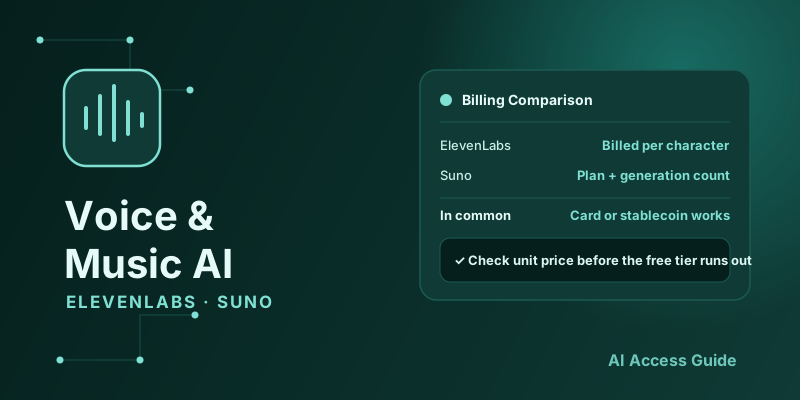
ElevenLabs bills on "character count" — however much text you convert to speech is what you draw down, largely independent of the resulting audio's length or how complex the voice is; it mainly comes down to text length. Suno works closer to Midjourney's model: a subscription plan includes a set number of generations (credits), each song generation draws down a fixed number of credits, and once you run out you either wait for the next cycle or buy more. These two billing models require completely different usage estimates: for ElevenLabs, work out how much text you'll convert before subscribing; for Suno, figure out roughly how many songs you'll generate per month.
2. ElevenLabs vs Suno: full billing comparison
| Dimension | ElevenLabs | Suno |
|---|---|---|
| Billing unit | Character count (text length converted to speech) | Subscription plan + generation count (credits) |
| Entry tier | Starter, fixed character allowance/month | Base subscription, monthly generation count |
| Higher tier | Creator/Pro, larger character allowance + voice cloning access | Premium subscription, more generations + commercial license |
| Overage handling | Buy more or upgrade once characters run out | Wait for next cycle or buy extra once generations run out |
| Typical use | Voiceovers, audiobooks, podcasts, voice cloning | Background music, short-video scoring, full song generation |
3. Voice cloning and commercial licensing are ElevenLabs' extra gate
ElevenLabs' voice cloning feature (training a custom voice model from a recording) is usually gated to mid-to-high tiers, and different tiers carry explicit limits on how many cloned voices you can create and how far the commercial license extends — free or entry tiers often only let you use the platform's stock voices, not upload your own for cloning. If your use case is "generate voiceovers at scale in my own voice," confirm the voice-cloning permissions and commercial terms before picking a tier, rather than discovering the feature is locked to a higher tier after paying.
4. Which tier fits an individual creator
If you only generate a handful of voiceover clips occasionally for video narration, ElevenLabs' entry tier is usually enough. If you're doing ongoing podcast or audiobook work — long-form text-to-speech — characters burn through faster than expected, so estimate the actual character count from one episode before working out the tier you need. On Suno's side, occasional background music is fine on the base subscription; if you're consistently producing short-video scoring or music content, a higher generation allowance avoids repeatedly hitting "used up for the month."
5. Paying with stablecoin or a virtual card
ElevenLabs and Suno bill the same way other overseas AI services do — through a card or whatever other channel the platform supports. If you're already paying for ChatGPT or Midjourney with a virtual card or stablecoins, the same setup carries over directly to voice and music generation tools; no separate payment channel needed. If your stablecoins sit on the wrong chain, a cross-chain swap aggregator can bridge them ahead of time — AllSwap works without registration and is non-custodial: pick your source and destination assets, compare quotes, and complete the swap before your renewal date.
6. Common pitfalls
A few issues come up often enough to plan for: ElevenLabs' character billing doesn't distinguish between languages, so the actual cost of converting non-English text doesn't map cleanly onto a per-word estimate — test a short passage first to check the real unit cost before converting a large batch. Suno's generation credits don't roll over month to month and reset unused, so matching your subscription to actual need beats stockpiling. Commercial licensing terms — especially around voice cloning and the copyright scope of generated music — vary by tier, so check the official terms carefully before using either for a commercial project to avoid infringement risk.
7. Summary
ElevenLabs bills by character count, Suno runs a subscription-plus-generations model — neither is a simple flat fee, so estimating actual usage before picking a tier beats buying the top tier upfront. Extra gates like voice cloning and commercial licensing are worth confirming before you pay. Payment still comes down to the same virtual card or stablecoin setup as any other subscription. This is the latest in our ongoing coverage of emerging AI service billing; more tools worth paying for will follow.