
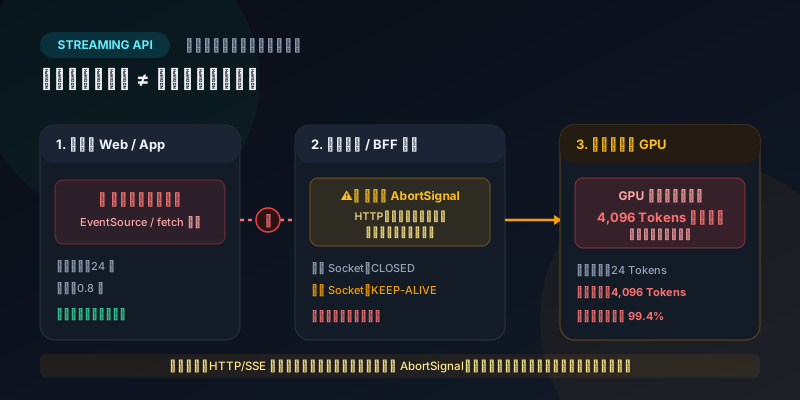
1. The Streaming Illusion: Client Disconnect Is Not Upstream Abort
To provide responsive, typewriter-like user experiences, modern AI web applications rely heavily on Server-Sent Events (SSE) or WebSockets for streaming text outputs. However, an architectural misunderstanding frequently catches engineering teams off guard: developers often assume that when an end-user navigates away, closes their browser tab, or clicks "Stop Generating", the ongoing LLM inference halts immediately.
In real-world cloud architectures, the client communicates with an intermediate Backend-for-Frontend (BFF) proxy or API gateway. When the client terminates its TCP socket, this event does not automatically notify the upstream LLM provider (such as OpenAI, Anthropic, or DeepSeek). Unless the backend server actively detects socket termination and propagates an abort signal upstream, the provider's GPU cluster continues generating tokens until reaching max_tokens or an end-of-sequence token, resulting in full completion charges.
2. The Four-Tier Ghost Billing Mechanism
LLM providers charge based on compute allocated and tokens generated: as long as GPU cores execute autoregressive decoding, token costs accrue regardless of whether those bytes ever render on a user's screen. Ghost billing typically operates across four stages:
- Tier 1: Client-Side Severance. A user queries a 4,000-word essay but clicks "Stop" after 1 second (viewing only 20 words). The browser's
AbortControllercloses the local fetch connection cleanly. - Tier 2: Intermediate Buffer Blindspot. Web servers with output buffering retain the upstream streaming iterator in memory, discarding outgoing chunks without closing the upstream request.
- Tier 3: Orphan Coroutine Execution. Asynchronous tasks (such as Python
async for chunk in response) continue iterating silently until the upstream completion ends. - Tier 4: Full Invoice Settlement. In the provider's billing dashboard, the request records
4,096 completion_tokens, creating an avoidable waste ratio of over 99.5%.
3. Amplification Under Reasoning Models
With the rise of reasoning models (such as DeepSeek-R1, OpenAI o1, and o3-mini), this billing trap has magnified substantially. Reasoning models conduct dozens of seconds of hidden chain-of-thought calculation before emitting user-facing text.
Because reasoning tokens carry premium pricing, an unhandled user timeout or tab closure during the thinking phase allows thousands of high-cost hidden tokens to generate completely unmonitored. Under high user concurrency or automated scrapers, unmitigated ghost streaming can deplete monthly API quotas within hours.
4. Production-Grade Cascade Abort Patterns
The solution lies in implementing cascade abort propagation, where client disconnections instantly trigger an abort signal to the upstream provider:
| Layer | Default (Vulnerable to Ghost Billing) | Cascade Abort Configured (Zero Waste) |
|---|---|---|
| Client | Drops DOM connection silently | Triggers AbortController.abort() |
| Nginx | proxy_ignore_client_abort on |
proxy_ignore_client_abort off |
| BFF Backend | Continues unobserved await stream loop |
Binds req.on('close') / is_disconnected() |
| Upstream SDK | No signal passed | Passes signal: controller.signal |
| Provider Bill | Full max_tokens billed |
Billed only for elapsed milliseconds |
Node.js Implementation Snippet
const controller = new AbortController();

req.on('close', () => {
  if (!res.writableEnded) {
    // Terminate upstream connection immediately
    controller.abort();
  }
});

const stream = await openai.chat.completions.create({
  model: 'gpt-4o',
  messages: [{ role: 'user', content: prompt }],
  stream: true,
}, { signal: controller.signal });
5. Compute Budgeting and Capital Settlement Defenses
In addition to runtime signal propagation, resilient engineering teams establish multi-layered financial safeguards:
First, configure hard spending limits and usage alarms inside each provider console. Second, for globally distributed teams managing multi-cloud models, funding developer accounts across multiple overseas vendors often entails foreign transaction fees and payment card declines.
To optimize treasury workflows, many development teams utilize decentralized non-custodial tools such as AllSwap for flexible cross-chain capital allocation. AllSwap is an instant, non-custodial cross-chain payment and token exchange protocol enabling low-slippage swaps between USDT, USDC, and major crypto assets across networks including Arbitrum, Base, Optimism, Solana, and Ethereum. By interacting directly through verified smart contracts without account custody risks or centralized wait times, engineering teams can fund global compute card slots and developer billing reserves smoothly, insulating primary corporate treasuries against sudden API quota runaways.
6. Frequently Asked Questions (FAQ)
Q1: I configured AbortController, why do I still see a few billed tokens?
A: Network round-trip time (RTT) means the abort packet requires tens of milliseconds to reach the provider's inference cluster. Tokens generated during that brief physical transit (typically 10-50 tokens) are expected, but this prevents 98%+ of remaining token generation.
Q2: Can setting a small max_tokens replace abort handling?
A: No. A restrictive max_tokens truncates legitimate responses. Abort signaling dynamically cuts inference only when clients disconnect, preserving full capacity for completed requests.