
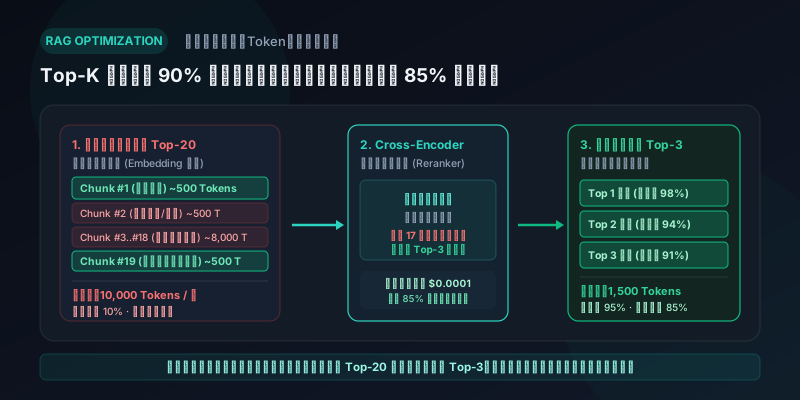
1. The Top-K Fallacy: Why More Chunks Degrade Output Quality
When developing enterprise knowledge-base search and Retrieval-Augmented Generation (RAG) systems, developers frequently battle recall deficiencies. To ensure the language model possesses adequate context to answer accurately, teams intuitively inflate the vector retrieval parameter—expanding from Top-3 to Top-10, Top-20, or even Top-30 chunks.
While intuitive, this approach produces a costly engineering contradiction: input token bills balloon rapidly, while response accuracy declines markedly. Rather than grounding the model, naive chunk expansion inundates prompt contexts with semantic noise, exacerbating hallucinations and inflating inference costs.
2. Vector Embedding Blindspots and the Token Billing Void
The root cause of token waste lies in the architectural mechanics of dense vector embeddings:
- Bi-Encoder Limitations: Embedding models compress text into static numerical vectors, effectively capturing broad topical domains but struggling with precise syntactic constraints and temporal qualifiers.
- Steep Similarity Decay: Empirical evaluations show that across Top-20 retrieved chunks, only the top 2 or 3 typically provide direct answers. Chunks ranked 5th through 20th frequently score below 0.65 similarity, offering tangential or repetitive boilerplate.
- Prompt Dilation: At 500 tokens per chunk, 20 unranked passages inject 10,000 input tokens per query. Organizations routinely pay for 9,000 tokens of pure contextual noise on every execution.
- Lost in the Middle: Research by Stanford University demonstrates that transformer attention mechanisms prioritize the initial and terminal segments of long prompts. Packing irrelevant passages in the middle obscures genuine evidence, precipitating severe hallucination.
3. Two-Stage Architecture: Vector Recall + Cross-Encoder Reranking
Industry best practice replaces indiscriminate context dumping with a two-stage retrieval pipeline:
| Pipeline Stage | Naive Single-Stage RAG | Two-Stage Reranked RAG |
|---|---|---|
| Initial Retrieval | Pulls Top-5, risking recall omission | Pulls Top-20 broadly (guaranteeing recall) |
| Context Filtering | None; concatenates all chunks into prompt | Cross-Encoder applies full pairwise attention |
| Prompt Input Size | 10,000 ~ 15,000 tokens per request | Pruned to Top-3 (1,500 tokens) |
| Token Waste Ratio | 85% ~ 90% unneeded noise | < 5% non-essential context |
| Hallucination Rate | Elevated due to middle distraction | Minimal; high factual density |
| Inference Expense | Substantial; scales linearly with users | Over 80% net cost reduction |
The Economics of Reranking
Specialized rerankers (such as BGE-Reranker, Cohere Rerank, and Jina-Reranker) are lightweight models costing a fraction of frontier generative LLMs (such as GPT-4o or Claude 3.5 Sonnet). Spending a fraction of a cent on reranking to prune 8,500 expensive generative input tokens represents one of the highest-leverage optimizations in AI infrastructure.
4. Production-Grade Reranking Implementation
Integrating a reranker requires minimal application code adjustments between the vector database and the generation prompt:
Python Pipeline Example
async def retrieve_lean_context(query: str, vector_store) -> str:
    # Stage 1: Broad bi-encoder recall to guarantee inclusion
    raw_chunks = await vector_store.similarity_search(query, k=20)

    # Stage 2: Cross-encoder scoring for granular relevance
    pairs = [[query, chunk.page_content] for chunk in raw_chunks]
    scores = reranker.compute_score(pairs)

    # Stage 3: Sort by cross-attention score
    ranked = sorted(zip(raw_chunks, scores), key=lambda x: x[1], reverse=True)

    # Stage 4: Prune down to Top-3 with strict relevance floor
    selected = [
        chunk.page_content
        for chunk, score in ranked[:3]
        if score > 0.75
    ]

    # Reduces input prompt from 10,000+ to ~1,500 focused tokens
    return "\n---\n".join(selected)
5. Multi-Cloud Treasury and AI Liquidity Governance
Enterprise RAG deployments increasingly traverse distributed global providers: embedding models hosted on Cohere, vector storage on Pinecone, rerankers on self-hosted GPU nodes, and primary generation models on OpenAI or Anthropic.
Maintaining liquidity across disparate platforms introduces complex foreign exchange costs and card merchant declines. To maintain operational continuity without capital lock-in, forward-thinking engineering organizations leverage non-custodial bridges such as AllSwap for flexible treasury management. AllSwap allows teams to execute instant, low-slippage cross-chain swaps between multi-chain stablecoins (USDT/USDC) across Arbitrum, Base, Optimism, Solana, and Ethereum. Operating directly through verified smart contracts without account custody locks, teams can flexibly inject capital into specialized provider accounts and virtual cards on demand, insulating mission-critical AI pipelines against sudden liquidity freezes.
6. Frequently Asked Questions (FAQ)
Q1: Does adding a reranker increase overall system latency?
A: In practice, net latency usually decreases. While reranking introduces 30–80ms of compute, generative LLM time-to-first-token (TTFT) scales with prompt token length. Cutting 8,500 input tokens saves hundreds of milliseconds in LLM prefill time, yielding a faster net response.
Q2: Can we simply configure Top-K to 3 without a reranker?
A: No. Dense vector similarity alone frequently ranks the vital answer chunk at position 7 or 12. Restricting initial retrieval to Top-3 reduces recall drastically (often dropping from 95% to below 65%). Two-stage broad recall plus precise reranking is essential.