
Verification Checklist
- ✓Confirm your current account tier. Standard prepaid token packages do not automatically elevate base QPS, RPM, or TPM thresholds.
- ✓Differentiate QPS from TPM bottlenecks. Submitting 10 parallel requests with 100k input context triggers TPM limits despite modest request frequency.
- ✓Inspect response headers for
retry-after,x-ratelimit-remaining-tokens, andx-ratelimit-reset-requests. - ✓Implement client-side token bucket or leaky bucket rate limiting before outbound API dispatch to prevent burst starvation.
- ✓Evaluate dedicated throughput instances (PTUs or dedicated model instances) for business scenarios requiring guaranteed SLA concurrency.
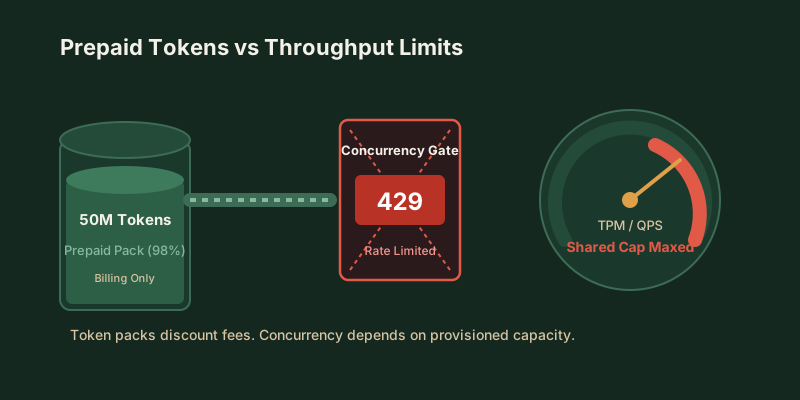
1. Prepaid token packs are billing vouchers, not dedicated compute
A widespread misconception among developers is that purchasing a 100-million token resource pack is equivalent to reserving a slice of dedicated GPU hardware. In reality, modern cloud AI architectures strictly separate the billing ledger from the inference routing layer.
When an API request arrives at the inference gateway, the billing layer checks your account balance or active token packages to verify solvency. Once approved, the gateway routes the request into a massive, multi-tenant compute pool. At this execution layer, the scheduler has zero awareness of whether your tokens were prepaid at a discount or billed on-demand: every tenant in the shared pool shares the exact same cluster compute and queue priority.
In essence, a token pack is a pre-funded discount voucher. It prevents credit balance exhaustion, but it does not buy an express lane or dedicated GPU memory on the provider's physical servers.
2. The three concurrency dimensions: QPS, RPM, and TPM
When an application receives an HTTP 429 response, it is rarely due to generic account exhaustion. Rather, it indicates a breach of one of three distinct throttling dimensions enforced by API gateways:
- QPS / RPS (Queries / Requests Per Second): A strict instantaneous rate limiter designed to shield API gateways and reverse proxies from microbursts. A single parallel batch of 50 asynchronous requests will instantly blow through a 10 QPS cap.
- RPM (Requests Per Minute): A rolling 60-second window monitoring sustained request frequency. While QPS prevents instant shocks, RPM limits long-duration request volume.
- TPM (Tokens Per Minute): The most subtle yet frequent cause of production 429 errors. TPM measures the sum of input and output tokens processed across all requests over a 60-second window. In agent workflows or retrieval-augmented generation (RAG) where single prompts carry 30,000 to 50,000 context tokens, just 3 concurrent requests can consume 150,000 tokens in seconds, blowing past standard TPM caps even when QPS remains well under 2.
Understanding which specific dimension triggered the throttling—by parsing gateway headers—is critical for tuning client concurrency parameters.
3. Shared multi-tenant pools vs. dedicated throughput reservations
Why do cloud providers decouple prepaid vouchers from concurrency guarantees? The underlying reason is hardware scarcity. Large-scale transformer inference requires contiguous clusters of high-bandwidth memory (HBM) GPUs (such as H100, H200, or domestic ascend accelerators).
In the default shared pool, providers practice statistical oversubscription: they assume that tenants will generate intermittent bursts rather than sustained 100% capacity utilization. This allows them to offer low pay-as-you-go pricing. If a single customer suddenly fires hundreds of parallel workers, the gateway immediately rejects excess calls to protect neighbors sharing the same physical GPU nodes.
When an enterprise requires guaranteed low-latency throughput with zero 429 errors under heavy load, the architectural answer is not buying more token packs, but provisioning Dedicated Capacity (such as Azure PTUs, Bedrock Provisioned Throughput, or dedicated private inference endpoints). Dedicated instances lease physical compute reservations billed hourly or monthly, guaranteeing exclusive memory and compute regardless of broader platform demand.
4. Production engineering: Smooth backoff, queues, and client-side pacing
For engineering teams operating within shared API pools, eliminating 429 errors requires proactive architectural defenses within the client application stack:
- Client-Side Rate Limiting: Deploy an in-process or distributed Token Bucket (via Redis) at your application gateway. Ensure client dispatch rates never exceed 80% of your provider's advertised QPS and TPM ceilings.
- Exponential Backoff with Jitter: Never retry immediately upon receiving a 429 error. Immediate retries cause catastrophic retry storms that prolong cluster lockouts. Always read the
retry-afterheader and apply truncated exponential backoff randomized with full jitter:sleep = min(cap, base * 2^attempt) * random(0, 1). - Multi-Account & Multi-Region Failover: In high-throughput RAG or batch evaluation workloads, register multiple distinct API accounts or configure cross-region multi-tenant routers to distribute spikes across diverse upstream rate limit pools.
- Decoupling via Asynchronous Task Queues: Never call shared LLM APIs synchronously within high-frequency user-facing request cycles. Push inference tasks into durable message queues (such as RabbitMQ, Kafka, or BullMQ), allowing background worker pools to consume tokens steadily at a controlled, flat cadence.
5. Balancing infrastructure allocations and treasury payment rails
Achieving stable high-concurrency AI operations requires aligning architectural capacity with financial treasury management. Large prepaid resource packs lock up capital in non-refundable tokens, yet fail to solve concurrency bottlenecks; conversely, dedicated throughput endpoints demand substantial recurring infrastructure budgets that must be continuously evaluated against actual utilization.
For cross-border engineering teams coordinating multi-cloud AI infrastructure across global regions, managing disparate billing accounts, API keys, and corporate cards introduces significant operational friction. In modern web3 and AI treasury workflows, decentralized non-custodial exchange platforms like AllSwap allow teams to perform instant, registration-free stablecoin conversions across multiple blockchain networks without counterparty custody risk. Maintaining liquid, modular funding reserves empowers development teams to dynamically reallocate capital between prepaid token pools and dedicated compute instances as production traffic demands shift.