
Verification Checklist
- ✓Inspect token offset zero in your system prompt to ensure no dynamic variables (timestamps, UUIDs, or usernames) precede static context.
- ✓Verify your static prompt length meets the provider minimum caching threshold: 1,024 tokens for OpenAI and Anthropic, or 64 tokens for DeepSeek.
- ✓Monitor the API response
usageobject to confirmcached_tokens(OpenAI) orcache_read_input_tokens(Anthropic) is greater than zero. - ✓Implement dynamic-static decoupling by pushing dynamic execution parameters into the final user turn or message tail.
- ✓Account for cross-region routing jitter where requests dispatched to new GPU clusters may encounter cold cache misses.
1. How KV prompt caching works: Prefix trees in GPU memory
To grasp why a small dynamic value invalidates tens of thousands of cached tokens, developers must first understand how inference engines manage Transformer attention states. When an LLM processes an input sequence, it projects each token into Key and Value (KV) vector matrices. In conventional stateless inference, even if two consecutive requests share 99% identical text, the GPU cluster recomputes the entire attention matrix from scratch.
To curb computational costs and accelerate time-to-first-token (TTFT), frontier AI platforms—including OpenAI, Anthropic, DeepSeek, and Google Cloud—introduced Radix Tree-based KV Caching at the model gateway layer. When a request arrives, the engine splits the token sequence into discrete chunks (e.g., 64, 128, or 1024 tokens) and generates cryptographic hashes for each segment rooted at offset zero.
If an incoming prompt shares an identical prefix with previously computed segments, the GPU skips the matrix projections, loads the pre-computed KV states directly from high-bandwidth memory (HBM), and computes only the trailing tokens. Because attention vectors depend sequentially on all preceding tokens, KV caching is fundamentally an exact prefix match system. Caching cannot jump over inconsistent text; if token 10 diverges, the entire chain of 50,000 downstream tokens becomes completely unreachable.
2. The fatal prefix break: Upstream dynamic variables
In autonomous agent workflows and conversational bots, applications frequently inject temporal awareness. Developers commonly structure system prompts with standard templating:
You are an enterprise support specialist.
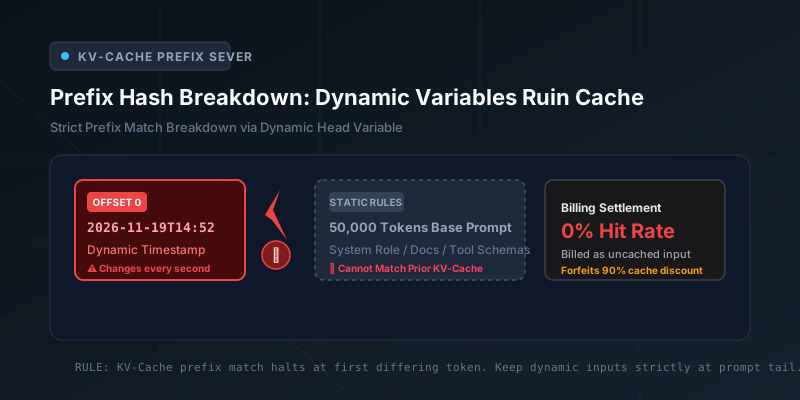
Current Timestamp: 2026-11-19 14:52:45
User ID: usr_892341
Session ID: 7c8a-11bc-993a
[Followed by 45,000 tokens of static business policy and 25 OpenAPI tool schemas...]
This layout triggers catastrophic cache invalidation. Because Current Timestamp changes every second and Session ID is generated uniquely per conversation, the tokens at offset 15 through 35 diverge on every single invocation.
In the provider's radix tree, the root branch forks immediately at the dynamic timestamp. Even though the subsequent 45,000 tokens of company policy and JSON schemas remain character-for-character identical, their position indices and preceding attention context have changed entirely. The inference engine fails to match any existing KV cache, forcing the customer to pay the full, uncached input price for all 45,000 tokens on every turn.
3. Chunk alignment and activation thresholds
Beyond exact character sequence matching, cloud providers enforce strict structural criteria before caching discounts take effect:
- Minimum Activation Thresholds: On OpenAI models (GPT-4o, o-series), caching activates automatically only when the prompt prefix reaches at least 1,024 tokens. Shorter static instructions never trigger caching. Once past 1,024 tokens, cache evaluation proceeds in 128-token increments.
- Anthropic Ephemeral Cache Rules: Claude requires explicit
cache_control: {"type": "ephemeral"}declarations, also requiring a minimum 1,024-token boundary. Crucially, writing to Claude's cache costs 1.25x the standard input rate and carries a 5-minute time-to-live (TTL). If dynamic variables prevent cache hits, the application incurs a 25% cache write surcharge on every request without ever realizing reading discounts. - Multi-Tenant Cluster Dispersion: Cloud load balancers distribute high-concurrency requests across multiple physical GPU nodes. If dynamic headers cause sporadic cache misses, requests fail to coalesce around shared GPU instances, destroying memory cache locality across the provider fleet.
4. Production architecture: Static-dynamic decoupling
Eliminating prompt cache invalidation requires adopting a strict Static-Dynamic Decoupling pattern. Engineering teams should structure prompt assembly pipelines into three hierarchical tiers:
- Tier 1: Global Invariant Prefix (Prompt Root): Place all immutable, universal content at the absolute beginning of the request. This includes system behavioral personas, guardrail policies, structured output formats, and all tool JSON schemas. Ranging typically between 3,000 and 30,000 tokens, this tier remains identical across all users and achieves near 100% cache hit rates.
- Tier 2: Tenant Semi-Static Slice: For multi-tenant SaaS, place account-level knowledge bases, company guidelines, and domain FAQs immediately after Tier 1. Within a given corporate tenant, this section maintains over 90% cache retention.
- Tier 3: Dynamic Tail Injection: Push all variable parameters—including timestamps, user identifiers, session states, and immediate chat turns—strictly to the end of the payload. For instance, append temporal context inside the user message:
[Context: Time is 2026-11-19 14:52:45] How do I process an invoice refund?.
By relegating dynamic data to the tail, the leading tens of thousands of tokens preserve immutable prefix hashes, allowing applications to capture the full 50% to 90% discount on every request.
5. Observability and cross-border treasury settlement
Maintaining prompt caching efficiency requires continuous observability. Engineering stacks should parse response headers and metadata on every completion: verify usage.prompt_tokens_details.cached_tokens on OpenAI and monitor cache_read_input_tokens versus cache_creation_input_tokens on Anthropic. Sudden dips in cache hit percentage indicate that recent code deployments inadvertently injected dynamic fields into the prompt header.
For organizations operating multi-region AI workloads, scaling API throughput involves frequent capital allocation across global providers like OpenAI, Anthropic, and AWS Bedrock. Corporate credit cards often incur unexpected fraud blocks or steep foreign exchange markups during high-frequency balance reloads. As a result, cross-border engineering teams frequently maintain treasury liquidity using stablecoins. In decentralized treasury workflows, non-custodial cross-chain platforms like AllSwap enable instant, registration-free stablecoin conversions across multiple blockchains without custodial risk. Sizing liquid reserves alongside disciplined prompt caching ensures that enterprise AI pipelines operate with maximum cost efficiency and uninterrupted availability.