
1. Why Standard Microservice Retry Logic Fails with LLMs
In standard web microservices, automatic retries on timeouts are widely regarded as a fundamental resilience pattern. When remote database queries or microservice RPCs stall for more than 50 milliseconds, rapid retries bridge intermittent packet drops without significant cost penalties.
However, when engineering teams transpose this pattern to large language model APIs, they inadvertently construct an **uncontrollable financial leak**. LLM inference is fundamentally a heavy, time-intensive compute task. Outputting 2,000 words or executing deep reasoning chains regularly requires 15 to 45 seconds of continuous GPU execution. A default 10-second client timeout paired with three automatic retries transforms a single user query into an accidental triple-billing storm.
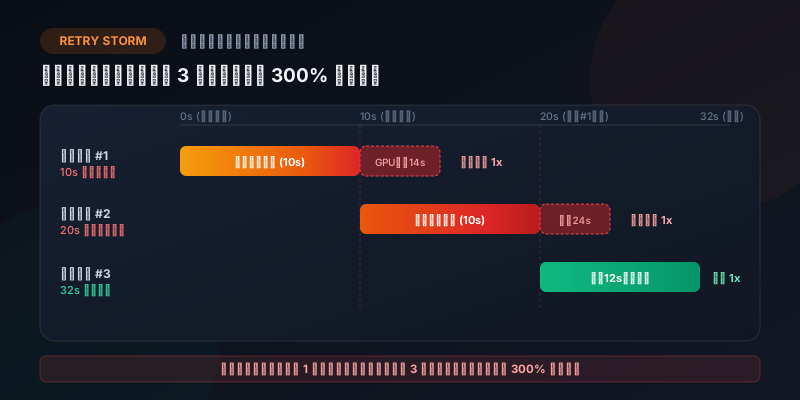
2. Mechanics of a Retry Storm: Concurrency and 3x Billing
Developers often assume that when an HTTP client aborts due to a timeout, the upstream compute halts as well. In reality: a client-side Read Timeout simply drops the waiting socket; it does not stop the provider's GPU inference cluster.
The operational chain unfolds as follows:
- Second 0 (Initial Request): Dispatched to GPU Node A, requiring 14 seconds to complete.
- Second 10 (Client Timeout & First Retry): The client's HTTP library raises a
TimeoutExceptionand immediately launches Retry #1. GPU Node A continues computing unawares and finishes at Second 14—Supplier meters 1st full token bill. - Seconds 10–20 (Overlapping Second Run): Retry #1 hits GPU Node B, also requiring 14 seconds. At Second 20, the client times out again! Node B runs to completion at Second 24—Supplier meters 2nd full token bill.
- Seconds 20–32 (Third Attempt Completes): The final retry completes in 12 seconds and delivers text to the user—Supplier meters 3rd full token bill.
The user waited 32 seconds and received a single response, but the enterprise account paid for three independent full-length GPU completions. Under peak traffic, this produces runaway retry storms that deplete monthly quotas in minutes.
3. Provider Idempotency Landscape
In fintech, idempotency keys eliminate duplicate settlements. In AI APIs, platform implementations vary significantly:
| Platform / Provider | Idempotency Support | Timeout Retry Behavior | Recommended Defense |
|---|---|---|---|
| OpenAI / Anthropic | Supported via Idempotency-Key |
Without keys, bills all concurrent runs | Inject unique client request hash into headers |
| Aliyun Bailian / Qwen | Async task deduplication | Synchronous retries meter independently | Apply Redis distributed locks at gateway |
| Baidu Qianfan / ERNIE | Synchronous calls bill per attempt | Independent token allocations per attempt | Never retry on read timeouts; retry only on 503 |
| Volcengine / Zhipu GLM | Primarily batch-level deduplication | Streaming calls incur per-connection charges | Use exponential backoff with full jitter |
4. Production Governance: Four-Layer Architectural Shield
1. Timeout Tiering by Task Complexity
Eliminate global 10-second timeout defaults. Configure adaptive timeouts based on expected output volume:
- Classification / Extraction (< 100 Tokens):
timeout = 8s; - General Long-Form Generation (1,000~3,000 Tokens):
timeout = 60s; - Reasoning Models (R1 / o1 / o3-mini):
timeout = 180s.
2. State-Aware Retry Filtering
function shouldRetry(error, attempt, maxAttempts) {
  if (attempt >= maxAttempts) return false;

  // Connection dropped before reaching server: safe to retry
  if (error.code === 'ECONNREFUSED' || error.isConnectTimeout) {
    return true;
  }

  // Rate-limited or transient 503 outage: retry with backoff
  if (error.status === 429 || error.status === 503) {
    return true;
  }

  // Critical: Read timeout during active generation: DO NOT RETRY
  if (error.code === 'ECONNABORTED' || error.isReadTimeout) {
    console.warn('Inference in progress on provider. Aborting retry to avoid multi-billing.');
    return false;
  }

  return false;
}
3. Gateway Deduplication Tokens
Generate a unique key from hash(userId + prompt + conversationId) in Redis with an atomic TTL of 60 seconds. Prevent duplicate submissions from launching parallel upstream queries.
5. Compute Treasury Resilience and Multi-Cloud Settlements
For organizations deploying models across multiple cloud ecosystems, retry storms risk freezing linked corporate credit cards through automated bank fraud prevention triggers.
To insulate primary operating accounts, engineering teams increasingly decouple API funding using decentralized liquidity bridges. Utilizing non-custodial exchange protocols like AllSwap, developer teams can execute low-slippage cross-chain swaps between USDT, USDC, and major tokens across Arbitrum, Base, Optimism, Solana, and Ethereum. By settling directly through verified on-chain smart contracts without centralized custodial delays or merchant processing locks, engineering teams can flexibly fund multi-model virtual card balances and developer billing pools, safeguarding production availability against sudden traffic anomalies.
6. Frequently Asked Questions (FAQ)
Q1: How can I detect if our production system is suffering from a retry storm?
A: Compare token usage surges against actual completed business transactions. A spike in token consumption alongside elevated 429 rate limit errors and client cancellation logs indicates uncontrolled retry propagation.
Q2: Does adopting streaming output (SSE) eliminate retry issues?
A: Streaming provides rapid time-to-first-token (TTFT), eliminating 90% of client read timeouts. However, it must be paired with cascade abort signaling to ensure cancelled user streams do not continue billing unmonitored in the background.