
Verification Checklist
- ✓Check whether your AI subscriptions are all charged to the same virtual card, or already spread across separate cards
- ✓If they do share one card, count how many distinct merchants' recurring charges land on it to gauge concentration
- ✓Check with your virtual card provider whether you can open more cards by subscription count, one card per service
- ✓If that card has had a recent renewal failure, check whether other subscriptions on it failed the same day too
- ✓After splitting into multiple cards, label each card with the service it's tied to so reconciliation doesn't get confusing
1. The pattern: one card gets frozen, several subscriptions fail renewal the same day
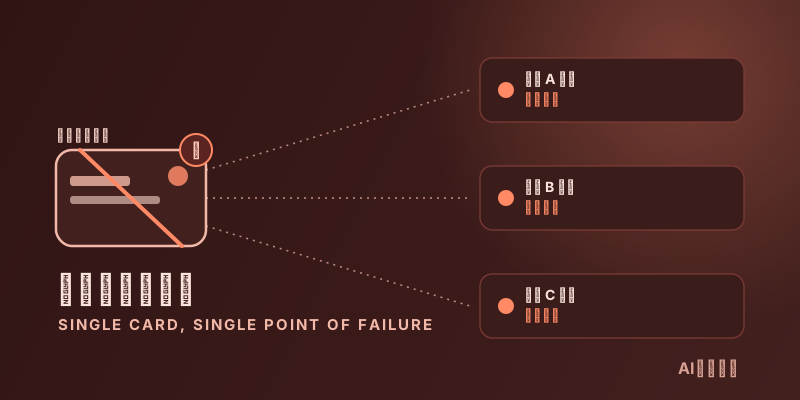
Our earlier article covered the trade-offs between sharing one card and using separate cards. This one covers a more specific mechanism: why putting multiple subscriptions on one virtual card can itself make that card more likely to draw scrutiny from a card issuer's or acquirer's risk system. Many users have hit this scenario — a virtual card used to pay for ChatGPT, Claude, Midjourney, and other AI subscriptions suddenly gets frozen or declined, and over the following days every subscription tied to that card fails renewal on its own billing cycle, one after another, turning into a chain of service interruptions that requires contacting several platforms at once. Had those same subscriptions been spread across separate cards, the same risk event would at most have taken out one service.
2. The mechanism: it's not just "one card breaks and several subscriptions suffer" — the transaction pattern itself is a signal
It's worth untangling something that's often oversimplified: the risk of a shared card isn't only the domino effect of "one card fails, several subscriptions go down with it." The deeper issue is that the transaction pattern that card carries can itself be more likely to trigger a risk model's suspicion than a card tied to a single merchant. A virtual card used, in a short window, for recurring charges to several different merchants of different kinds (say, the same card charged monthly by OpenAI, Anthropic, and Midjourney — three unrelated merchant accounts) — that combination of "one card, many merchants, all recurring" sits squarely within the kind of pattern many risk rules use to flag anomalies. A typical consumer's card is usually tied to a small, familiar set of merchants; a card suddenly showing dense, recurring charges to several unrelated merchants in a short period is exactly the kind of pattern risk systems reference when screening for account abuse, card testing on a stolen number, or money-laundering-adjacent behavior. In other words, "one card, one merchant" is generally less likely to be misread by risk models than "one card, many merchants" — not because the card itself is inherently safer, but because the transaction pattern it produces looks closer to normal consumer behavior and is less likely to be flagged as anomalous.
3. To be clear: the exact rules vary by issuer and provider, and aren't uniformly published
It's important to be honest here rather than present this as some universal industry rule: different card issuers, virtual card providers, and acquirers each run their own risk scoring models and decision logic, and these aren't fully public. Whether a specific card gets flagged for recurring charges to multiple merchants depends on that issuer's own risk strategy, the card's transaction history, and the account's overall credit and usage profile, among other factors — this article makes no claim about any single institution's uniform rule. What can be confirmed at the industry level: card networks like Visa and Mastercard maintain their own merchant/transaction risk monitoring frameworks aimed at issuers and acquirers (for example, continuously scoring merchants and transaction patterns by fraud rate and dispute rate). These frameworks are built specifically to watch for "does this account's or merchant's transaction pattern deviate from the norm" — and a single card showing many recurring charges to many merchants naturally sits closer to the patterns such frameworks are designed to flag. But whether any specific card actually gets frozen, and at what threshold, varies by institution, and there's no single published number that applies across the board.
4. A concrete plan: allocate cards by subscription count, one card per service
Building on the two points above, a more practical approach is to plan virtual card allocation by subscription count rather than defaulting to convenience and putting everything on one card. If you subscribe to three AI services, the ideal setup is three cards, each tied to only one service's merchant account, keeping each card's transaction pattern as simple and singular as possible — closer to normal consumer usage. Most virtual card providers that support batch card issuance already let you open several cards under one account, each with its own label and limit, at low operational cost. If the number of subscriptions is high enough that opening one card per service becomes unwieldy, a reasonable compromise is grouping by service type or billing frequency — say, monthly-billed subscriptions on one card and annual ones on another — rather than mixing every merchant onto a single card. That at least breaks up some of the "one card, many merchants, all recurring" pattern, and carries less concentration risk than sharing one card entirely.
5. Summary
Putting several AI subscriptions on one virtual card is convenient for reconciliation, but the cost isn't just the surface-level domino effect of "one card breaks, several subscriptions go down together." The deeper issue is that the transaction pattern that card carries — recurring charges to multiple different merchants in a short window — can itself read as an anomaly signal to risk models, and the exact decision logic varies by issuer and provider with no uniform public standard. A more practical response is to plan card allocation by subscription count, keeping each card tied to one service where possible, spreading out this concentration risk instead of waiting to fix things after a single risk freeze takes out every subscription at once.