
Verification Checklist
- ✓Check each card's bound subscription list and confirm its label/note clearly states which service it belongs to, so reconciliation doesn't get confused
- ✓Confirm your one or two most critical subscriptions — the ones where a failed renewal hurts most — actually sit on a dedicated card rather than sharing one with others
- ✓Pick a fixed day each month to export and reconcile every card's statement together, rather than checking sporadically
- ✓If a shared card fails a charge due to an AVS mismatch or 3DS verification issue, check whether other subscriptions bound to that same card failed renewal in the same window
1. After picking a card type, there's still an allocation question
Our Single-Use vs Recurring Virtual Cards guide covers whether a single card should be one-time or recurring, but many people run more than one AI subscription at once — ChatGPT, Claude, Gemini, and Perplexity might all be active. A more practical question follows: should those subscriptions share one card, or should each get its own?
2. The case for one shared card: easy reconciliation, low overhead
Putting every subscription on the same card makes reconciliation simple: at month's end, one statement shows exactly what all your AI subscriptions cost combined, with no need to hop between multiple card dashboards. Fewer cards also means fewer numbers, expiry dates, and balances to keep track of.
3. The risk of sharing: one issue takes down every subscription
Our Virtual Card Declined? Troubleshooting Guide covers how a card can get flagged over an AVS mismatch, a 3DS failure, or BIN-level risk controls. If that one card is tied to every subscription, ChatGPT, Claude, and Gemini can all fail to renew on the same day — leaving you to fix several platforms' billing at once, all under pressure at the same time.
4. The case for separate cards: failure isolation, per-service cost tracking
Giving each subscription its own card isolates failures: if one card has an issue, only the subscription tied to it is affected — nothing else gets dragged down. It also makes cost tracking easy — to see what Claude actually cost over a year, just check that one card's statement instead of sifting through a mixed feed.
5. The cost of separating: more overhead, easier to miss one
More cards means more issuance dates, expiry windows, and balances to remember. Once you're past four or five subscriptions, it gets easy to miss a low balance on some rarely-checked card — leading to a renewal quietly failing on a subscription you weren't watching, which can end up more disruptive than sharing a single card.
6. A middle ground: group by importance instead of going all-in on either extreme
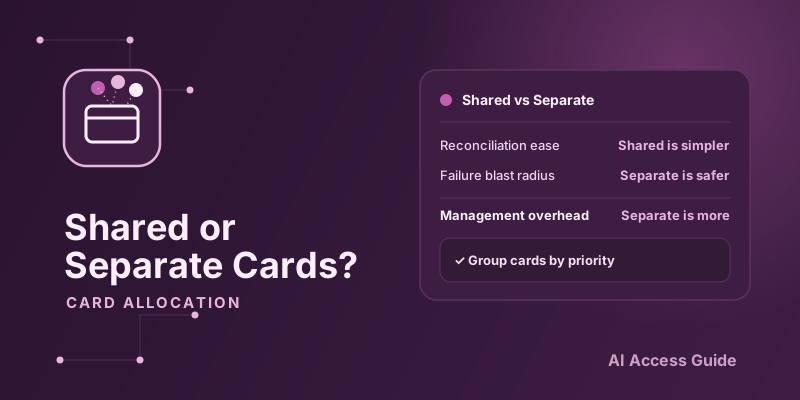
The more practical approach is grouping: put your one or two most critical subscriptions — the ones where a failed renewal actually hurts, like your primary ChatGPT or Claude plan — on their own dedicated cards to isolate risk, and let lower-priority, less-frequently-used subscriptions share a card for simplicity. There's no need to pick "all shared" or "all separate" — tiering by importance is usually the better fit.
7. Reconciling quickly across multiple cards
If you land on grouped or fully separate cards, label each card by what it's for (a note with the bound subscription's name works fine), and pick a fixed day each month to export and check every card's statement together, rather than checking sporadically whenever you remember. That keeps reconciliation manageable even as the card count grows.
8. In practice: use a provider that makes batch card issuance easy
Grouped management only works if opening cards is genuinely easy. Using the virtual card provider RDVCC as an example, you can issue multiple cards under one account, set an independent monthly cap and label on each, and bind primary and secondary subscriptions to different groups of cards — without registering a separate account for every subscription. That keeps the overhead of grouped management low. Worth setting at the same time is each card's expiry, matched to the renewal rhythm of the subscriptions on it — see our AI Subscription Virtual Card Expiry: How Long Is Safe? guide.
9. Summary
Sharing one card is simple but concentrates risk; separate cards are safer but add overhead. For most people, grouping by importance works best: isolate your critical subscriptions on their own cards, and let lower-priority ones share one to keep management simple. Once you've picked an allocation, label each card clearly so monthly reconciliation stays easy.