
Verification Checklist
- ✓Confirm whether your shared/family plan only has the owner's card on file, or supports separate payment methods per member
- ✓Ask the owner whether their card was recently swapped or is close to expiring, and if so, confirm whether this specific plan's payment method was actually updated
- ✓If the service suddenly shows "expired," check whether every member lost access on the same day — that quickly tells you it's the owner's card, not your own account
- ✓Confirm whether renewal reminders are turned on in the subscription settings, and whether the platform supports adding a backup payment method
1. The structural weak point: one card holds up everyone's access
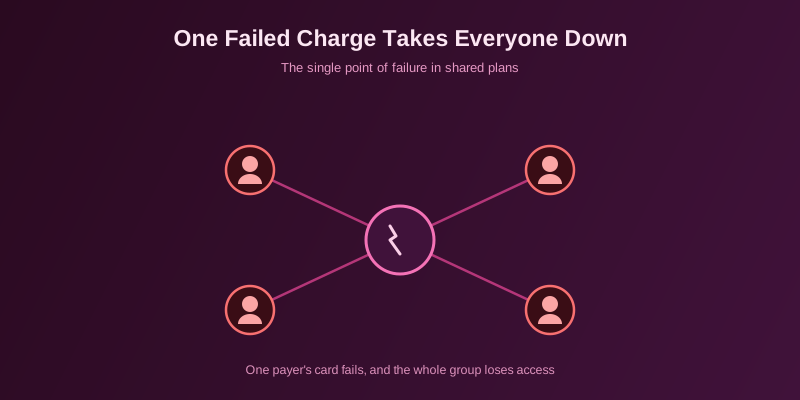
Whether it's a family plan tier, a team seat, or friends informally splitting the cost of one shared account, the billing structure is almost always the same: the plan recognizes exactly one payment method, and it either renews for everyone or fails for everyone. That's convenient for the platform, but for the people sharing it, it's a hidden single point of failure — access isn't tied to each member's own standing, it's tied entirely to the owner's personal payment situation, which has nothing to do with whether each member paid their share on time.
2. An expired or frozen owner card locks out everyone but the owner first notices last
The most common trigger is the owner's card hitting its expiration date, running low on balance, or getting temporarily frozen by the issuing bank's fraud controls — all of which are the owner's personal account issues, but the consequences land directly on every member splitting the cost. Most members find out something's wrong not through a notification, but by opening the AI tool and suddenly being asked to log in again or seeing "subscription expired" — often before the owner has even noticed the card issue themselves.
3. A forgotten card swap means everyone gets "service paused" on the same day
An even easier thing to overlook: the owner proactively replaces a card — an old one expires and the bank mails a new one, or they switch issuers entirely — and updates the payment method on every recurring charge they personally use, except this one, because it isn't something the owner interacts with daily and it slips through the cracks. Come the next renewal cycle, the old card details are still on file, the charge fails, and every member gets a "service paused" notice on the same day, while the owner often takes a while to even remember which subscription it was.
4. Members can't fix it themselves — they can only wait on the owner
The most powerless part of a shared plan is the permission structure: aside from the owner, no other member typically has access to the billing settings to update the card or trigger a renewal themselves. Everyone just waits for the owner to notice, log in, and add a new payment method. If the owner happens to be traveling, switched phone numbers and can't receive the bank's verification text, or simply missed the failed-charge email, that waiting period can stretch on for days — and every member paying their share is stuck watching the tool sit locked, unable to do anything about it.
5. When a group collects money through the owner, getting paid and renewing are two different things
Plenty of informal group subscriptions don't split the bill through the platform at all — each member transfers their share to the owner, who then charges their own card for the whole plan. It's easy to assume "I paid my share, so the renewal is handled," but the money landing in the owner's account and the owner's card actually clearing the charge are two separate events. If the owner doesn't promptly turn the collected money into an actual renewal, or the card itself has an issue, a clean transfer history on the members' side doesn't buy back access — there's no step in between confirming the renewal actually went through.
6. When a bank blocks a cross-border charge, even the owner may not get notified
For subscriptions billed across borders, a bank's fraud system will sometimes block a charge from an unfamiliar region or currency outright, and the notification for that block isn't always reliable — texts get flagged as spam by the carrier, emails land in a junk folder, and the owner often only finds out once they themselves can't open the tool anymore. For a shared plan, that means even an owner who wants to act fast might miss the best window to fix it simply because the bank's block notice never reached them, stretching the outage for everyone even longer.
7. A renewal reminder set up ahead of time beats scrambling after the fact
The more practical move is for the owner to turn on renewal reminders in the subscription settings and mark the charge date on a personal calendar separately, rather than relying entirely on the platform's email — this money isn't just being spent on one person, and any delay ripples out to everyone splitting the cost. If the platform supports a backup payment method, adding one ahead of time meaningfully cuts the odds of a primary-card failure locking everyone out. It takes a few minutes of setup and saves the hassle of explaining, refunding, and re-coordinating with every member after the fact.
8. A dedicated virtual card for the shared plan makes the failure reason obvious at a glance
If the owner is willing to move the shared plan's billing onto its own dedicated virtual card instead of mixing it with everyday personal spending, things get much clearer: the virtual card's transaction history stays clean, and the moment a charge fails, it's immediately obvious whether it's a balance issue, a fraud block, or an expired card — no digging through a pile of unrelated personal charges to find the one that took the shared plan down with it. A virtual card also makes it easier to set alerts and limits, so a failed-charge notification stands out instead of getting buried among other credit card alerts.
9. Bottom line: the money you save sharing a plan is worth a sturdier renewal process
Family plans, team seats, and informal group subscriptions save real money, but the model carries a risk that's easy to overlook: everyone's access rides on the owner's one card, and when the owner's payment situation breaks, members lose access together even though they did nothing wrong on their end. Setting up reminders, adding a backup card, and moving the shared plan onto its own dedicated virtual card aren't complicated steps, but they meaningfully shorten the gap between "everyone's locked out" and "everyone's back in." This is entry nine in the series — more overlooked details in AI subscription payments and account management are coming.