
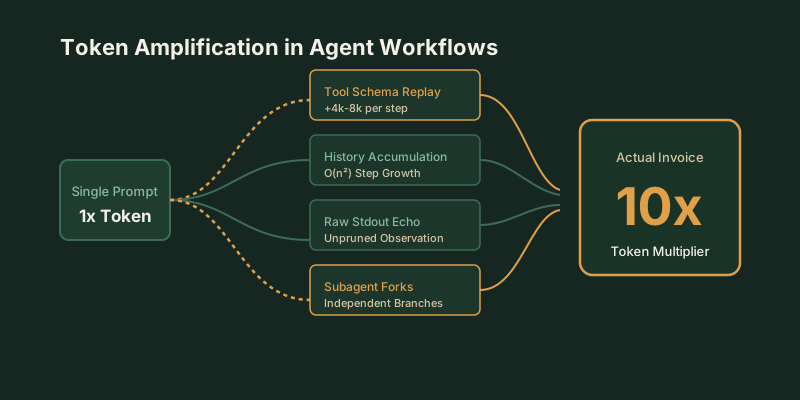
Verification Checklist
- ✓Audit the total size of declared
toolsschemas on every turn. All listed tools are billed as input tokens regardless of whether they are invoked. - ✓Inspect
toolmessage returns from shell commands and file reads. Raw, unpruned logs stay in context across all subsequent turns. - ✓Configure hard
max_stepsboundaries and exit triggers to prevent infinite reasoning loops on ambiguous tasks. - ✓Check subagent instantiation parameters. Inheriting complete parent history multiplies input context volume across concurrent sessions.
- ✓Verify whether reasoning models are active. Hidden internal thinking tokens are charged at premium completion rates even if omitted from user-visible UI.
1. Single prompts hide an underlying multi-turn ReAct loop
In standard conversational interfaces like ChatGPT, cost calculation is trivial: you type a paragraph, the model writes a response, and billing reflects that straightforward exchange. However, autonomous coding and operations agents (such as Claude Code, AutoGen, CrewAI, and LangGraph pipelines) break a high-level goal into an automated ReAct (Reason + Act) loop.
In a ReAct loop, the agent does not immediately deliver an answer. Instead, it reasons about its next move, emits a tool call, pauses while the execution sandbox evaluates the command, ingests the resulting observation, and calls the language model again. A single task often runs through 6 to 15 internal round-trips before resolving.
Because LLM APIs are strictly stateless, each subsequent request must re-transmit the entire conversation history from step one. Turn 1 might send 1,200 tokens; turn 5 sends 14,000 tokens; turn 10 can easily exceed 45,000 tokens. Total input tokens grow as an arithmetic progression sum, resulting in O(n²) quadratic cost accumulation that catches unmonitored deployments by surprise.
2. Tool schemas and environment definitions bill on every pass
To grant an agent real-world utility, developers configure diverse capabilities: shell execution, file reading, code search, database queries, and web browsing. In both OpenAI and Anthropic API specifications, every tool is described using an exhaustive JSON Schema containing parameter names, types, descriptions, and enum validations.
The foundational billing rule is absolute: every declared tool schema in the tools parameter is converted into input tokens and billed on every request, whether or not the model invokes that tool in the current turn.
When an agent maintains 15 to 20 registered tools, their static definitions alone consume 4,000 to 8,000 tokens. If a workflow runs 10 steps, those static definitions are serialized and billed 10 times, consuming 40,000 to 80,000 input tokens before factoring in actual code or user messages. Without dynamic tool filtering, unused functions act as a permanent background tax on every reasoning step.
3. Observation echoes and unpruned stdout contaminate context
The steepest spikes in context volume stem from raw command observations. When an agent runs git diff, executes a test suite, or scrapes a webpage, the output is returned to the model within a tool message role.
If a test failure prints a 2,500-token stack trace, that block becomes permanent ballast. It is billed on step 3; it is re-billed on step 4; and it remains present through step 12. This creates an observation echo where historical terminal output repeatedly drains the token budget on every follow-up turn.
Failing to truncate or semantically summarize command outputs also degrades model focus. Flooding context with thousands of irrelevant lines dilutes attention, leading to hallucinations, misguided tool calls, and additional retry steps that further accelerate token burn.
4. Subagent forks and hidden reasoning tokens multiply spend
Modern agent frameworks frequently deploy multi-agent swarms. A coordinator orchestrates work by delegating specialized tasks to child agents. However, each subagent instance represents an entirely separate API session with its own context tree.
If a child agent inherits the parent's full conversation history upon initialization, tens of thousands of tokens are duplicated into a second channel. That child agent then initiates its own multi-turn ReAct loop. Running three concurrent subagents with inherited state triples the ongoing token throughput in an instant.
Furthermore, frontier reasoning models (such as Claude 3.7 Sonnet Thinking, DeepSeek-R1, and OpenAI o-series) produce internal chain-of-thought tokens. These thinking tokens are billed at higher output rates, even though they remain hidden behind the scenes and never appear in final user-facing text. Compounding subagent branching with hidden reasoning can inflate a single run into hundreds of thousands of tokens.
5. Budget guardrails and funding preparation for agent infrastructure
Deploying autonomous agents reliably requires disciplined architectural guardrails. First, enforce strict max_steps thresholds and timeout caps to abort runaway loops. Second, implement aggressive output truncation on shell tools, retaining only essential headers and error tails. Third, filter active tool schemas dynamically so only relevant domain functions enter the request. Fourth, leverage provider prompt caching (KV-cache reuse) by structuring prompts with immutable system headers at the very top. Fifth, isolate subagents with lean, scoped inputs rather than blanket history clones.
On the payment and balance tier, autonomous workflows require isolated budget pools to insulate corporate cards from surprise exhaustion. Teams frequently allocate dedicated virtual cards or maintain prepaid balances funded via cryptocurrency rails. In these treasury workflows, non-custodial cross-chain platforms like AllSwap enable fast, registration-free stablecoin conversions without counterparty risk. Sizing developer balances into isolated pools ensures that experimentation stays contained within budgeted boundaries.