
Verification Checklist
- ✓Is the reserve report you're reading a point-in-time attestation or a full annual audit — the cover page or summary usually states which
- ✓Is the date on Circle's most recent monthly reserve report (via its official Reserve Fund page) recent enough — generally within the last month
- ✓Does Tether's latest quarterly reserve report break out cash and cash equivalents into specific categories, rather than just stating reserves are "adequate"
- ✓If you routinely hold a meaningful stablecoin balance, is it split between USDT and USDC rather than concentrated in a single issuer
1. Why the reserves behind the "1:1 peg" matter
For most people, a stablecoin's whole appeal is that you don't have to think about it — it settles at roughly one dollar, both sender and receiver book it as one dollar, and it doesn't swing the way Bitcoin does. But that convenience rests on an assumption: the issuer actually holds enough backing assets to redeem the coin for real dollars when someone asks. That assumption is nearly invisible in normal times, because most holders never redeem at all — they just pass the token along as "on-chain dollars." The moment sentiment turns and a run starts, whether the reserves are real, fully backed, and quickly liquid decides, in a matter of hours, whether the "stable" part of stablecoin holds up. Looking into this isn't about stoking panic — it's about understanding what the funding layer you rely on is actually built on.
2. Three peg mechanisms: fiat-backed, over-collateralized crypto, and algorithmic
Stablecoins don't all hold their peg the same way. The mainstream approaches fall into three buckets. Fiat-backed coins hold reserves of dollars or dollar-equivalent assets matching each token issued — USDT and USDC both fall here. Over-collateralized crypto-backed coins mint against a larger value of volatile crypto collateral (ETH, for example), using the excess collateral to absorb price swings — DAI is the classic example. Algorithmic stablecoins don't hold full asset backing at all; they rely on an algorithm balancing supply and demand to hold the price — TerraUSD (UST), which collapsed in 2022, is the best-known cautionary tale of this category failing under stress. That collapse is a useful reminder of how fragile a peg becomes once it's detached from real backing assets and depends purely on algorithmic mechanics and market confidence. This piece focuses on USDT and USDC, both fiat-backed, whose stability hinges directly on whether their reserves are real and liquid.
3. USDT's reserve composition and disclosure history
Tether, USDT's issuer, faced sustained scrutiny for a long stretch over opaque reserve disclosures — for years the market got little beyond a blanket assurance that "sufficient assets" existed, with no asset breakdown and no independent verification. That opacity triggered major controversy around 2018, and a subsequent investigation by the New York Attorney General's office confirmed Tether had, at one point, continued asserting its peg while reserves were in fact insufficient. Since then, Tether has moved to publishing quarterly reserve reports that break reserves into broad categories — the current disclosed composition leans heavily on cash and cash equivalents (including US Treasury bills and overnight repurchase agreements), alongside a portion of secured loans and other investments (including assets like Bitcoin). Transparency has clearly improved relative to the earlier period, but Tether still has not undergone a full annual audit in the strict sense, and the market continues to watch the completeness and independence of what it does disclose.
4. USDC's reserve composition: the Circle Reserve Fund and money market structure
Circle, USDC's issuer, took a more transparent route. USDC reserves are held primarily through the Circle Reserve Fund, a fund registered with the US SEC and managed by BlackRock, composed mainly of short-dated US Treasury bills and overnight repurchase agreements, with a smaller cash portion held at regulated banking institutions. Circle publishes monthly reserve reports produced by an independent accounting firm, disclosing total reserves, their composition, and the corresponding USDC in circulation — generally at a higher frequency and finer granularity than Tether's disclosures. That structural edge is a big part of why USDC is widely seen as more transparent and more readily accepted by institutions. But "more transparent" isn't the same as "risk-free" — the 2023 Silicon Valley Bank episode that briefly depegged USDC (covered in Section 7) happened within this relatively transparent framework, showing that reserve transparency alone can't eliminate counterparty risk on the banking side.
5. "Attestation" is not the same thing as an "audit"
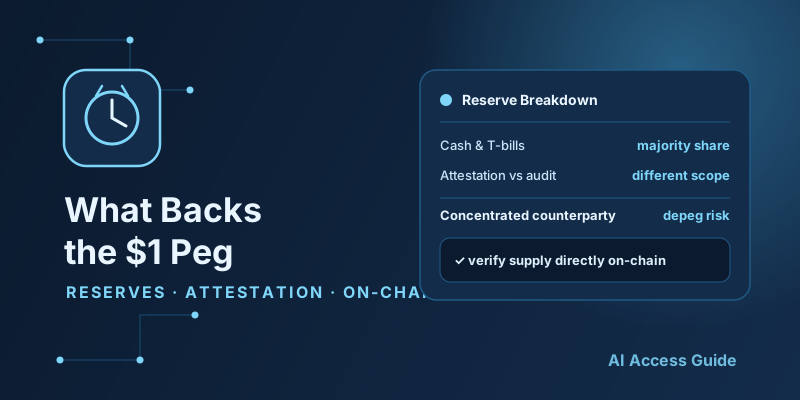
This is the single most confused — and most consequential — point in understanding stablecoin reserves. Most of the Tether and Circle reserve reports circulating publicly are, strictly speaking, attestations, not full audits. An attestation is typically an accounting firm confirming, at one specific point in time, that account balances and holdings match what the issuer has disclosed — essentially a snapshot reconciliation. A full audit is far broader in scope: it examines internal controls, the complete flow of funds in and out, related-party transactions, and other deeper financial detail, and typically takes longer and applies stricter standards. This distinction directly shapes how much confidence the market should place in a given report: an attestation confirms "the money was there on that day," but it can't fully rule out funds being moved around the snapshot window, or reserve assets being pledged more than once elsewhere. Understanding this gap is what keeps "a third party already reported on it" from being mistaken for full audited financial assurance.
6. How an ordinary user can self-verify: on-chain supply and third-party trackers
You don't have to take an issuer's disclosures at face value — there are a few practical ways to self-verify. First, on-chain data is public and tamper-resistant: total USDT and USDC supply, distribution across chains, and large mint/burn events can all be checked directly on a block explorer (Etherscan, Tronscan, and similar), and unusual spikes or drops in supply are worth a second look. Second, independent third-party tracking sites continuously aggregate on-chain data alongside issuer-published reserve reports, cross-checking the two and flagging discrepancies. Third, go straight to the issuer's own quarterly or monthly reserve report and check whether the date is recent and whether the asset breakdown is specific enough to be useful, rather than settling for a vague "reserves are adequate" headline. Combining these three gives a more accurate read than any single news headline, but it's still after-the-fact verification, not a real-time guarantee — there's always some lag between on-chain data and the next published report.
7. Depeg case study: the 2023 Silicon Valley Bank episode and USDC's brief depeg
The clearest real-world test of stablecoin reserve risk came in March 2023, when Silicon Valley Bank (SVB) was taken over by US regulators. Circle disclosed that roughly $3.3 billion of USDC's reserves sat at SVB. Once that became public, fear that the funds couldn't be withdrawn in time pushed USDC down to around $0.87 within hours — a drop of nearly 13% — triggering knock-on effects across several exchanges and DeFi protocols. The US Federal Deposit Insurance Corporation then announced it would fully guarantee SVB depositors, Circle confirmed the reserve funds were safe, and USDC gradually recovered to near $1 over the following one to two days. The key lesson isn't about disclosure quality — it's that even a reserve with a clean, transparent composition remains exposed to traditional banking counterparty risk if it's heavily concentrated at a single institution. Transparency shows you where the exposure sits; it doesn't substitute for the soundness of the counterparty itself. This episode is also the direct backdrop for Circle subsequently diversifying where it holds banking reserves.
8. What this means for paying AI subscriptions with stablecoins
Bringing this back to the scenario most readers of this site actually deal with — funding a virtual card or paying an overseas AI subscription with USDT/USDC — a few habits are worth adopting rather than filing this away as pure background reading. First, minimize how long stablecoins sit idle in a wallet: once funds are ready, complete the top-up or payment promptly rather than parking a large balance in stablecoin form for an extended period — depeg windows tend to be short, so shortening dwell time shortens exposure. Second, concentration risk in a single stablecoin or a single banking counterparty is worth watching; if you routinely hold a meaningful balance, spreading it across USDT and USDC, or following the chain-diversification approach covered earlier on this site, limits the damage from any single incident. Third, when swapping across chains or consolidating assets, favor non-custodial tools with verifiable transparency and automatic refunds on failure — an aggregator like AllSwap avoids introducing yet another place for funds to sit idle mid-transfer. To be clear: this is information and technical research, not investment advice — stablecoins still carry price risk, issuer credit risk, and on-chain execution risk, so weigh your own circumstances before deciding anything.
9. Summary
The dollar peg on USDT and USDC isn't a given — it rests on whether the underlying reserves are real, fully backed, and verifiable. USDT went through a period of real opacity and has since moved to quarterly disclosure; USDC took the more transparent route from the start, yet the 2023 SVB episode showed that reserve transparency alone doesn't eliminate banking counterparty risk. Understanding the real difference between an attestation and an audit, and knowing how to cross-check on-chain data against third-party trackers, lets anyone who relies on stablecoins long-term size up the risk they're actually carrying, instead of treating "pegged to $1" as a settled fact that never needs a second look. This is the more research-oriented entry in our stablecoin series; we'll keep following developments in reserve transparency and on-chain verification tooling.