
Verification Checklist
- ✓If you're going with a single-chain approach, have you confirmed your payment channel supports that chain's stablecoin on an ongoing basis, not just temporarily
- ✓If you're diversifying, does the balance you left on a backup chain actually cover two or three renewals, not just a token amount
- ✓After each rebalancing swap, have you verified the destination chain balance matches the amount sent minus fees
- ✓Are you re-checking your main-chain and backup-chain balances on a regular cadence (e.g. before each renewal), rather than setting it once and forgetting it
1. After consolidating, a more fundamental question remains
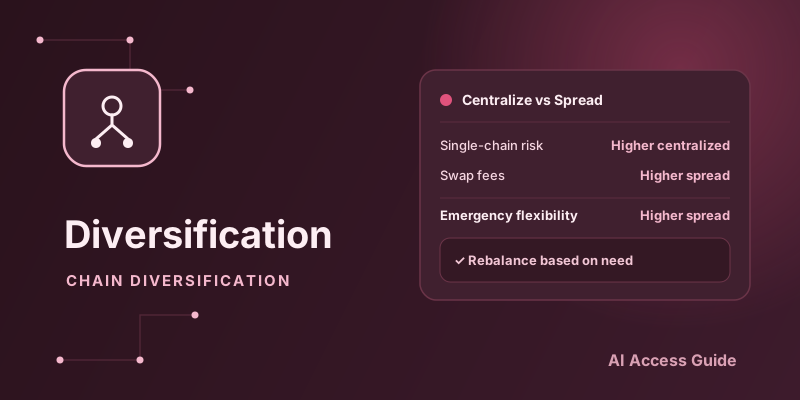
Our Consolidating Scattered Stablecoins guide covers gathering leftover balances scattered across chains into one usable reserve. But once that's done, a bigger question follows: should the reserve live entirely on one main chain, or stay spread across a few? It isn't a one-time decision — it's an ongoing tradeoff between fees and risk exposure.
2. The case for one chain: lower fees, simpler management
Keeping the whole reserve on one chain means no back-and-forth swapping: renewals draw directly from that balance, saving the fees and spread of repeated cross-chain conversions. The account structure stays simple too — just one chain's balance and gas fee to watch, so it's harder to forget to top up.
3. The risk of consolidation: single-chain dependency
The tradeoff is putting all your eggs in one basket. If that chain hits congestion, a bridge has issues, or a payment channel temporarily drops support for that chain's stablecoin, the balance can become unusable for renewals right when you need it — forcing a scramble to find a workaround.
4. The case for diversifying: resilience and channel flexibility
Spreading the reserve across two or three major chains limits the fallout if any single one has an issue — another chain's balance can cover you. If you use a mix of payment methods like virtual cards and direct stablecoin payments, diversifying also makes it easier to match whichever chain or coin each channel prefers.
5. The cost of diversifying: more fees, more to manage
Diversification isn't free. Every rebalance between chains means another cross-chain swap, and over time the fees and spread add up to more than a consolidated approach. You also need to track each chain's balance and gas fee separately, raising the odds of missing a low balance on one of them.
6. Which fits you: subscription scale and payment channel count
If you only subscribe to one or two platforms and consistently use a single payment channel, consolidating onto one chain is usually the simpler choice. If you juggle multiple subscriptions, mix virtual cards with direct stablecoin payments, or worry about single points of failure, moderate diversification pays off. Smaller and simpler leans toward consolidating; larger and more varied leans toward spreading out.
7. A middle ground: a main chain plus a small backup buffer
Most situations don't require picking an extreme. Keep the bulk of the reserve on the chain you use most day to day, and leave a smaller buffer — enough for two or three renewals — on one or two backup chains. That keeps most of the low-cost benefit of consolidation while still leaving a cushion if the main chain runs into trouble.
8. Rebalancing on demand with a cross-chain swap tool
Whichever approach you pick, the split isn't fixed forever — payment channels change, fees on a given chain rise, and the ratio needs the occasional adjustment. Using the non-custodial cross-chain swap aggregator AllSwap as an example, the flow is the same one covered in our Consolidating Scattered Stablecoins guide: pick the source and destination chain assets, compare quotes pulled from multiple sources, then send funds to the generated one-time deposit address and the system completes the swap automatically. Small, frequent rebalances tend to be easier to control the cost of than one large move.
9. Summary
Consolidating saves fees and keeps things simple; diversifying adds resilience and channel flexibility. Neither is universally right — it depends on your subscription scale and payment habits. Most people do best with a main-chain-plus-buffer setup, adjusting the ratio with a cross-chain swap tool as needed rather than locking into one approach permanently.