
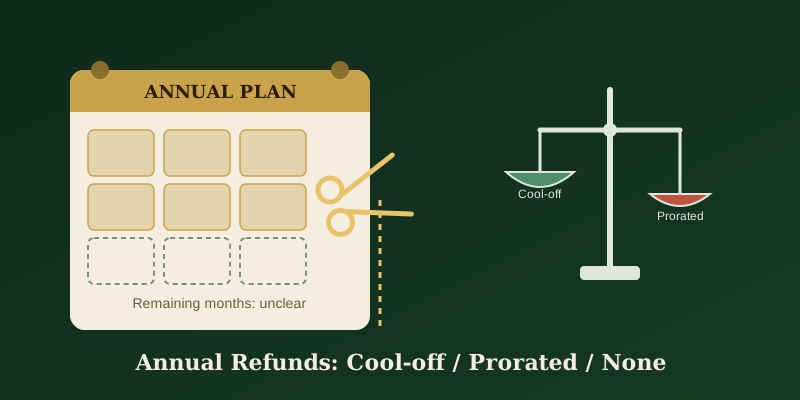
Verification Checklist
- ✓Before buying an annual plan, did you actually find the word "cooling-off" (or equivalent) in the checkout page or terms of service, and confirm how many days it covers — or whether there is none at all
- ✓Have you confirmed what happens after the cooling-off window closes: fully non-refundable until renewal, or a prorated refund based on unused days — these produce very different outcomes
- ✓If it's "prorated," have you confirmed the actual formula — a straight unused-days-over-total-days calculation, or a calculation that first claws back the already-used months at full monthly price before prorating the remainder
- ✓Have you checked which channel you purchased through — the platform's own website, Apple App Store, or Google Play — since each routes refund requests to a different party with different rules
- ✓Are you assuming annual plans work like "12 monthly payments you can walk away from anytime," without actually having read the official refund terms
1. An annual plan trades lock-in for a discount — refund terms are the part of that trade most people skip
Annual plans for overseas AI subscriptions typically run 10-20% cheaper than paying month to month, and that discount itself isn't the problem — vendors are willing to lower the price in exchange for a customer committing a full year of revenue upfront instead of being free to churn at any point. But that's a two-sided trade: the customer gets the discount, and the vendor gets a lock-in period, and what that lock-in period actually means in practice is exactly the part most people skip at checkout. Many buyers compare only the headline numbers — annual total versus monthly price times twelve — without ever opening the refund policy to check what happens if, six months in, they want to switch to monthly, downgrade to a cheaper tier, or just stop using the service. An annual plan isn't installment payments in disguise; it's a single upfront purchase paired with a commitment period, and the refund clause is the real price tag on that commitment.
2. Cooling-off window: whether one exists, and how long it lasts, sets your room to change your mind
Many platforms give annual subscribers a post-purchase "cooling-off period," during which canceling typically qualifies for a full or prorated refund; once that window closes, the rules usually get much stricter. OpenAI's own Help Center documents this for ChatGPT: users in the EU, UK, and Turkey qualify for a prorated refund if they cancel within 14 days of purchase, while users in South Korea get a full refund within 7 days. Anthropic's Help Center describes something similar for paid Claude plans: users in the European Economic Area and UK can request a prorated refund within 14 days of purchase, while the general policy otherwise is that payments are non-refundable except where Anthropic's consumer terms or local law require otherwise. In other words, whether a cooling-off window exists — and how long it lasts — is often tied directly to consumer-protection law in your specific region, not a universal benefit every subscriber gets. Confirm this before you buy rather than assuming it applies to you.
3. After the cooling-off window: the actual proration formula is where the real trap lives
Even when a platform's terms clearly state that a prorated refund is available after the cooling-off window, how that proration is actually calculated varies enough between vendors that "I expected most of it back" and "I actually received far less" are both common outcomes. One reading is the intuitive one: refund = (remaining days ÷ total days in the year) × the annual price, so canceling halfway through the year gets back roughly half the money. But a more common approach in practice first claws back the months already used at the full monthly retail rate — which is typically higher than what those months worked out to under the annual discount — and only prorates whatever balance is left after that deduction. That means the months you enjoyed at the discounted annual rate get re-billed at the pricier monthly rate when you cancel, and the actual refund ends up smaller than a simple days-based calculation would suggest. This distinction is often buried in a sentence or two of policy language that's easy to skim past. Google One's Help Center, for example, states that storage/subscription purchases are non-refundable by default in most regions, with only specific regions (such as Israel) explicitly documenting a "prorated based on days remaining" refund mechanism — this kind of region- and platform-specific detail can only be confirmed against the current official terms for wherever you actually are, not assumed to be universal.
4. The most common wrong assumption: annual isn't "12 monthly payments you can walk away from anytime"
Many people's mental model of an annual plan is essentially "12 months of payments bundled together," expecting that canceling mid-term simply deducts the months already used and refunds the rest proportionally — that intuition feels natural, but it usually doesn't match what the actual terms say. The real commercial and legal structure of an annual plan is closer to "you bought a one-year commitment at a lower price," and the discount only exists because the customer locked in for the full year rather than retaining the option to bail out monthly. If refund policies genuinely worked like "get back most of your money anytime, prorated to the monthly rate," the entire pricing rationale behind offering an annual discount would collapse. So when you run into terms like "annual plans are non-refundable, wait for renewal" or "prorated, but first deducted at monthly rate," that's not the vendor being unreasonable — it's the built-in trade-off of how annual pricing is structured in the first place. The move is to do this math before you buy, not to discover the gap between expectation and reality only once you're trying to get money back.
5. Bottom line: settle these two questions before buying annual, not after trying to get a refund
Choosing an annual plan for the discount is perfectly reasonable — but an annual plan is fundamentally a trade of lock-in for a lower price, and the refund terms are the part of that trade most likely to be skipped, and most likely to matter later. Before you buy, confirm two specific things: first, whether a cooling-off window exists, how many days it covers, and whether it actually applies to your region; second, what happens after that window closes — fully non-refundable until renewal, a straight proration by unused days, or a proration that first claws back already-used months at the full monthly rate. These three outcomes can produce very different amounts of money back. The answers differ by platform, by purchase channel (direct website, Apple App Store, Google Play), and by region, with no universal rule — treat the platform's current official terms as the source of truth. Settling these two questions before checkout beats assuming an annual plan behaves like a cancel-anytime monthly plan and only reading the fine print once you actually want your money back.