
Check this call
- ✓Confirm the line item is the multimodal interaction kit, not realtime model tokens and not CosyVoice characters.
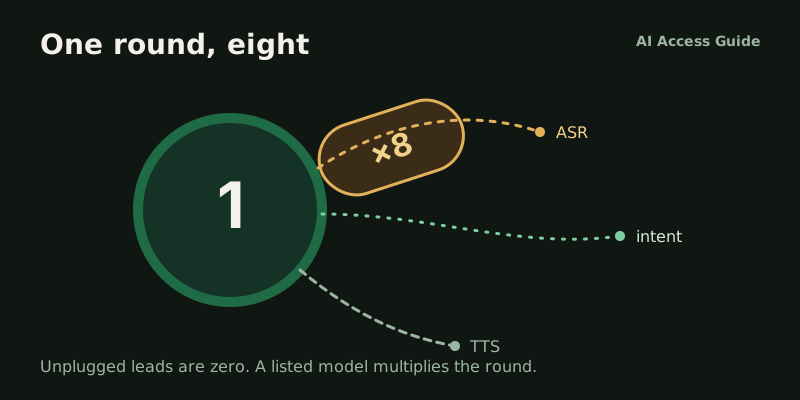
- ✓Split the round into recognition, intent, dialogue and synthesis. An unused part is zero. Do not estimate all four as on.
- ✓Read the push-count table. A listed expensive model bills the same round at 2x through 32x, not as one charge.
- ✓The knowledge-base round already includes tokens from retrieved snippets. Storage, embedding and retrieval are billed by the library service.
- ✓A radio adds synthesis once per spoken sentence. A device license runs one year from activation, and the purchase is not refundable.
1. This round is not the model-token column
The multimodal interaction billing page prices postpaid use by the interaction round. One chain has four parts: speech recognition, intent recognition, the large-model dialogue, and speech synthesis. Each round bills the parts that actually ran. An unused part is not billed. Recognition and synthesis each have two specs. Intent classifies the user and hands the turn to a downstream module. Inside dialogue, chat, knowledge-base Q&A and the various agents are alternatives for that round, billed by the capability that was called.
Two other domestic speech meters are different products. Synthesis by character and recognition by the second belong to the model service and the speech-interaction price rows. On this kit, recognition and synthesis are one charge per round, not a second pass over audio seconds or billable characters. Model input and output tokens, batch discounts and explicit cache are not on this round table either. When the kit calls an agent or a plugin on Model Studio, Model Studio settles that fee and the kit adds nothing. One spoken turn can therefore leave a kit round and a model-platform line. Reconciling only one of them makes the other look like a duplicate.
A light voice chat can omit intent. The page says that without intent you cannot turn on plugins, commands, web search or an agent. Dropping that part also drops those abilities. Leave intent in the configuration and a text-only turn still carries it. Count the parts that were actually connected before you count the multiplier.
2. Changing the model changes the count first
On postpaid billing, some expensive models make one interaction count as more than one charge. The page's line is that a more expensive model means a higher billed count. The push-count table is the source. Unit prices stay on that page. This article keeps the multipliers and does not freeze a day's amount as a standing rate.
On recognition, Fun-ASR, qwen3-asr-flash and Qwen-Audio-3.0-ASR-Flash-Streaming are 3x. On synthesis, cosyvoice-v3.5-plus, cosyvoice-v3.5-flash, cosyvoice-v3-plus, the qwen3-tts series and qwen-audio-3.0-tts are 3x. Dialogue splits further. qwen3.7-plus, qwen3.6-plus, qwen-max, Qwen3-Coder-Plus and qwen-mt-plus are 2x. DeepSeek models other than v4 pro, plus glm-5 / 5.1, Kimi, MiniMax and qwen3.5-omni-flash, are 4x. qwen3.6-max is 6x. qwen3.8-Max, qwen3.7-Max, qwen3.5-omni-plus-textout, deepseek-v4-pro and qvq-72b-preview are 8x. qwen-deep-research is 32x. Knowledge-base Q&A follows the chosen model and uses that same multiplier.
A single spoken sentence does not imply a single charge. On the 8x row the log still shows one round, and the billed count is already eight times the base. The 32x row cannot be estimated from the chat base count. Comparing models on answer quality alone, without this table, misses the bill in the count, not in the length of the sentence.
3. Some abilities bill per sentence, or per entry
News radio and the children's story agent keep talking. Starting the agent bills once. Each spoken sentence then bills speech synthesis again. More sentences mean more synthesis charges. One open does not cover the broadcast. Voice translation is the opposite: entering the agent bills once, and the length of the translation does not change that charge. A short translation and a long one share the same entry fee on this row. Dual simultaneous interpretation, once enabled, bills per sentence. It is not capped at one entry.
An active guided tour bills each round, and each image analysis the agent starts on its own is another interaction. Balanced photo Q&A applies in direct mode, and the image must stay within 640 by 480. A larger image belongs on the advanced tier. Long-term memory is described as free for a limited time, not as a permanent grant. Meeting notes are not on this round table. They settle through Tingwu. Overseas acceleration, if enabled, is its own per-round item. The shared point is that the trigger is written on the ability, not on the fact that the user said one sentence.
4. The round price does not cover the library
Knowledge-base Q&A on the kit is a per-round charge, and the page explains it as model inference. Retrieved snippets are written into the prompt, the model processes more tokens, and that increase is already inside the round price. The same page lists a second fee. Running the library, embedding and retrieval are charged by the knowledge-base service, not inside the kit round. The knowledge-base billing page starts the specification clock when the library is created, and closing the chat does not stop it. That clock is a separate article. The kit pays for the model reading those snippets. The library pays for still running and still searching. A round that used a library is the sum of the two. The kit bill alone makes the library look free. The library bill alone makes the dialogue round look missing.
Device subscription is a different prepay. The page limits it to the RTOS, Linux, Android and iOS SDKs, sold as an interaction bundle per device per year, with a minimum of 100 devices. What you buy is a shared pool. Features consume it differently, and the number of rounds you actually get depends on the mix. The calculator on the purchase page is a reference, not a quota. The same app or workspace can be topped up more than once, and the allowances merge. Bind the purchase to a workspace and several apps share one pool. Each license must be activated within a year, and the usage clock starts on the activation day. The page's example is an order on 1 July 2026 activated on 1 October 2026, with use running until 1 October 2027. There is no refund after purchase. Months before activation are not usage time, and they cannot be recovered by cancelling.
A savings plan offsets every postpaid item on this kit. The page describes the discount, against pay-as-you-go, as roughly a tenth off through half off. It is prepaid in one payment. The lowest commitment lasts three months. From the 100-yuan band upward, the term is one year. Unused amount at expiry is not returned. The plan offsets the kit's postpaid bill. It does not pay the knowledge-base service, and it does not turn the device rule of "no refund" into a refund. A new account can also claim one trial credit. The page states 10 yuan, postpaid only, valid for three months after the claim. It is not a monthly refresh of model tokens, and it does not pay a device license or a library specification fee.
5. A top-up does not cancel the multiplier
Reconcile in five columns. First, the product: kit rounds, Model Studio tokens, and library specification, not one bucket called speech. Second, which parts of the round were connected. An unconnected part is zero. Third, the push count: 2x, 3x, 4x, 6x, 8x or 32x. Fourth, the exceptions: a radio adds synthesis per sentence, translation bills on entry, interpretation bills per sentence, and a tour's own image analysis is another interaction. Fifth, the clocks on a license and a savings plan: activation day, the one-year term, and whether unused prepay is kept.
Topping up the account happens before these columns are charged. Swapping a stablecoin on-chain for an asset that can pay the account does not turn an 8x round into one charge, and it does not stop a library specification fee you have not deleted. When that swap is the step you need, a no-signup, non-custodial exchange on AllSwap does it. A completed swap only means the asset changed hands. Rounds, multipliers and library hours still follow the parts this call actually connected.