
Verification Checklist
- ✓Is the gap between the settled amount and the quote you saw at request time within a range you actually find acceptable (say, under 0.5%–1%)
- ✓Before sending funds, does the tool expose a visible or settable slippage tolerance parameter — and if not, what rule does it default to at settlement
- ✓If the deviation exceeds what you expected, can the transaction record show whether it auto-cancelled and refunded, or force-settled at the new price
- ✓For a swap meant to fund an AI subscription charge, does the settled amount exactly cover what the merchant requires, and have you already run a small test swap first
- ✓Was either the source or destination chain congested when you submitted (check a block explorer for a backlog of pending transactions or an unusual gas fee spike)
1. The number on the quote screen is really just a timestamped snapshot
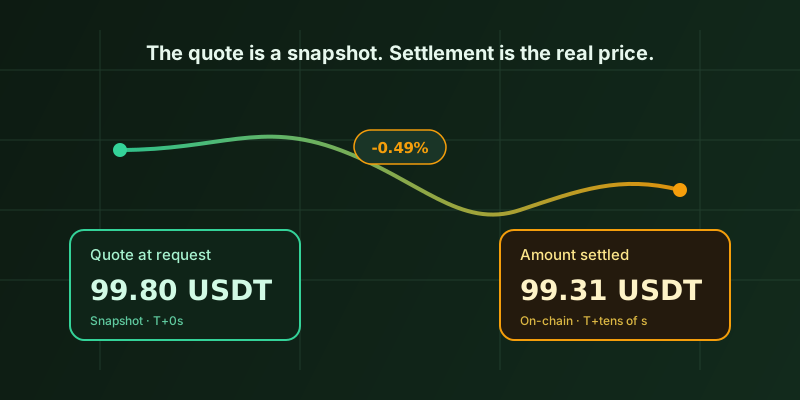
Open any cross-chain swap aggregator, enter the asset and amount you want to convert, and a quote appears almost instantly. Behind that number, the aggregator queried several market makers or liquidity pools at that exact moment and surfaced the best result — functionally no different from a live quote on a trading app. It's only guaranteed accurate at the instant it's generated; it makes no promise the price will hold for the next thirty seconds, let alone the next few minutes. The mistake users make is treating that number as a locked-in contract — assuming that clicking confirm should guarantee that exact figure arrives. In reality, most swap tools don't hard-code that quoted price into the transaction itself at the protocol level. The moment the transaction is actually submitted on-chain and picked up by a miner or validator is when the price truly locks in — every second before that, the quote is informational only.
2. Between quote and settlement, the market-maker's live price never stops moving
The market makers providing liquidity behind a cross-chain swap are, functionally, automated systems running market-making strategies across multiple trading pairs and chains at once. Their quoted prices adjust continuously based on their own inventory, price movement on other exchanges, and overall buy/sell pressure — often at a sub-second to few-second cadence. During the ten seconds to a minute a user spends looking at the quote screen, confirming, signing, and broadcasting the transaction, the market maker's price may have already refreshed several times based on newer market information. By the time the submitted transaction is actually picked up by a node and matched against the live price at that moment, the executed price has naturally drifted from what was first shown. The more volatile the market — a sharp short-term move in the underlying asset — the wider that drift tends to be; in a calm market, the gap can be small enough to go unnoticed. That's also why the same tool can feel like it settles exactly at quote one day and shows a visible gap the next: the difference isn't the tool, it's how turbulent the market was during those few seconds.
3. Slippage tolerance: some tools hand this control to you, others hide it entirely
To manage the price drift between quote and settlement, mature decentralized exchange protocols generally build in a parameter called slippage tolerance: the user sets a maximum acceptable percentage deviation, and if the actual execution price on-chain moves beyond that threshold relative to the quote, the transaction simply fails and reverts rather than force-settling at a worse price (funds aren't taken, though gas already spent on the attempt is usually not refunded). This mechanism exists to protect the user, but set the tolerance too low and normal market noise alone causes transactions to fail routinely; set it too high and you've effectively pre-authorized settlement at a price that's visibly off from what you were quoted. The more important detail is that not every consumer-facing cross-chain swap aggregator exposes this parameter for the user to adjust — some bake in a fixed default tolerance without ever disclosing the number; others impose no cap at all, executing the trade as long as it can be matched. In that second case, the user has no control whatsoever over how bad the worst-case settled amount could get — they simply have to accept whatever comes back.
4. Network congestion stretches an already-existing time gap even further
The gap between quote and settlement is fundamentally a function of elapsed time — the longer that window stays open, the more room the market has to move. The most common thing that actually stretches this window is congestion on either the source or destination chain. If the source chain has a backlog, the submitted swap transaction may sit waiting for several blocks before it's confirmed, pushing the moment it actually matches against a live price well past when the quote was first shown. If the destination chain is also congested, the leg where the aggregator forwards the settled asset to the user's wallet gets delayed too. Stack both delays together and the gap between the moment the quote was generated and the moment funds actually land can stretch to several minutes or more — and the market has proportionally more room to drift in that window. This is why the same tool can feel like it settles almost instantly at off-peak times and produce a visibly wider gap during a period of chain congestion — the tool hasn't changed, congestion has simply extended the exposure window the quote was never designed to survive.
5. Why this gap matters more for funding an AI subscription than for an ordinary swap
If you're just moving stablecoins from one chain to another to hold for yourself, landing a fraction of a percent short of the quote is usually harmless — it's still your money, and you can adjust next time. But when the destination of that swap is a direct AI subscription charge, the calculus changes. Many subscription billing systems — especially ones that charge stablecoins directly rather than crediting a prepaid balance pool first — require the received amount to exactly match the billed amount. A shortfall of even a few cents can trigger an "amount mismatch" and fail the charge outright, leaving you to send a small top-up before the renewal goes through. The opposite problem is just as real: if the settled amount comes in slightly above the quote (a favorable price move), it leaves an odd, hard-to-spend remainder sitting in the account that accumulates into meaningfully stranded funds over time. This is why the quote-to-settlement gap can't be dismissed as an irrelevant rounding detail in this specific use case — it's a practical variable that determines whether the payment actually clears.
6. Practical steps when using a tool like AllSwap
Take a non-custodial cross-chain swap aggregator like AllSwap as an example: the typical flow shows live comparative quotes from multiple market makers, generates a one-time deposit address once you confirm, and completes the swap without requiring an account. When using a tool like this to fund an AI subscription, a few things are worth doing proactively. First, look for any language about slippage or price protection on the quote or confirmation screen — if there's an explicit tolerance setting, adjust it to a deviation you're actually comfortable with rather than leaving the default untouched. Second, try to avoid submitting during a window when the source or destination chain is visibly congested — a quick look at a block explorer for a backlog of pending transactions or an unusual gas spike can tell you whether it's a good time. Third, before moving a large amount, run a small test swap first to measure the tool's actual typical drift under normal conditions, so you know roughly how much buffer, if any, to build in before sending the amount that really matters.
7. If the settled amount doesn't match the quote, how to verify and fix it
If a swap settles noticeably off from the quoted price, the first step is to look up the transaction hash on the relevant chain's block explorer and confirm the actual execution price and amount received, rather than trusting a bare "completed" status shown by the swap tool itself. Second, check whether the resulting charge to the AI subscription merchant actually went through — if it failed due to an amount mismatch, most billing pages will show something like "insufficient amount" rather than a generic decline, and usually all that's needed is a small top-up rather than redoing the entire swap. Third, if a particular tool repeatedly produces deviations well outside what normal market movement would explain, it's worth switching to one with clearer slippage disclosure or deeper market-maker liquidity rather than writing it off as bad luck every time. Building these checks into a habit is what keeps the natural gap between quote and settlement from turning into a surprise failed renewal.
8. Bottom line: the quote is a snapshot, the settled amount is the real price
The gap between a quote and the amount that actually arrives isn't a defect in any specific swap tool — it's a physical reality of "snapshot quote, settle later" mechanics that no swap involving a live, moving market can fully avoid. Market makers' prices never stop moving, on-chain confirmation takes real time, congestion stretches that window further, and slippage tolerance — the one lever meant to bound the damage — isn't something every tool hands to the user. Once you understand that mechanism, funding an AI subscription with a cross-chain swap stops being a blind assumption that the exact number will land, and becomes something you can actively manage: check the slippage disclosure, avoid congested windows, and test with a small amount first. The gap will never fully disappear, but understanding where it comes from is enough to keep it from ever standing between you and a successful payment.