
Verification Checklist
- ✓Does throttling consistently happen during a fixed window (e.g. global peak hours), and does retrying off-peak clear it
- ✓Has a previously unrestricted window started getting blocked for several consecutive days, with matching reports on community forums
- ✓If the quota looks unchanged but answers get shorter or weaker, is it silent routing to a lighter model (try explicitly requesting the full model in the prompt)
- ✓Have you tried logging out/in, clearing cache, and switching networks — only escalate to support if all three fail
1. A free-tier cap was never a number — it's an adjustable band
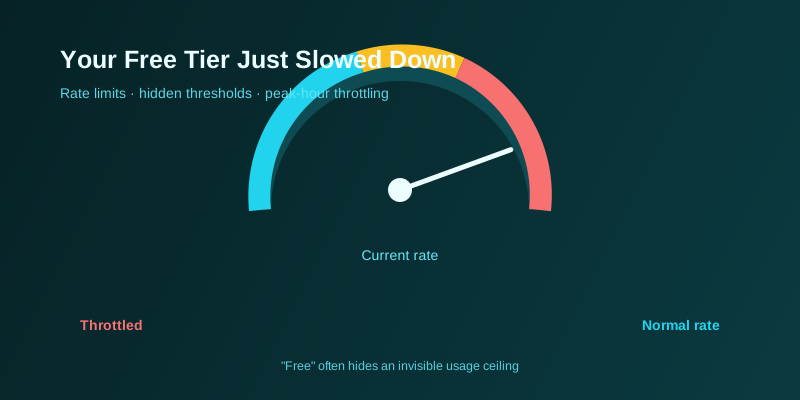
The typical help-doc phrasing — "free users can send roughly N messages a day" — buries the word "roughly," and most users skip right past it. But that hedge is exactly the operational reality: what actually ships in the backend config is usually a band with an upper and lower bound plus a set of trigger conditions, not a single fixed value. The same account with identical usage habits might get pushed to the top of that band during low-traffic hours and squeezed to the bottom during peak load. What feels like "my limit suddenly dropped" is really that variable being reassigned at the configuration layer — nothing about the account itself changed.
2. The driver: GPU compute is the scarcest, most expensive resource in the system
Inference cost scales close to linearly with concurrent request volume, and GPU cluster capacity almost never scales as fast as demand — especially right after a new model launch or when some feature suddenly goes viral. In the platform's cost model, paid subscription revenue is expected to cover the inference cost of paying users plus margin; free-tier inference cost has no matching direct revenue, and gets amortized indirectly through ads, conversion value, or long-term growth. When aggregate compute gets tight, the economically rational move is to protect paid-queue throughput first and dial the free-tier threshold down — a pure marginal-cost queueing decision, not something aimed at any individual user.
3. Cuts are almost never announced in advance — that's a deliberate communication choice
Emailing every user each time the free cap tightens would mean publicly admitting "the free experience is getting worse," inviting media pickup and giving fence-sitting users a concrete reason to churn instead of upgrade. The more common approach keeps the adjustment entirely in backend config, surfacing only a generic "you've reached your current usage limit, try again later" — with no indication of whether it's a temporary load spike or a permanent baseline cut. From that one line alone, a user has almost no way to tell which one it is.
4. Three distinct failure modes get lumped together as "it got worse"
What users experience as degradation can come from three genuinely different mechanisms, and conflating them makes troubleshooting harder. The first is temporary throttling, which typically self-resolves within hours and correlates with regional peak-usage windows. The second is a permanent free-tier baseline cut, which doesn't bounce back on its own and usually only gets confirmed through community reports or a changelog. The third is the most subtle: under load, free-tier requests get silently routed to a smaller, faster, lower-quality model — the quota looks unchanged but responses get noticeably dumber — and this routing switch is rarely surfaced in the UI, so it's easy to mistake for the model itself regressing.
5. How to tell which one you're actually looking at
The simplest self-diagnostic is logging the time and context. If throttling consistently shows up during a fixed window (say, US daytime hours, which is the global peak overlap), it's most likely temporary load scheduling, and retrying during an off-peak window usually clears it. If a previously unrestricted time window starts getting blocked for several consecutive days, and community forums or third-party review sites report the same pattern around the same time, a permanent baseline cut is more likely. If the quota itself looks unchanged but answers get noticeably shorter, logic gets weaker, or code tasks start failing more often, suspect silent routing to a lighter model — some platforms will honor an explicit prompt request to use the full model and switch back.
6. Don't mistake throttling for an account problem — the fixes are completely different
The wording shown for throttling can look deceptively similar to what shows up when an account is fraud-frozen or a payment failure interrupts service — both might say something like "temporarily unavailable." But the paths diverge completely: throttling usually clears itself after switching networks or waiting a fixed interval, with no effect on login state; an account problem typically comes with a login error, a payment page prompt, or an actual support ticket you can look up. When you hit a cap, try logging out and back in, clearing cache, and testing on a different network first — only escalate to support if all three fail and the same message keeps recurring, rather than treating a throttle you should just wait out as an account failure to keep disputing.
7. Leaning on the free tier for high-frequency work is a bet on the platform's compute cycle
If the free tier is just for occasional trial use, the fluctuation barely matters. But once a free-tier model is wired into a fixed step of a daily workflow — say, processing a batch of tasks at the same time every day — that dependency is really a bet on "the platform's compute will always stay loose enough," a variable you don't control at all. The moment a major model launch, a user surge, or a deliberate free-tier tightening (often timed to nudge conversion) hits, a workflow that felt stable can break with zero warning. For anyone using it at real frequency, it's cheaper to treat the free allowance as elastic overflow capacity and keep a stable paid quota backing the tasks that actually matter, rather than trying to out-guess a scheduling system you can't see.
8. When you do decide to upgrade, sort out the payment path too
Once it's clear you actually need a stable quota and it's time to move from free to paid, the payment side of an overseas AI subscription has its own set of snags worth clearing up in advance — a single card getting flagged across multiple platforms' fraud engines, exchange-rate markups, and failed charges can all interrupt an upgrade right when you're trying to push it through. For anyone paying with stablecoins whose USDT or USDC balances are scattered across different chains, consolidating first with a non-custodial service like allswap.io — swapping into whatever the target virtual card can accept directly, no account required, failed transactions refunded automatically — keeps the upgrade itself from getting stuck in the payment step.
9. Takeaway: a free-tier cap is a live cost variable, not a fixed promise
An AI platform's free usage cap was never designed as a locked-in commitment — it's a flexible threshold recalculated continuously against compute cost and concurrency pressure, and it usually shrinks quietly with little to no advance notice. Telling temporary throttling, a permanent baseline cut, and silent model downgrading apart is what tells you whether a given dip is worth waiting out or worth planning around — instead of treating every fluctuation as a broken account to keep troubleshooting.