
Verification Checklist
- ✓Do the last 4 digits on your bank's app/site match the card on file in the AI platform's billing page?
- ✓Did you get a bulk-reissue notice (letter/email/push) from your bank, and does its date precede the failed charge?
- ✓Does the date of your last successful charge predate the new card's effective date?
- ✓After lockout, does the login screen ask for re-verification, or does it show a downgrade/cancellation notice — the unlock path differs
1. Bulk reissues happen for reasons that have nothing to do with expiry
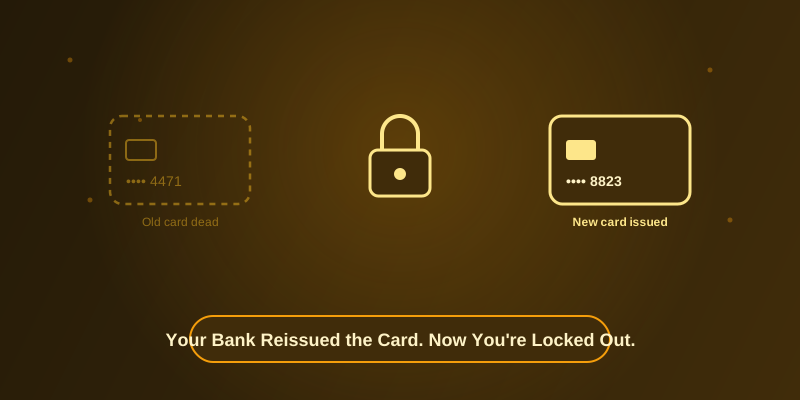
Most people think "card reissue" means one of two things: the card expired and it's time to renew, or the card was lost or stolen and reported. In practice, issuing banks reissue entire batches of cards for reasons that involve zero fault on the cardholder's part: a data breach at an unrelated third-party merchant that shares the same BIN range, an internal migration off a legacy issuing platform to a new one, or a preemptive risk decision to retire a BIN range entirely. These bulk reissues usually come with a letter or an email, but that notice is easy to mistake for marketing and ignore, and the old physical card keeps working fine for in-person purchases right up until expiry — it's specifically the "card on file, charge automatically" pattern used by online subscriptions where the old number quietly stops being a live billing channel.
2. Account updaters are the card networks' patch for this — with real coverage gaps
To keep bulk reissues from breaking the online subscription economy, card networks like Visa and Mastercard run account updater services: a merchant's payment processor periodically submits its stored card numbers and expiry dates for comparison, and whenever a card has been reissued, the network pushes back the new number and expiry to replace the merchant's stored token — no manual action required from either side. But this service isn't free, and it isn't switched on by default across every payment rail. Acquirers have to apply and pay per query, and many smaller AI subscription platforms, to control costs, either skip the integration entirely or only enable it for one or two of their primary acquiring banks. If the specific rail a given card runs through isn't in that coverage set, the reissue notification never reaches that platform's billing system, and it keeps charging against a token that's already dead.
3. A stale token doesn't come back as a decline — it fails silently
Charging a card number the issuer has already flagged "replaced" doesn't behave exactly like a frozen card or insufficient funds. The old number still exists in the issuer's records, just with its status field changed to "superseded" — and some acquiring gateways classify that response as a soft decline rather than a hard, clearly-coded rejection. It's neither an immediate failure the merchant's system can flag with a clean error code, nor a successful charge; it sits in an ambiguous middle state. Because many AI platforms' "renewal failed" email triggers are wired to specific hard-decline error codes, a soft decline like this can slip through without generating any notification at all — the account looks completely normal from the user's side, right up until an internal billing job eventually flags the unpaid balance as long overdue.
4. When the grace period runs out, it's a security lockout, not a downgrade
For a normal insufficient-funds or expired-card failure, most platforms give a grace period of a few days to a couple of weeks with repeated retry attempts, then downgrade the account to free rather than banning it outright — that's the default expectation most people carry into the phrase "renewal failed." A silent failure caused by an account-updater coverage gap behaves differently: some platforms treat "the same card has failed to charge for an extended period with no clear decline or expiry code" as anomalous payment behavior, and their fraud-prevention logic responds not with a routine downgrade but with a full account security lockout — requiring identity re-verification and a brand-new payment method before the account unlocks. Prior paid entitlements and historical data aren't always preserved the way a simple downgrade would preserve them; the exact handling varies by platform.
5. The signal people miss: an unopened card-reissue email
Looking back at almost every case like this, there's a reissue notice sitting in the inbox from weeks earlier — the subject line and formatting just tend to blend in with promotional email and routine statement alerts, so it gets ignored or filtered straight to spam. Building the habit of actually opening bank emails, especially ones with subject lines like "card update," "security refresh," or "BIN migration," is far more effective than troubleshooting after the fact — even when the physical card looks completely unchanged, it's worth a minute to confirm the new number and expiry and proactively update payment details on every AI subscription yourself, rather than waiting on an account updater sync that may never happen.
6. If the account gets locked, check for a reissue first — don't just keep retrying
If an AI subscription suddenly demands identity re-verification or a new card, the first move isn't to keep retrying the same old card number — it's already dead, and repeated retries only pile up more failed-charge history, pushing the account's risk score higher in whatever fraud system is reviewing it and slowing down the eventual unlock review. It's far more effective to log into online banking or contact the issuer directly, confirm whether there's been a recent bulk reissue or BIN migration, get the confirmed new number and expiry, and manually update the payment method in the AI platform's account settings — rather than hoping the account updater eventually catches up.
7. A dedicated virtual card per subscription limits how far a silent failure spreads
Anyone in the habit of binding one physical card to every overseas AI subscription will see all of them start failing silently, or getting locked, in roughly the same window once that card gets bulk-reissued — which makes troubleshooting messy and makes it easy to miss one or two less-used platforms entirely. A virtual card, generated on demand with its own independently managed expiry and limit, sidesteps this: even if the underlying physical card gets reissued at the bank level, as long as the virtual card itself stays active, each AI subscription's billing chain stays independent, and a problem stays contained to a single subscription. A service like Rongda Virtual Credit Card (rdvcc.com), which supports opening a separate card per subscription with a self-managed expiry date, isolates a risk entirely outside the cardholder's control — a bank-side bulk reissue — to a single card, instead of taking down every subscription at once; it's also worth checking a third-party review site like chdh.me to compare a few virtual card providers' reliability and payout speed before picking one.
8. Takeaway: the card isn't lost or expired — the merchant's stored token just never caught up
An AI subscription lockout triggered by a bank-side bulk card reissue comes down to a sync path between systems that never got wired up for this specific merchant and payment rail — the physical card is fine, and the user didn't do anything wrong. Understanding how account updater coverage actually works, building the habit of opening reissue notices instead of ignoring them, and spreading subscriptions across independent virtual cards are what keep the next bulk reissue from being something you only discover once the account is already locked.